KI-Beratung Beta

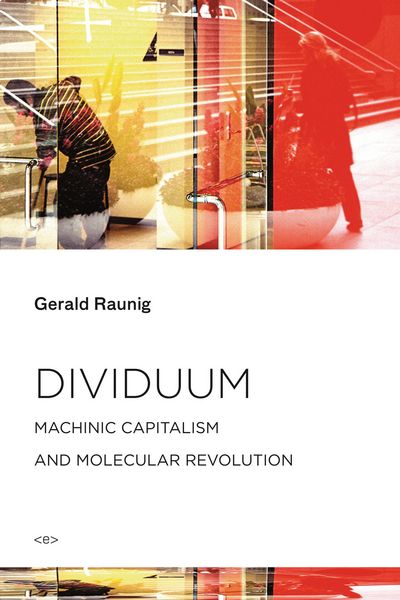
Produktbild: Dividuum

Dividuum Machinic Capitalism and Molecular Revolution

18,99 €

inkl. gesetzl. MwSt., zzgl. Versandkosten


  • Kostenlose Lieferung ab 30 € Einkaufswert
  • Versandkostenfrei für Bonuscard-Kund*innen

Beschreibung

Raunig develops a philosophy of dividuality as a way of addressing contemporary modes of production and forms of life.

The animal of the molecular revolution will be neither mole nor snake, but a drone-animal-thing that is solid, liquid, and a gas. from Dividuum

As the philosophical, religious, and historical...

Beschreibung

Raunig develops a philosophy of dividuality as a way of addressing contemporary modes of production and forms of life.

The animal of the molecular revolution will be neither mole nor snake, but a drone-animal-thing that is solid, liquid, and a gas.
from Dividuum

As the philosophical, religious, and historical systems that have produced the individual (and its counterparts, society and community) over the years continue to break down, the age of dividuality is now upon us. The roots of the concept of the dividuum can be traced back to Latin philosophy, when Cicero used the term to translate the divisible in the writings of Epicurus and Plato; later, medieval scholars utilized the term in theological discussions on the unity of the trinity. Grounding himself in the writings of the medieval bishop Gilbert de Poitiers and his extensive commentaries on Boethius, Gerald Raunig charts a genealogy of the concept and develops a philosophy of dividuality as a way of addressing contemporary modes of production and forms of life. Through its components of dispersion, subsistence, and similarity, dividuality becomes a hidden principle of obedience and conformity, but it also brings with it the potential to realize disobedience and noncompliant con/dividualities.

Raunig's bad news is that dividuality is responsible for much of the intensified exploitation and enslavement taking place under contemporary machinic capitalism. Algorithms, derivatives, big data, and social media technology all contribute to the rampant expansion of divisive management strategies and desires for self-division. The good news, however, is that this same terrain of dividuality presents an opportunity for a new kind of resistance, one that can be realized in the form of con/division.

Rezension

It is obvious that Gerald Raunig owes the authors of the Anti- dipe stylistic inspirations, theoretical background and a terminological basis, when he talks of the molecular revolutions, desiring machines, the dividuum, deterritorialization, machinic subservience and lines of flight. He manages to contextualise a concept that has historic weight and current relevance within a wide field of cultural phenomena, philosophical positions, technological innovation and political problems. A great book. Mathias Fuchs, Furtherfield

Produktdetails

Einband

Taschenbuch

Erscheinungsdatum

19.02.2016

Verlag MIT Press
Seitenzahl

208

Produktdetails

Einband

Taschenbuch

Erscheinungsdatum

19.02.2016

Verlag MIT Press
Seitenzahl

208

Maße (L/B/H)

22,8/15,1/3 cm

Gewicht

323 g

Übersetzt von

Aileen Derieg

Sprache

Englisch

ISBN

978-1-58435-180-1

Herstelleradresse

Libri GmbH
Europaallee 1
36244 Bad Hersfeld
DE

Email: gpsr@libri.de

Noch keine Bewertungen vorhanden

Verfassen Sie die erste Bewertung zu diesem Artikel

Helfen Sie anderen Kundinnen und Kunden durch Ihre Meinung.

Kundinnen und Kunden meinen

Bewertungen (0)

  • Produktbild: Dividuum