KI-Beratung Beta

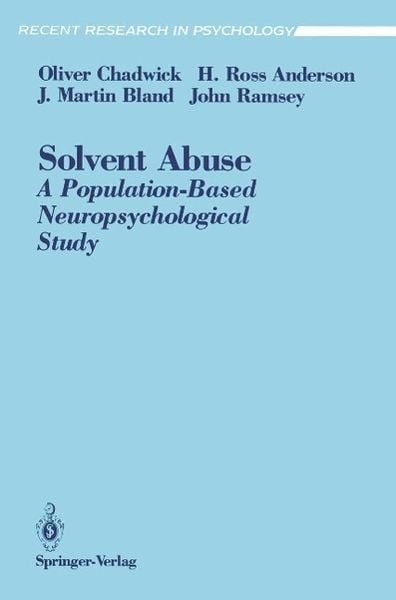
Produktbild: Solvent Abuse

Solvent Abuse A Population-Based Neuropsychological Study

  • Form:Einzelkauf Download
  • Sprache:Englisch

98,99 €

inkl. gesetzl. MwSt.

Beschreibung

1. 1 History of Solvent Abuse The practice of deliberately inhaling various gases or vapors in order to induce an altered state of mood or sensibility is not new. As noted repeatedly in other reviews (eg, Cohen, 1973; Novak, 1980), it was recognized in early Greek civilization as an adjunct to divination;...

Beschreibung

1. 1 History of Solvent Abuse The practice of deliberately inhaling various gases or vapors in order to induce an altered state of mood or sensibility is not new. As noted repeatedly in other reviews (eg, Cohen, 1973; Novak, 1980), it was recognized in early Greek civilization as an adjunct to divination; indeed, it has now become customary, if not obligatory, to refer to the Oracle at Delphi before considering the more recent history of the subject. According to legend, the priestess at the Temple at Delphi would achieve communion with the Gods by inhaling the naturally-occurring gas that emanated from a fissure in a rock. Inhalation would induce a trance-like state. Her mystical observations and utterances while in this state were interpreted by the Temple Prophet and issued as divine pronouncements to those seeking guidance. Incenses, perfumes and spices have probably always been used in ceremonial worship and religious ritual. However, in sofar as it is possible to make the distinction, these substances have been used primarily for their aromatic qualities rather than for their intoxicating effects. The recreational use of gases and vapors dates from the end of the eighteenth century and may be seen as a concomitant of the scientific advances that preceded the industrial revolution. Following the synthesis of nitrous oxide by Sir Joseph Priestley in 1776, the potential uses of the gas were explored in depth by Sir Humphrey Davy.

Produktdetails

Format

PDF

Kopierschutz

Nein

Family Sharing

Nein

Text-to-Speech

Nein

Produktdetails

Format

PDF

Format

eBooks im PDF-Format haben eine festgelegte Seitengröße und eignen sich daher nur bedingt zum Lesen auf einem tolino eReader oder Smartphone. Für den vollen Lesegenuss empfehlen wir Ihnen bei PDF-eBooks die Verwendung eines Tablets oder Computers.

Kopierschutz

Nein

Kopierschutz

Dieses eBook können Sie uneingeschränkt auf allen Geräten der tolino Familie, allen sonstigen eReadern und am PC lesen. Das eBook ist nicht kopiergeschützt und kann ein personalisiertes Wasserzeichen enthalten. Weitere Hinweise zum Lesen von eBooks mit einem personalisierten Wasserzeichen finden Sie unter Hilfe/Downloads.

Family Sharing

Nein

Family Sharing

Mit Family Sharing können Sie eBooks innerhalb Ihrer Familie (max. sechs Mitglieder im gleichen Haushalt) teilen. Sie entscheiden selbst, welches Buch Sie mit welchem Familienmitglied teilen möchten. Auch das parallele Lesen durch verschiedene Familienmitglieder ist durch Family Sharing möglich. Um eBooks zu teilen oder geteilt zu bekommen, muss jedes Familienmitglied ein Konto bei Thalia oder einem anderen tolino-Buchhändler haben. Weitere Informationen finden Sie unter Hilfe/Family-Sharing.

Text-to-Speech

Nein

Text-to-Speech

Bedeutet Ihnen Stimme mehr als Text? Mit der Funktion Text-to-Speech können Sie sich im tolino webReader und in der aktuellen Thalia – Lesen & Hören App das eBook vorlesen lassen. Weitere Informationen finden Sie unter Hilfe/Text-to-Speech.

Erscheinungsdatum

07.03.2013

Verlag Springer Us
Seitenzahl

150 (Printausgabe)

Dateigröße

11589 KB

Sprache

Englisch

EAN

9781461231844

Barrierefreiheit
  • keine Information zur Barrierefreiheit bekannt

Noch keine Bewertungen vorhanden

Verfassen Sie die erste Bewertung zu diesem Artikel

Helfen Sie anderen Kundinnen und Kunden durch Ihre Meinung.

Kundinnen und Kunden meinen

Bewertungen (0)

Weitere Artikel finden Sie in

  • Produktbild: Solvent Abuse