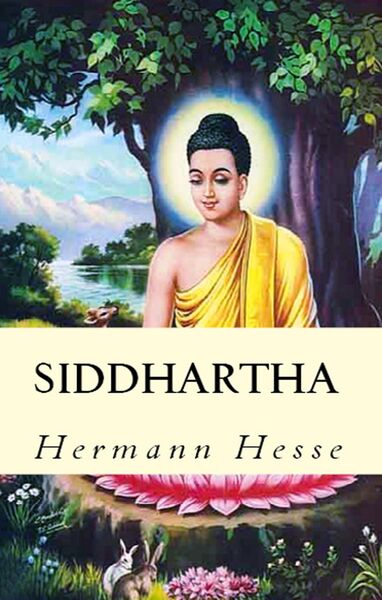
Siddhartha is a novel by Hermann Hesse that deals with the spiritual journey of self-discovery of a man named Siddhartha during the time of the Gautama Buddha. The book, Hesse's ninth novel (1922), was written in German, in a simple, lyrical style. It was published in the U.S. in 1951 and became influential during the 1960s. Hesse dedicated Siddhartha to his wife Ninon ("Meiner Frau Ninon gewidmet ") and supposedly afterwards to Romain Rolland and Wilhelm Gundert.
The word Siddhartha is made up of two words in the Sanskrit language, siddha (achieved) + artha (meaning or wealth), which together means "he who has found meaning (of existence)" or "he who has attained his goals". In fact, the Buddha's own name, before his renunciation, was Siddhartha Gautama, Prince of Kapilvastu, Nepal. In this book, the Buddha is referred to as "Gotama".
The story takes place in ancient India. Siddhartha, the son of a Brahmin, decides to leave behind his home in the hopes of gaining spiritual illumination by becoming an ascetic wandering beggar of the Samanas. Joined by his best friend Govinda, Siddhartha fasts, becomes homeless, renounces all personal possessions, and intensely meditates, eventually seeking and personally speaking with Gautam, the famous Buddha, or Enlightened One. Afterward, both Siddhartha and Govinda acknowledge the elegance of the Buddha's teachings. Although Govinda hastily joins the Buddha's order, Siddhartha does not follow, claiming that the Buddha's philosophy, though supremely wise, does not account for the necessarily distinct experiences of each person.
He argues that the individual seeks an absolutely unique and personal meaning that cannot be presented to him by a teacher; he thus resolves to carry on his quest alone. Siddhartha crosses a river and the generous ferryman, who Siddhartha is unable to pay, merrily predicts that Siddhartha will return to the river later to compensate him in some way. Venturing onward toward city life, Siddhartha discovers Kamala, the most beautiful woman he has yet seen. Kamala, a courtesan of affluent men, notes Siddhartha's handsome appearance and fast wit, telling him that he must become wealthy to win her affections so that she may teach him the art of love. Although Siddhartha despised materialistic pursuits as a Samana, he agrees now to Kamala's suggestions. She directs him to the employ of Kamaswami, a local businessman, and insists that he have Kamaswami treat him as an equal rather than an underling. Siddhartha easily succeeds, providing a voice of patience and tranquility against Kamaswami's fits of passion, which Siddhartha learned from his days as an ascetic. Thus, Siddhartha becomes a rich man and Kamala's lover, though in his middle years realizes that the luxurious lifestyle he has chosen is merely a game, empty of spiritual fulfillment. Leaving the fast-paced bustle of the city, Siddhartha returns to the river and thinks of killing himself. He is saved only by an internal experience of the holy word, Om. The very next morning Siddhartha briefly reconnects with Govinda, who is passing through the area as a wandering Buddhist.
Siddhartha decides to live out the rest of his life in the presence of the spiritually inspirational river. Siddhartha thus reunites with the ferryman, named Vasudeva, with whom he begins a humbler way of life. Although Vasudeva is a simple man, he understands and relates that the river has many voices and significant messages to divulge to any who might listen.
HERMANN HESSE:
Hermann Hesse (German; July 2, 1877 - August 9, 1962) was a German-born, Swiss poet, novelist, and painter. His best-known works include Steppenwolf, Siddhartha, and The Glass Bead Game, each of which explores an individual's search for authenticity, self-knowledge and spirituality. In 1946, he received the Nobel Prize in Literature.
Biography:
Family background
Hermann Hesse was born on 2 July 1877 in the Black Forest town of Calw in Württemberg, Germany. His parents served in India at a mission under the auspices of the Basel Mission, a Protestant Christian missionary society. Hesse's mother, Marie Gundert, was born at such a mission in India in 1842. In describing her own childhood, she said, "A happy child I was not..." As was usual among missionaries at the time, she was left behind in Europe at the age of four when her parents went to India.
Becoming a writer:
On 17 October 1895, Hesse began working in the bookshop in Tübingen, which had a specialized collection in theology, philology, and law. Hesse's tasks consisted of organizing, packing, and archiving the books. After the end of each twelve-hour workday, Hesse pursued his own work, and he spent his long, idle Sundays with books rather than friends. Hesse studied theological writings and later Goethe, Lessing, Schiller, and Greek mythology. He also began reading Nietzsche in 1895, and that philosopher's ideas of "dual...impulses of passion and order" in humankind was a heavy influence on most of his novels.
By 1898, Hesse had a respectable income that enabled financial independence from his parents. During this time, he concentrated on the works of the German Romantics, including much of the work from Clemens Brentano, Joseph Freiherr von Eichendorff, Friedrich Hölderlin and Novalis. In letters to his parents, he expressed a belief that "the morality of artists is replaced by aesthetics."