KI-Beratung Beta

Produktbild: Invisible Languages in the Nineteenth Century
Band 2

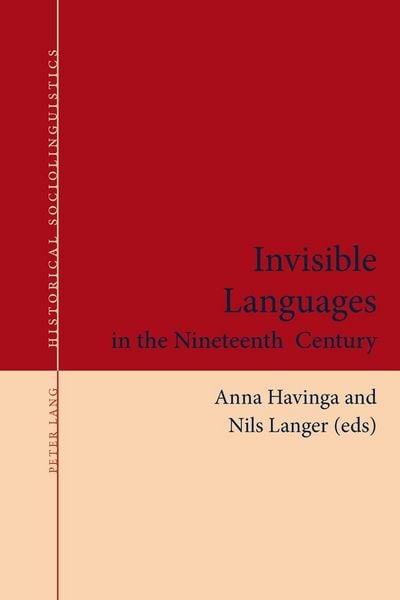
Invisible Languages in the Nineteenth Century

88,15 €

inkl. gesetzl. MwSt., Versandkostenfrei


Beschreibung

The great linguistic diversity of spoken languages contrasts greatly with the much smaller number of languages used in written discourse. Many linguistic varieties – in particular, regional and minority languages – are not deemed suitable for writing because they do not possess the necessary lexical...

Beschreibung

The great linguistic diversity of spoken languages contrasts greatly with the much smaller number of languages used in written discourse. Many linguistic varieties – in particular, regional and minority languages – are not deemed suitable for writing because they do not possess the necessary lexical wealth or grammatical complexity. Such prejudices are commonplace amongst non-linguists and they have their origin in the sociolinguistic history of their speaker communities.
This book focuses on the nineteenth century as the time when language became an important part of the cultural identity of speakers, communities and nations. It comprises fourteen chapters on a variety of languages and countries and seeks to explore why and how certain linguistic varieties were excluded from written discourse – in other words, why they remain invisible to contemporary readers and modern historians. The case studies in this book illustrate the factors involved in the invisibilisation of languages in the nineteenth century; the metalinguistic debates about the suppression or promotion of regional, minority and non-standard languages; and the ways in which a careful study of informal writing can visibilise the linguistic diversity of spoken languages.

Portrait

Anna Havinga is a doctoral student in historical sociolinguistics at the University of Bristol. Her PhD thesis investigates the standardisation process of German in eighteenth-century Austria, with a particular focus on the role of education. Further research interests include folk linguistics, language attitudes and language contact phenomena.
Nils Langer is Professor of Germanic Linguistics at the University of Bristol. Born and raised in Schleswig-Holstein, he studied German and English linguistics at the University of Newcastle upon Tyne, where he completed his PhD on the effectiveness of seventeenth-century German grammarians. He researches a broad range of topics in historical sociolinguistics and currently works on language contact phenomena and language politics in the German–Danish borderlands.

Produktdetails

Einband

Taschenbuch

Erscheinungsdatum

29.09.2015

Herausgeber Anna Havinga + weitere
Verlag Peter Lang Group AG, International Academic Publishers

Produktdetails

Einband

Taschenbuch

Erscheinungsdatum

29.09.2015

Herausgeber
Verlag Peter Lang Group AG, International Academic Publishers
Seitenzahl

310

Maße (B/H)

14,8/21 cm

Gewicht

470 g

Auflage

1

Sprache

Englisch

ISBN

978-3-0343-1968-3

EU-Ansprechpartner

Kolibri 360 GmbH
Ettore-Bugatti-Straße 6-14
51149 Köln
DE
produktsicherheit@kolibri360.de

Herstelleradresse

Peter Lang
Avenue du Théâtre 7
1005 Lausanne
CH
orders@peterlang.com

Noch keine Bewertungen vorhanden

Verfassen Sie die erste Bewertung zu diesem Artikel

Helfen Sie anderen Kundinnen und Kunden durch Ihre Meinung.

Kundinnen und Kunden meinen

Bewertungen (0)

  • Produktbild: Invisible Languages in the Nineteenth Century
  • Contents: Nils Langer/Anna D. Havinga: Invisible Languages in Historical Sociolinguistics: A Conceptual Outline, with Examples from the German-Danish Borderlands – Niall Ó Ciosáin: The Celtic Languages: Visible and Invisible – Joanna Crow: Mapudungun and the Contested Process of (Nation) State Building in Nineteenth-Century Chile – Markus Schiegg: The Invisible Language of Patients from Psychiatric Hospital – Elin Fredsted: How a Minority Lost its Vernacular: Language Shift in Written Sources from the German-Danish Borderlands – Aidan Doyle: A Sociolinguistic Analysis of a National Language: Irish in the Nineteenth Century – Jochen A. Bär: Dialect in German Literature, 1760-1930 – Harald Wolbersen: The Decline of the South Jutish in Angeln: A Historical Case of Transformation into the Modern Age around 1800 – Joakim Enwall: Co-opting the Marginalised? Western Mission and Script Creation among the Miao in Southwest China, 1877-1915 – Róisín Healy: The Visible Church and «Invisible» Polish: Protestant and Catholic Clergy in Prussian Poland – Joan Leopold: Lithuanian Made «Visible» through German Linguists: August Friedrich Pott and August Schleicher – Steen Bo Frandsen: The Danish Composite State and the Lost Memory of a Multilingual Culture – Anna D. Havinga: Germanising Austria: The Invisibilisation of East Upper German in Eighteenth- and Nineteenth-Century Austria – José del Valle: Ways of Seeing Language in Nineteenth-Century Galicia, Spain.