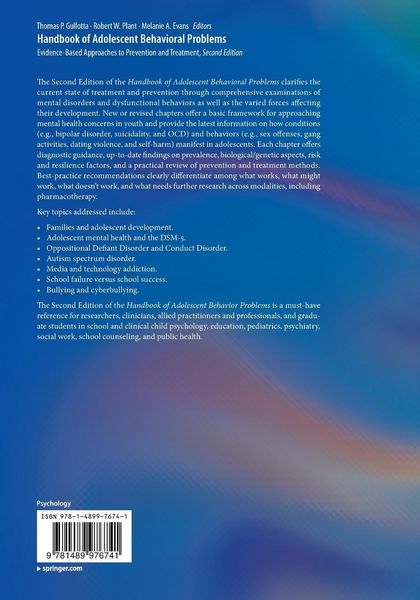
• Produktbild: Handbook of Adolescent Behavioral Problems
  • Produktbild: Handbook of Adolescent Behavioral Problems

Handbook of Adolescent Behavioral Problems Evidence-Based Approaches to Prevention and Treatment

212,99 €

inkl. gesetzl. MwSt., Versandkostenfrei


Beschreibung

Produktdetails

Einband

Taschenbuch

Erscheinungsdatum

19.11.2015

Abbildungen

XXXIII, 697 p. 7 illus.

Herausgeber

Thomas P. Gullotta + weitere

Verlag

Springer Us

Seitenzahl

697

Maße (L/B/H)

25,4/17,8/4 cm

Gewicht

1351 g

Auflage

Second Edition 2015

Sprache

Englisch

ISBN

978-1-4899-7674-1

Beschreibung

Rezension

“This book discusses theoretical and treatment approaches to DSM-5 childhood diagnostic categories, along with specific problem areas as well as prevention methods. … The intended audience is practitioners, policymakers, and human service directors, as well as graduate students in the helping professions. … This book does a good job of covering a number of DSM-5 diagnostic categories and behavior problems. With the introduction of DSM-5, this update was necessary.” (Gary B. Kaniuk, Doody's Book Reviews, May, 2016)

Portrait

Thomas P. Gullotta is C.E.O. of Child and Family Agency and is a member of the psychology and education departments at Eastern Connecticut State University. He is the senior author of the 4th edition of The Adolescent Experience , co-editor of The Encyclopedia of Primary Prevention and Health Promotion , and editor emeritus of the  Journal of Primary Prevention . He is the senior book series editor for Issues in Children's and Families' Lives. He has published extensively on young people and primary prevention. In 1999, Tom was honored by the Society for Community Research and Action, Division 27 of the American Psychological Association with their Distinguished Contributions to Practice in Community Psychology Award.

Robert W. Plant, Ph.D. is a licensed clinical psychologist and the Senior Vice President for Quality and Innovation at Value Options - CT Behavioral Health Partnership. Dr. Plant received his doctorate from The University of Rochester and has been an adjunct member of the faculty at Yale University Medical School since 2003. Over the last twenty years he has overseen the management of mental health services and service systems and has been a major contributor to the dissemination of evidence based practices in Connecticut. Dr. Plant is expert in the development of performance improvement programs for behavioral health. 

Melanie A. Evans, Ph.D., is an Associate Professor of Psychology at Eastern Connecticut State University. She earned her M.S. and Ph.D. from Syracuse University and A.B. from Vassar College. Her research interests broadly revolve around child and adolescent development in diverse cultures (e.g., African American, Caribbean immigrant) and contexts (e.g., school and extra-curricular settings, family relationships). Much of her research has focused on factors (e.g., individual, family) that impact academic outcomes for adolescents.

Produktdetails

Einband

Taschenbuch

Erscheinungsdatum

19.11.2015

Abbildungen

XXXIII, 697 p. 7 illus.

Herausgeber

Verlag

Springer Us

Seitenzahl

697

Maße (L/B/H)

25,4/17,8/4 cm

Gewicht

1351 g

Auflage

Second Edition 2015

Sprache

Englisch

ISBN

978-1-4899-7674-1

Herstelleradresse

Springer-Verlag KG
Sachsenplatz 4-6
1201 Wien
AT

Email: ProductSafety@springernature.com

Noch keine Bewertungen vorhanden

Verfassen Sie die erste Bewertung zu diesem Artikel

Helfen Sie anderen Kundinnen und Kunden durch Ihre Meinung.

Kundinnen und Kunden meinen

Bewertungen (0)

  • Produktbild: Handbook of Adolescent Behavioral Problems
  • Produktbild: Handbook of Adolescent Behavioral Problems
  • Section I: Introduction and Overview.- Chapter 1. An Overview of Adolescent Development.- Chapter 2. From Theory to Practice: Treatment and Prevention Possibilities.- Chapter 3. DSM V and Adolescent Behavioral Problems.- Chapter 4. Biological / Genetic Influences on Adolescent Development.- Chapter 5. Family Influences on Adolescent Development.- Chapter 6. Community Influences on Adolescent Development.- Chapter 7. Evidence-Based Practice.- Section II: Disorders.- Chapter 8. Intellectual Disabilities.- Chapter 9. Communication and Learning Challenges.- Chapter 10. School Failure.- Chapter 11. Anxiety Disorders.- Chapter 12. Posttraumatic Stress Disorder.- Chapter 13. Attention-Deficit Hyperactivity Disorder.- Chapter 14. Depression.- Chapter 15. Bipolar Disorder.- Chapter 16. Suicide.- Chapter 17. Oppositional Defiant Disorder and Conduct Disorder.- Chapter 18. Obesity.- Chapter 19. Eating Disorders.- Chapter 20. Autism.- Chapter 21. Schizophrenia.- Section III: Problem Behaviors.- Chapter 22. Media/technology addiction.- Chapter 23. Bullying.- Chapter 24. Delinquency.- Chapter 25. Gangs.- Chapter 26. Homicide.- Chapter 27. Substance Misuse.- Chapter 28. Gambling.- Chapter 29. Adolescent Sex Offenders (Include incest here).- Chapter 30. Dating Violence.- Chapter 31. Adolescent Pregnancy.- Chapter 32. Physical / Emotion Abuse and Neglect.- Chapter 33. Self-Inflicted Harm.- Section IV: Services and Conclusion.- Chapter 34. Young Adult Services.- Chapter 35. Epilogue.