
KI-Beratung Beta

  • Produktbild: Global Perspectives on Desistance
  • Produktbild: Global Perspectives on Desistance

Global Perspectives on Desistance Reviewing what we know and looking to the future

63,99 €

inkl. gesetzl. MwSt., Versandkostenfrei


Beschreibung

Produktdetails

Einband

Taschenbuch

Erscheinungsdatum

14.04.2016

Abbildungen

35 SW-Abb., 35 SW-Zeichn., 15 Tabellen

Herausgeber

Joanna Shapland + weitere

Verlag

Taylor & Francis

Seitenzahl

322

Maße (L/B/H)

23,4/15,6/1,7 cm

Gewicht

491 g

Sprache

Englisch

ISBN

978-1-138-85100-9

Beschreibung

Rezension

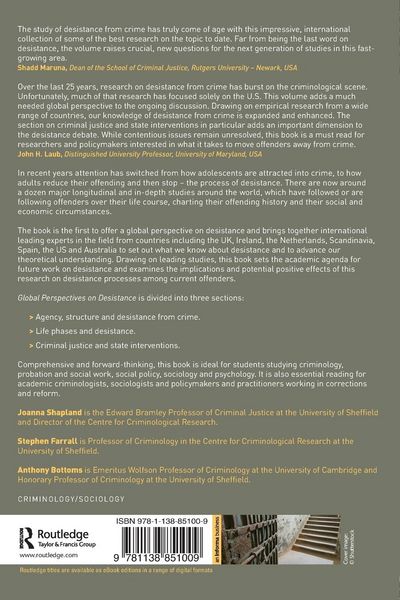
"The study of desistance from crime has truly come of age with this impressive, international collection of some of the best research on the topic to date. Far from being the last word on desistance, the volume raises crucial, new questions for the next generation of studies in this fast-growing area."

Professor Shadd Maruna, Dean of the School of Criminal Justice, Rutgers University - Newark, USA

"Over the last 25 years, research on desistance from crime has burst on the criminological scene. Unfortunately, much of that research has focused solely on the U.S. This volume adds a much needed global perspective to the ongoing discussion. Drawing on empirical research from a wide range of countries, our knowledge of desistance from crime is expanded and enhanced. The section on criminal justice and state interventions in particular adds an important dimension to the desistance debate. While contentious issues remain unresolved, this book is a must read for researchers and policymakers interested in what it takes to move offenders away from crime."

John H. Laub, Distinguished University Professor, University of Maryland, USA

"This volume offers an impressive array of divergent perspectives on the process of desistance from crime, and successfully integrates these diverse outlooks into a coherent story. Drawing on an assortment of varied research methodologies and cultural settings, the authors take stock of the state of knowledge on desistance and provide a useful roadmap for future desistance research."

Lila Kazemian, Associate Professor, John Jay College of Criminal Justice, CUNY, USA

"In this very rich and truly international (albeit with a strong European base) collection, classical desistance discussions (e.g. hooks for change, social capital, cognitive and narrative changes, etc.) are updated and extended both theoretically (notably by integrating developmental theories), and in terms of research subjects (e.g. agency, and structural, economic, and cultural contexts). Importantly, this exciting edited book reveals how desistance theory now appears ready to start developing alternative treatment methods, and to move beyond a mere desistance paradigm (e.g. regarding criminal records or probation sanctions policies). This integrated volume reveals how mature desistance research has become."

Professor Martine Herzog-Evans, University of Rheims, France

Produktdetails

Einband

Taschenbuch

Erscheinungsdatum

14.04.2016

Abbildungen

35 SW-Abb., 35 SW-Zeichn., 15 Tabellen

Herausgeber

Verlag

Taylor & Francis

Seitenzahl

322

Maße (L/B/H)

23,4/15,6/1,7 cm

Gewicht

491 g

Sprache

Englisch

ISBN

978-1-138-85100-9

EU-Ansprechpartner

Taylor & Francis Verlag GmbH
Kaufingerstraße 24
80331 München
DE
GPSR@taylorandfrancis.com

Herstelleradresse

Taylor & Francis Group
5 Howick Place
SW1P 1WG London
UK
GPSR@taylorandfrancis.com

Noch keine Bewertungen vorhanden

Verfassen Sie die erste Bewertung zu diesem Artikel

Helfen Sie anderen Kundinnen und Kunden durch Ihre Meinung.

Kundinnen und Kunden meinen

Bewertungen (0)

  • Produktbild: Global Perspectives on Desistance
  • Produktbild: Global Perspectives on Desistance
  • Introduction (Joanna Shapland, Stephen Farrall and Anthony Bottoms)

    Section I: Agency, structure and desistance from crime

    1. Mechanisms underlying the desistance process: Reflections on 'A theory of cognitive transformation' (Peggy C. Giordano)

    2. Human agency, criminal careers and desistance (Christoffer Carlsson)

    3. "I've always tried but I hadn't got the willpower": Understanding pathways to desistance in the Republic of Ireland (Deirdre Healy)

    4. Structural context and pathways to desistance (José Cid and Joel Marti)

    Section II: Life phases and desistance

    5. Key behavioral aspects of desistance from conduct problems and delinquency (Rolf Loeber, Magda Stouthamer-Loeber, and Lia Ahonen)

    6. Learning to desist in early adulthood: the Sheffield Desistance Study (Anthony Bottoms and Joanna Shapland)

    7. Observations from the Pathways to Desistance study: Some issues to consider in future work on desistance from adolescence to early adulthood (Edward P. Mulvey and Carol A. Schubert)

    8. How important are life-course transitions in explaining desistance? Examining the extent to which marriage, divorce and parenthood account for the age-crime relationship in former juvenile delinquents (Arjan Blokland and Niek de Schipper)

    9. Timing of change: Are life course transitions causes or consequences of desistance? (Torbjørn Skardhamar and Jukka Savolainen)

    Section III: Criminal justice and state interventions

    10. Understanding desistance in an assisted context: Key findings from tracking progress on probation (Stephen Farrall)

    11. In search of desistance: Notes from an Australian study (Mark Halsey)

    12. The increasing stickiness of public labels (Chris Uggen and Lindsay Blahnik)

    13. Understanding and identifying desistance: an example exploring the utility of sealing criminal records (Megan C. Kurlychek, Shaun D. Bushway and Megan Denver)

    14. The fuel in the tank or the hole in the boat? Can sanctions support desistance? (Fergus McNeill)

    Afterword: diversity or congruence? (Joanna Shapland, Stephen Farrall and Anthony Bottoms)