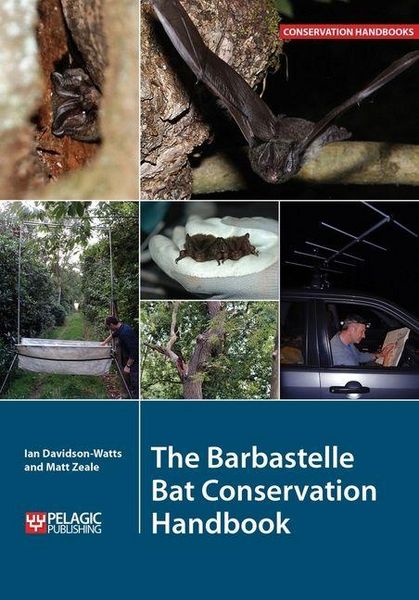
The Barbastelle Bat Conservation Handbook
-
- Hardcover ausgewählt
- Taschenbuch
- eBook
-
Sprache:Englisch
103,99 €
inkl. gesetzl. MwSt.,
Beschreibung
Produktdetails
Einband
Gebundene Ausgabe
Erscheinungsdatum
27.10.2026
Verlag
Pelagic PublishingSeitenzahl
350
Maße (L/B/H)
24,4/17/1,9 cm
Gewicht
653 g
Sprache
Englisch
ISBN
978-1-78427-055-1
The Barbastelle Bat Conservation Handbook is a long-awaited guide to barbastelle bat ecology, behaviour, conservation management and threats, the first publication of its kind to draw together all of the scientific research on the barbastelle bat into one comprehensive volume.
The most up-to-date methods for surveying the species are explained, accompanied by case studies and practical tips on how to conserve and manage the barbastelle bat’s roosting and foraging habitats.
A much-needed resource to help conservation planners and others support barbastelle bat conservation, it is an essential manual for land managers and developers, conservation managers, ecologists and ecological consultants, bat workers and bat groups, nature conservation agencies, other government agencies and departments, conservation NGOs, ecologists, zoologists and other researchers.
Contents include:
Foreword by Chris Packham.
Introduction – purpose and aims; what makes the barbastelle bat unique and why it needs our help; identification; current conservation status; distribution; protection.
Chapter 1: The ecology of barbastelle bats – roosting ecology; ranging behaviour: home ranges, commuting, the importance of landscape; dietary ecology: foraging behaviour, prey choice, predator-prey interactions; mating and hibernation.
Chapter 2: Survey techniques and considerations – challenges; acoustic surveys and sound analysis; catching and radio tracking; roost survey techniques (including hibernation roosts); diet analysis; interpreting data.
Chapter 3: Habitat management and enhancement for barbastelle bats –managing woodlands/forests; preservation and future provision of trees; managing wetlands; barbastelle bats and buildings.
Chapter 4: Development control and land management policies – landscape approach; managing the effects of development on roosts, foraging areas and flight lines; development control policies around breeding colonies.
Chapter 5: Conservation achievements and priorities – UK BAP; National Bat Monitoring Programme; threats: land-use change, habitat loss, climate change; research requirements.
Chapter 6: References, contacts and where to get help.
Noch keine Bewertungen vorhanden
Verfassen Sie die erste Bewertung zu diesem Artikel
Helfen Sie anderen Kundinnen und Kunden durch Ihre Meinung.
Kurze Frage zu unserer Seite
Vielen Dank für Ihr Feedback
Wir nutzen Ihr Feedback, um unsere Produktseiten zu verbessern. Bitte haben Sie Verständnis, dass wir Ihnen keine Rückmeldung geben können. Falls Sie Kontakt mit uns aufnehmen möchten, können Sie sich aber gerne an unseren Kund*innenservice wenden.
zum Kundenservice