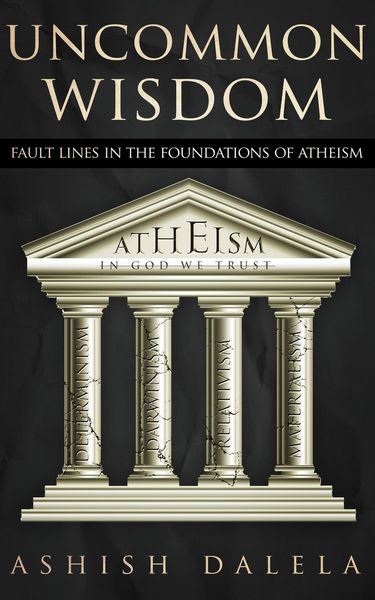
Uncommon Wisdom: Fault Lines in the Foundations of Atheism
-
- Einzelkauf Download ausgewählt
-
Sprache:Englisch
4,99 €
inkl. gesetzl. MwSt.Beschreibung
Produktdetails
Format
ePUB
Kopierschutz
Ja
Family Sharing
Ja
Text-to-Speech
Ja
Erscheinungsdatum
18.05.2015
Verlag
Shabda PressSeitenzahl
(Printausgabe)
Dateigröße
636 KB
Sprache
Englisch
EAN
9789385384059
The rise of militant atheism has brought to fore some fundamental issues in our conventional understanding of religion. However, because it offers science as an alternative to religion, militant atheism also exposes to scrutiny the fundamental problems of incompleteness in current science. The book traces the problem of incompleteness in current science to the problem of universals that began in Greek philosophy and despite many attempts to reduce ideas to matter, the problem remains unsolved. The book shows how the problem of meaning appears over and over in all of modern science, rendering all current fields-physics, mathematics, computing, and biology included-incomplete. The book also presents a solution to this problem describing why nature is not just material objects that we can perceive, but also a hierarchy of abstract ideas that can only be conceived. These hierarchically 'deeper' ideas necessitate deeper forms of perception, even to complete material knowledge. The book uses this background to critique the foundations of atheism and shows why many of its current ideas-reductionism, materialism, determinism, evolutionism, and relativism-are simply false. It presents a radical understanding of religion, borrowing from Vedic philosophy, in which God is the most primordial idea from which all other ideas are produced through refinement. The key ideological shift necessary for this view of religion is the notion that material objects, too, are ideas. However, that shift does not depend on religion, since its implications can be known scientifically. The conflict between religion and science, in this view, is based on a flawed understanding of how reason and experiment are used to acquire knowledge. The book describes how reason and experiment can be used in two ways-discovery and verification-and while the nature of truth can never be discovered by reason and experiment, it can be verified in this way. This results in an epistemology in which truth is discovered via faith, but it is verified by reason and experiment.
Noch keine Bewertungen vorhanden
Verfassen Sie die erste Bewertung zu diesem Artikel
Helfen Sie anderen Kundinnen und Kunden durch Ihre Meinung.
Kurze Frage zu unserer Seite
Vielen Dank für Ihr Feedback
Wir nutzen Ihr Feedback, um unsere Produktseiten zu verbessern. Bitte haben Sie Verständnis, dass wir Ihnen keine Rückmeldung geben können. Falls Sie Kontakt mit uns aufnehmen möchten, können Sie sich aber gerne an unseren Kund*innenservice wenden.
zum Kundenservice