KI-Beratung Beta

Gutscheinbedingungen

**Gültig bis 30.11.2026 auf Spielzeug, Schreibwaren, Filme, Geschenke & Trends, Musik, tolino eReader & Zubehör, Hörbücher und Hörbuch-Downloads, nicht preisgebundene Bücher und Kalender online auf thalia.at und in der Thalia App. Einzelne Artikel können ausgeschlossen sein. Aufgrund der Buchpreisbindung sind deutschsprachige Bücher und eBooks ausgenommen. Zusätzlich ausgenommen sind Abos & Flatrates, Games, Geschenkkarten/-boxen, Shelfies, Software, Zeitschriften sowie einzelne Artikel von tonies®. Pro Einkauf einmal einlösbar. Nur gültig mit im Onlineshop hinterlegter Bonuscard. Click & Collect nur bei Onlinevorabzahlung möglich. Keine Barauszahlung. Nicht kombinierbar mit anderen Aktionen und Gutscheinen. Gutschein wird auf max. 500€ Bestellwert angerechnet. Nicht gültig für Versandkosten und Services.

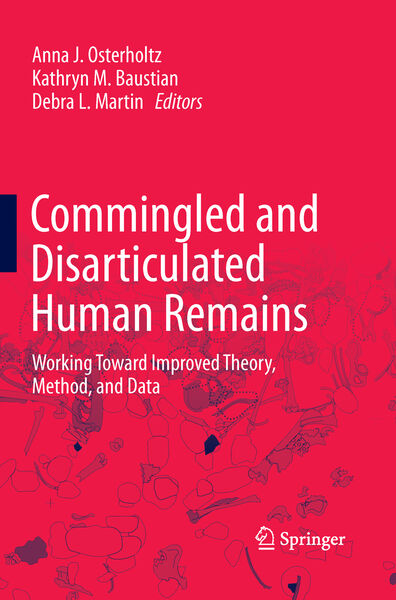
  • Produktbild: Commingled and Disarticulated Human Remains
  • Produktbild: Commingled and Disarticulated Human Remains
- 11%

Commingled and Disarticulated Human Remains Working Toward Improved Theory, Method, and Data

11% sparen

96,99 € UVP 109,99 €

inkl. gesetzl. MwSt., Versandkostenfrei


Beschreibung

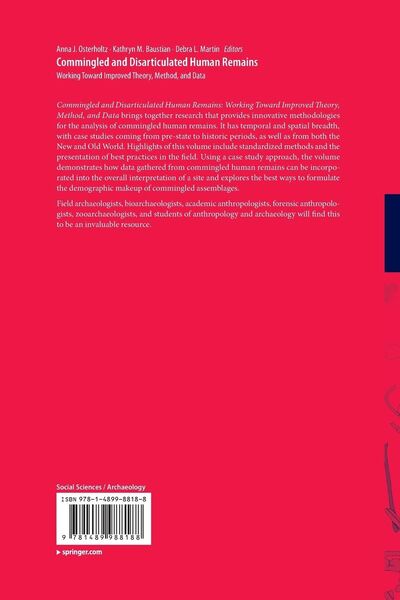
Commingled and Disarticulated Human Remains:Working Toward Improved Theory, Method, and Data brings together research that provides innovative methodologies for the analysis of commingled human remains. It has temporal and spatial breadth, with case studies coming from pre-state to historic periods,...

Beschreibung

Commingled and Disarticulated Human Remains:Working Toward Improved Theory, Method, and Data brings together research that provides innovative methodologies for the analysis of commingled human remains. It has temporal and spatial breadth, with case studies coming from pre-state to historic periods, as well as from both the New and Old World. Highlights of this volume include:
standardizes methods and presents best practices in the field using a case study approach
demonstrates how data gathered from commingled human remains can be incorporated into the overall interpretation of a site
explores best way to formulate population size, using commingled remains

Field archaeologists, bioarchaeologists, academic anthropologists, forensic anthropologists, zoo archaeologists, and students of anthropology and archaeology will find this to be an invaluable resource.

Rezension

"Overall, this volume is a major contribution in this area.....It will be an added resource to all those who work with human and animal remains in both archaeological and forensic contexts" (Bernadette M. Manifold, PaleoAnthropology, 2014)"I recommend the volume by Osterholtz and coworkers to practitioners in bioarchaeology and forensic anthropology.....the volume has much to offer in terms of ideas for dealing with commingling, and I am happy to recommend this book for all bioarchaeologists and forensic anthropologists" (John E. Byrd, American Journal of Physical Anthropology, Vol. 155, 2014) 

Portrait

Anna Osterholtz is a PhD Candidate in the Department of Anthropology at the University of Nevada, Las Vegas.  Her bioarchaeological research interests include the health consequences of trade, migration and interaction and the social role of violence.  She has worked extensively with commingled and fragmentary collections from around the world. 

Kathryn Baustian is a PhD Candidate in the Department of Anthropology at the University of Nevada, Las Vegas. Her research interests include bioarchaeological investigations focused on ancient social organization and the biological effects of culture change. She is also interested in forensic anthropology and the interpretation of violence in ancient and modern settings.

Debra L. Martin is Lincy Professor of Anthropology in the Department of Anthropology at the University of Nevada, Las Vegas.  Her interests include bioarchaeological approaches to understanding social processes that produce and reproduce poor health and violence within culturally defined and marginalized subgroups.

Produktdetails

Einband

Taschenbuch

Erscheinungsdatum

26.08.2015

Abbildungen

XVI, 285 p.

Herausgeber Anna J. Osterholtz + weitere

Produktdetails

Einband

Taschenbuch

Erscheinungsdatum

26.08.2015

Abbildungen

XVI, 285 p.

Herausgeber
Verlag Springer Us
Seitenzahl

285

Maße (L/B/H)

23,5/15,5/1,7 cm

Gewicht

464 g

Auflage

Softcover reprint of the original 1st ed. 2014

Sprache

Englisch

ISBN

978-1-4899-8818-8

Herstelleradresse

Springer-Verlag KG
Sachsenplatz 4-6
1201 Wien
AT

Email: ProductSafety@springernature.com

Noch keine Bewertungen vorhanden

Verfassen Sie die erste Bewertung zu diesem Artikel

Helfen Sie anderen Kundinnen und Kunden durch Ihre Meinung.

Kundinnen und Kunden meinen

Bewertungen (0)

  • Produktbild: Commingled and Disarticulated Human Remains
  • Produktbild: Commingled and Disarticulated Human Remains
  • Chapter 1- IntroductionChapter 2- Making Sense of Social Behavior from Disturbed and Commingled Skeletons: A Case Study from Çatalhöyük, TurkeyChapter 3- Commingled Human Skeletal Assemblages: Integrative Techniques in Determination of the MNI/MNEChapter 4- Bioarchaeological Spatial Analysis of the Walker-Noe Crematory (15GD56)Chapter 5- Into the Kettle:  The Analysis of Commingled Remains from Southern OntarioChapter 6- Crow Creek Bone Bed Commingling: The Relationship between Bone Mineral Density and Minimum Number of Individuals and Its Effect on Paleodemographic AnalysesChapter 7- Extreme Processing at Mancos and Sacred Ridge: The Value of Comparative Studies Chapter 8- Disarticulated and Disturbed, Processed and Eaten?  Cautionary Notes from the La Plata Assemblage   (AD 1000-1150)Chapter 9- Partible, Permeable, and Relational Bodies in a Maya Mass GraveChapter 10- Unmingling Commingled Museum Collections: A Photographic MethodChapter 11- Primary and secondary burials with commingled remains from archaeological contexts in Cyprus, Greece, and TurkeyChapter 12- Commingled Bone Assemblages: Insights from Zooarchaeology and Taphonomy of a Bonebed at Karain B Cave, SW TurkeyChapter 13- Normal Goat or Diseased Human? Disciplinary Boundaries and Methodological Traps in the Analysis of Fragmentary Remains at Franchthi Cave, GreeceChapter 14-Taking Analyses of Commingled Remains into the Future:  Challenges and Prospects