• Produktbild: Children Learn by Observing and Contributing to Family and Community Endeavors
  • Produktbild: Children Learn by Observing and Contributing to Family and Community Endeavors
Band 49

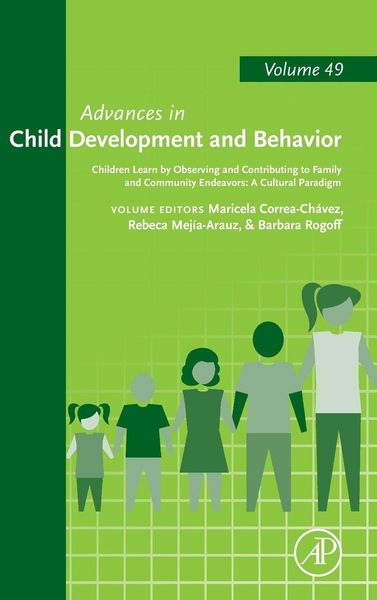
Children Learn by Observing and Contributing to Family and Community Endeavors A Cultural Paradigm

78,99 €

inkl. gesetzl. MwSt., Versandkostenfrei


Beschreibung

Produktdetails

Einband

Gebundene Ausgabe

Erscheinungsdatum

08.12.2015

Herausgeber

Maricela Correa-Chávez + weitere

Verlag

Elsevier Science & Technology

Seitenzahl

450

Maße (L/B/H)

22,9/15,2/2,9 cm

Gewicht

829 g

Sprache

Englisch

ISBN

978-0-12-803121-6

Beschreibung

Rezension

Praise for the Series:
"This book is useful, not only for scholars already interested in the specific topics reviewed, but for anyone open to the scientific process." --Child Development Abstracts and Bibliography

Portrait

Maricela Correa-Chávez is an assistant professor of developmental psychology at Long Beach State University in California. Her work centers on understanding children's learning as a cultural practice that develops through participation in activity with others in communities that have Indigenous Mexican and Central American roots, focusing particularly on how children use forms of attention and communication in learning that are different from the forms of attention and communication expected by the institution of school. She has conducted research on these topics in Mexico and Guatemala, as well as in the United States with both immigrant and middle-class families. Dr. Correa-Chávez received her doctoral degree in Developmental Psychology from the University of California, Santa Cruz, and her work has been funded by the Ford Foundation, the Spencer Foundation, the American Educational Research Association/Institute for Educational Sciences, the UC Linguistic Minority Research Institute, and the Foundation for Child Development.Rebeca Mejia-Arauz is faculty professor and researcher in the Department of Health, Psychology, and Community at ITESO University, Guadalajara, Mexico. She obtained the doctoral degree in Developmental Psychology at the University of California, Santa Cruz, the M. Sc. in Social Psychology at the London School of Economics, and a specialty in Cognitive Development at ITESO University, in México. Her line of research focuses on sociocultural and cognitive development, specifically on processes of social interaction, participation, and communication for learning. Her current research projects study cultural contrasts in interaction, attention, communication and collaboration among Indigenous and urban children; children´s out-of-school practices in urban and Indigenous contexts; cultural and intergenerational family transformations affecting children´s participation in cultural activities and their education and development; and children´s literacy development in urban Mexico. She is representative of Latin America and The Caribbean at the International Society for Cultural and Activity Research; she is a member of the National System of Researchers (SNI) in México. In 2014 she received the award for Research Trajectory and Contributions to Knowledge in Psychology from the Society of Intervention Psychologists of the State of Jalisco.Barbara Rogoff is UC Santa Cruz Foundation Distinguished Professor of Psychology. She received the 2013 Award for Distinguished Lifetime Contributions to Cultural and Contextual Factors in Child Development, from the Society for Research in Child Development. She is a Fellow of the National Academy of Education, Association for Psychological Sciences, American Anthropological Association, American Psychological Association, and American Educational Research Asociation. She has been Fellow of the Center for Advanced Study in the Behavioral Sciences, Kellogg Fellow, Spencer Fellow, and Osher Fellow of the Exploratorium. She has served as Editor of Human Development and committee member for the U.S. National Academy of Science.

Produktdetails

Einband

Gebundene Ausgabe

Erscheinungsdatum

08.12.2015

Herausgeber

Verlag

Elsevier Science & Technology

Seitenzahl

450

Maße (L/B/H)

22,9/15,2/2,9 cm

Gewicht

829 g

Sprache

Englisch

ISBN

978-0-12-803121-6

EU-Ansprechpartner

Kolibri 360 GmbH
Ettore-Bugatti-Straße 6-14
51149 Köln
DE
produktsicherheit@kolibri360.de

Herstelleradresse

Elsevier Science & Technology
125 London Wall
EC2Y 5AS London
GB
tradeorders@elsevier.com

Noch keine Bewertungen vorhanden

Verfassen Sie die erste Bewertung zu diesem Artikel

Helfen Sie anderen Kundinnen und Kunden durch Ihre Meinung.

Kundinnen und Kunden meinen

Bewertungen (0)

  • Produktbild: Children Learn by Observing and Contributing to Family and Community Endeavors
  • Produktbild: Children Learn by Observing and Contributing to Family and Community Endeavors
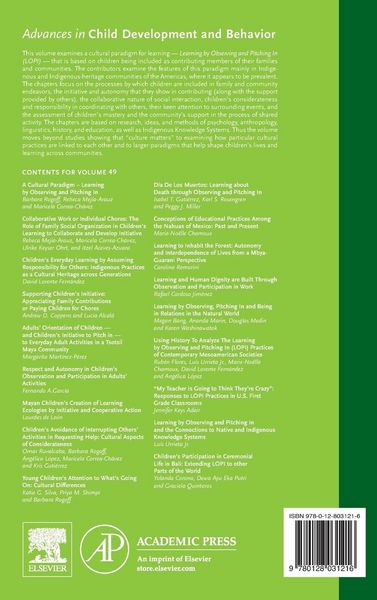
  • 1. A Cultural Paradigm - Learning by Observing and Pitching In
    Barbara Rogoff, Rebeca Mejía-Arauz and  Maricela Correa-Chávez

    Children Observing and Pitching In
    2. Collaborative Work or Individual Chores: The Role of Family Social Organization in Children's Learning to Collaborate and Develop Initiative
    Rebeca Mejía-Arauz, Maricela Correa-Chávez, Ulrike Keyser Ohrt, and Itzel Aceves-Azuara
    3. Children's Everyday Learning by Assuming Responsibility for Others: Indigenous Practices as a Cultural Heritage across Generations
    David Lorente Fernández
    4. Supporting Children's Initiative: Appreciating Family Contributions or Paying Children for Chores
    Andrew D. Coppens and Lucía Alcalá
    5. Adults' Orientation of Children - and Children's Initiative to Pitch in - to Everyday Adult Activities in a Tsotsil Maya Community
    Margarita Martínez-Pérez
    6. Respect and Autonomy in Children's Observation and Participation in Adults' Activities
    Fernando A.García
    7. The Hidden Life Behind 'Observing' and 'Pitching in:' Mayan Children's Creation of Learning Ecologies by Initiative and Co-operative Actions
    Lourdes de León
    8. Children's Avoidance of Interrupting Others' Activities in Requesting Help: Cultural Aspects of Considerateness
    Omar Ruvalcaba , Barbara Rogoff , Angelica Lopez , Maricela Correa-Chavez  and Kris Gutierrez
    9. Young Children's Attention to What's Going On: Cultural Differences
    Katie G. Silva, Priya M. Shimpi , Barbara Rogoff and Santa Cruz
    10. Día De Los Muertos: Learning about Death through Observing and Pitching In
    Isabel T. Gutiérrez, Karl S. Rosengren and Peggy J. Miller

    Learning by Observing and Pitcing in (LOPI) Fits with Cultural Cosmovisions
    11. Conceptions of Educational Practices Among the Nahuas of Mexico: Past and Present
    Marie-Noëlle Chamoux
    12. Learning to Inhabit the Forest: Autonomy and Interdependence of Lives from a Mbya-Guarani Perspective
    Carolina Remorini
    13. Learning and Human Dignity are Built Through Observation and Participation in Work
    Rafael Cardoso Jiménez
    14. Learning by Observing, Pitching In and Being in Relations in the Natural World
    Megan Bang, Ananda Marin, Douglas Medin and Karen Washinawatok
    15. Using History To Analyze The Learning by Observing and Pitching In (Lopi) Practices Of Contemporary  Mesoamerican Societies
    Rubén Flores, Luis Urrieta, Marie-Noelle Chamoux, David Lorente Fernández and  Angélica López
    16. "My Teacher is Going to Think They're Crazy?: Responses to LOPI Practices in U.S. First Grade Classrooms 
    Jennifer Keys Adair
    17. Learning by Observing and Pitching-In and the Connections to Native and Indigenous Knowledge Systems
    Luis Urrieta
    18. Children's Participation in Ceremonial Life in Bali: Extending LOPI to other Parts of the World
    Yolanda Corona, Dewa Ayu Eka Putri and Graciela Quinteros