KI-Beratung Beta

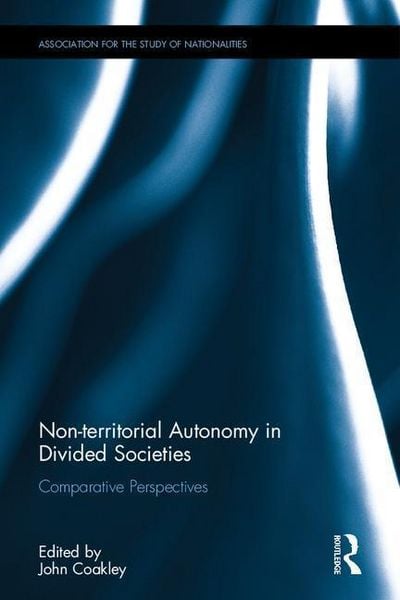
Produktbild: Non-territorial Autonomy in Divided Societies

Non-territorial Autonomy in Divided Societies

229,99 €

inkl. gesetzl. MwSt., Versandkostenfrei


Beschreibung

Non-territorial autonomy is an unusual method of government based on the notion of the devolution of power to entities within the state which exercise jurisdiction over a population defined by personal features (such as opting for a particular ethnic nationality) rather than by geographical location...

Beschreibung

Non-territorial autonomy is an unusual method of government based on the notion of the devolution of power to entities within the state which exercise jurisdiction over a population defined by personal features (such as opting for a particular ethnic nationality) rather than by geographical location (such as the region in which they live). Developed theoretically by Karl Renner in the early twentieth century as a mechanism for responding to demands for self-government from dispersed minorities within the Austro-Hungarian empire, it had earlier roots in the Ottoman empire, and later formed the basis for constitutional experiments in Estonia, in Belgium, and in states with sizeable but dispersed minorities. More recently, efforts have been made to apply it in respect of indigenous communities. This approach to the management of ethnic conflict has attracted a small literature, but there is no comprehensive overview of its application. The intention of this volume is to fill this gap, for the first time offering a comparative assessment of the significance of this political institutional device. Authors of case studies follow a common framework.

This book was published as a special issue of Ethnopolitics.

Rezension

'Non-territorial Autonomy in Divided Societies can be taken as a first step in the study of non-territorial forms of autonomy and may therefore serve as an extensive introduction for academics who are approaching a new field of research: it poses questions and draws methods of evaluation; it brings back to the front an unfairly neglected field of research; and, finally, it lays the groundwork for a much-needed revival of the topic.'

Mattia Zaba, School of International Studies of the University of Trento

Produktdetails

Einband

Gebundene Ausgabe

Erscheinungsdatum

07.02.2017

Herausgeber John Coakley
Verlag Taylor & Francis

Produktdetails

Einband

Gebundene Ausgabe

Erscheinungsdatum

07.02.2017

Herausgeber John Coakley
Verlag Taylor & Francis
Seitenzahl

200

Maße (L/B/H)

24,6/17,4/1 cm

Gewicht

362 g

Sprache

Englisch

ISBN

978-1-138-95395-6

Herstelleradresse

Taylor and Francis
Taylor & Francis Verlag GmbH, Kaufingerstraße 24
80331 München
DE
gpsr@taylorandfrancis.com

Noch keine Bewertungen vorhanden

Verfassen Sie die erste Bewertung zu diesem Artikel

Helfen Sie anderen Kundinnen und Kunden durch Ihre Meinung.

Kundinnen und Kunden meinen

Bewertungen (0)

Die Leseprobe wird geladen.
  • Produktbild: Non-territorial Autonomy in Divided Societies
  • 1. Introduction: non-territorial minorities and the notion of cultural autonomy (John Coakley, Queen's University Belfast) 2. The Jewish question and national cultural autonomy in Europe (Roni Gechtman, Mount Saint Vincent University) 3. The Ottoman empire: the millet system (Karen Barkey, Columbia University) 4. Moravia: an early experiment in non-territorial autonomy (Börries Kuzmany, Central European University, Budapest) 5. Estonia: a model for interwar Europe? (David J Smith, University of Glasgow) 6. Belgium: non-territorial and territorial devolution (Emmanuel Dalle Mulle, University of Geneva) 7. Canada: First Nations in a federal state (Bettina Petersohn, University of Edinburgh) 8. The Sami: indigenous autonomy in Scandinavia (Per Selle, University of Bergen) 9. The Maori quest for autonomy in New Zealand (Richard Hill, Victoria University, Wellington) 10. Conclusion: patterns of non-territorial autonomy (John Coakley, Queen's University Belfast)