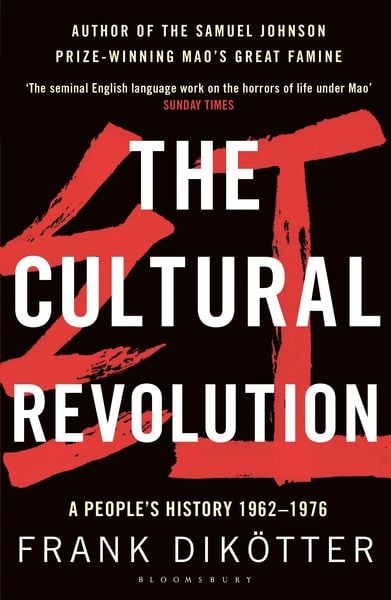
The Cultural Revolution A People's History, 1962--1976
-
- Taschenbuch ausgewählt
- eBook
- Hörbuch
-
Sprache:Englisch
15,89 €
inkl. gesetzl. MwSt.,
- Kostenlose Lieferung ab 30 € Einkaufswert
- Versandkostenfrei für Bonuscard-Kund*innen
Beschreibung
Produktdetails
Verkaufsrang
11839
Einband
Taschenbuch
Erscheinungsdatum
09.02.2017
Abbildungen
1 x 16pp B&W plate section
Verlag
Bloomsbury PublishingSeitenzahl
396
Maße (L/B/H)
19,8/12,8/3,8 cm
Gewicht
361 g
Farbe
Schwarz / Salsa Rot
Sprache
Englisch
ISBN
978-1-4088-5652-9
Acclaimed by the Daily Mail as 'definitive and harrowing', this is the final volume of 'The People's Trilogy', begun by the Samuel Johnson prize-winning Mao's Great Famine. 'The seminal English language work on the subject' Sunday Times 'A major contribution to scholarship on modern China, one that is unequalled, certainly in the English language . both revealing and rewarding reading - for specialists and non-specialists alike' Literary Review After the economic disaster of the Great Leap Forward that claimed tens of millions of lives between 1958 and 1962, an ageing Mao launched an ambitious scheme to shore up his reputation and eliminate those he viewed as a threat to his legacy. The stated goal of the Cultural Revolution was to purge the country of bourgeois, capitalist elements he claimed were threatening genuine communist ideology. But the Chairman also used the Cultural Revolution to turn on his colleagues, some of them longstanding comrades-in-arms, subjecting them to public humiliation, imprisonment and torture. Young students formed Red Guards, vowing to defend the Chairman to the death, but soon rival factions started fighting each other in the streets with semi-automatic weapons in the name of revolutionary purity. As the country descended into chaos, the military intervened, turning China into a garrison state marked by bloody purges that crushed as many as one in fifty people. When the army itself fell victim to the Cultural Revolution, ordinary people used the political chaos to resurrect the market and hollow out the party's ideology. In short, they buried Maoism. In-depth interviews and archival research at last give voice to the people and the complex choices they faced, undermining the picture of conformity that is often understood to have characterised the last years of Mao's regime. By demonstrating that decollectivisation from below was an unintended consequence of a decade of violent purges and entrenched fear, Frank Dikötter casts China's most tumultuous era in a wholly new light. Written with unprecedented access to previously classified party documents from secret police reports to unexpurgated versions of leadership speeches, this third chapter in Frank Dikötter's extraordinarily lucid and ground-breaking 'People's Trilogy' is a devastating reassessment of the history of the People's Republic of China.
Noch keine Bewertungen vorhanden
Verfassen Sie die erste Bewertung zu diesem Artikel
Helfen Sie anderen Kundinnen und Kunden durch Ihre Meinung.
Kurze Frage zu unserer Seite
Vielen Dank für Ihr Feedback
Wir nutzen Ihr Feedback, um unsere Produktseiten zu verbessern. Bitte haben Sie Verständnis, dass wir Ihnen keine Rückmeldung geben können. Falls Sie Kontakt mit uns aufnehmen möchten, können Sie sich aber gerne an unseren Kund*innenservice wenden.
zum Kundenservice