
Why Law Matters
-
- Hardcover
- Taschenbuch ausgewählt
- eBook
-
Sprache:Englisch
65,99 €
inkl. gesetzl. MwSt.,
Beschreibung
Produktdetails
Einband
Taschenbuch
Erscheinungsdatum
29.10.2015
Verlag
Oxford University PressSeitenzahl
254
Maße (L/B/H)
23,4/15,6/1,4 cm
Gewicht
392 g
Sprache
Englisch
ISBN
978-0-19-876621-6
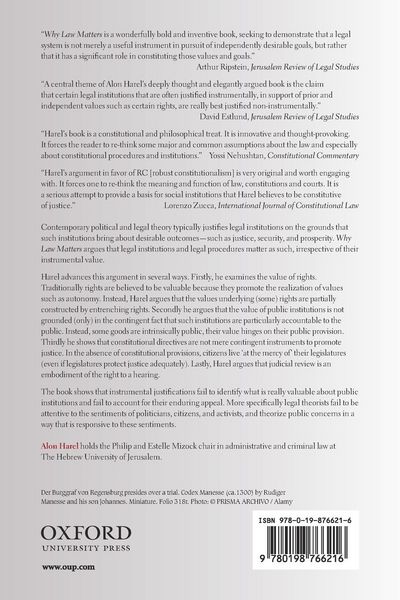
Contemporary political and legal theory typically justifies the value of political and legal institutions on the grounds that such institutions bring about desirable outcomes - such as justice, security, and prosperity. In the popular imagination, however, many people seem to value public institutions for their own sake. The idea that political and legal institutions might be intrinsically valuable has received little philosophical attention. Why Law Matters presents the argument that legal institutions and legal procedures are valuable and matter as such, irrespective of their instrumental value. Harel advances the argument in several ways. Firstly, he examines the value of rights. Traditionally it is believed that rights are valuable because they promote the realisation of values such as autonomy. Instead Harel argues that the values underlying (some) rights are partially constructed by entrenching rights. Secondly he argues that the value of public institutions are not grounded (ONLY) in the contingent fact that such institutions are particularly accountable to the public. Instead, some goods are intrinsically public; their value hinges on their public provision. Thirdly he shows that constitutional directives are not mere contingent instruments to promote justice. In the absence of constitutional entrenchment of rights, citizens live "at the mercy of" their legislatures (even if legislatures protect justice adequately). Lastly, Harel defends judicial review on the grounds that it is an embodiment of the right to a hearing. The book shows that instrumental justifications fail to identify what is really valuable about public institutions and fail to account for their enduring appeal. More specifically legal theorists fail to be attentive to the sentiments of politicians, citizens and activists and to theorise public concerns in a way that is responsive to these sentiments.
Noch keine Bewertungen vorhanden
Verfassen Sie die erste Bewertung zu diesem Artikel
Helfen Sie anderen Kundinnen und Kunden durch Ihre Meinung.
Kurze Frage zu unserer Seite
Vielen Dank für Ihr Feedback
Wir nutzen Ihr Feedback, um unsere Produktseiten zu verbessern. Bitte haben Sie Verständnis, dass wir Ihnen keine Rückmeldung geben können. Falls Sie Kontakt mit uns aufnehmen möchten, können Sie sich aber gerne an unseren Kund*innenservice wenden.
zum Kundenservice