• Produktbild: The Real and the Complex: A History of Analysis in the 19th Century
  • Produktbild: The Real and the Complex: A History of Analysis in the 19th Century

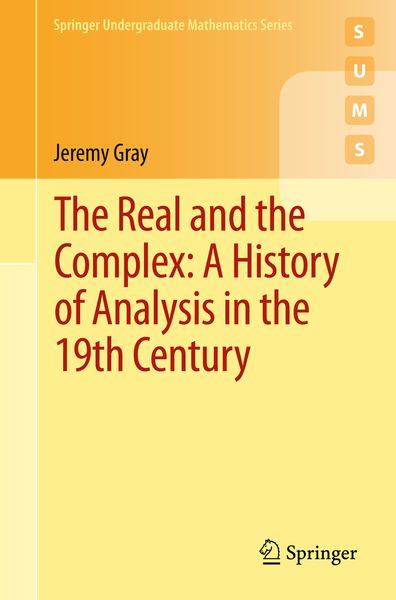
The Real and the Complex: A History of Analysis in the 19th Century

38,99 €

inkl. gesetzl. MwSt., Versandkostenfrei


Beschreibung

Produktdetails

Einband

Taschenbuch

Erscheinungsdatum

05.11.2015

Verlag

Springer

Seitenzahl

350

Maße (L/B/H)

23,5/15,5/2 cm

Gewicht

557 g

Auflage

1st edition 2015

Sprache

Englisch

ISBN

978-3-319-23714-5

Beschreibung

Rezension

“The Real and the Complex originated in a course Jeremy Gray gave to upper-level mathematics students and is part of a Springer series on undergraduate mathematics. An important aim of the book is to help the student understand how any given part of mathematics first arises and comes to fruition. … for those readers with some university-level background in mathematics who are interested in the technical contours of nineteenth-century science, Gray’s book will repay careful study and is highly recommended.” (Craig Fraser, Isis, Vol. 108 (2), June, 2017)“I view it as an extremely valuable addition to my library and a book that I am sure I will consult frequently in the future: this is a text that should serve well as a desk reference for a faculty member teaching either analysis (real or complex) or the history of mathematics. Certainly, no good university library should be without it.” (Mark Hunacek, MAA Reviews, maa.org, January, 2017)“Gray’s 29 chapters take us on quite a ride through the ideas, results, and difficulties of the major figures of nineteenth-century analysis. …  Any mathematician who would like to know how analysis developed should find it interesting. Those who teach analysis can gain much insight from seeing the blind alleys as well as the great ideas … . The writing style is clear and unpretentious, as well as marked by immense learning. … I strongly recommend … .” (Judith V. Grabiner, Notices of the AMS, Vol. 64 (11), 2017)“The Real and the Complex … develops the subject of analysis by reviewing the works of some of the prominent mathematicians of the 19th century. … Summing Up: Recommended. Upper-division undergraduates, graduate students, researchers/faculty, professionals/practitioners.” (M. D. Sanford, Choice, Vol. 53 (9), May, 2016)“This is a history book on the development of mathematics in the 19th century. Each chapter is built up around one or a few mathematicians. … this book is not only an interesting read for the students who (have to) study it, but equally valuable for professional mathematicians.” (Adhemar Bultheel, European Mathematical Society, euro-math-soc.eu, February, 2016)

Produktdetails

Einband

Taschenbuch

Erscheinungsdatum

05.11.2015

Verlag

Springer

Seitenzahl

350

Maße (L/B/H)

23,5/15,5/2 cm

Gewicht

557 g

Auflage

1st edition 2015

Sprache

Englisch

ISBN

978-3-319-23714-5

Herstelleradresse

Springer-Verlag KG
Sachsenplatz 4-6
1201 Wien
AT

Email: GPSR Kontakt

Noch keine Bewertungen vorhanden

Verfassen Sie die erste Bewertung zu diesem Artikel

Helfen Sie anderen Kundinnen und Kunden durch Ihre Meinung.

Kundinnen und Kunden meinen

Bewertungen (0)

  • Produktbild: The Real and the Complex: A History of Analysis in the 19th Century
  • Produktbild: The Real and the Complex: A History of Analysis in the 19th Century
  • Lagrange and foundations for the calculus.- Joseph Fourier.- Legendre.- Cauchy and continuity.- Cauchy: differentiation and integration.- Cauchy and complex functions to 1830.- Abel.- Jacobi.- Gauss.- Cauchy and complex function theory, 1830-1857.- Complex functions and elliptic integrals.- Revision.- Gauss, Green, and potential theory.- Dirichlet, potential theory, and Fourier series.- Riemann.- Riemann and complex function theory.- Riemann's later complex function theory.- Responses to Riemann's work.- Weierstrass.- Weierstrass's foundational results.- Revision { and assessment.- Uniform Convergence.- Integration and trigonometric series.- The fundamental theorem of the calculus.- The construction of the real numbers.- Implicit functions.- Towards Lebesgue's theory of integration.- Cantor, set theory, and foundations.- Topology.- Assessment.