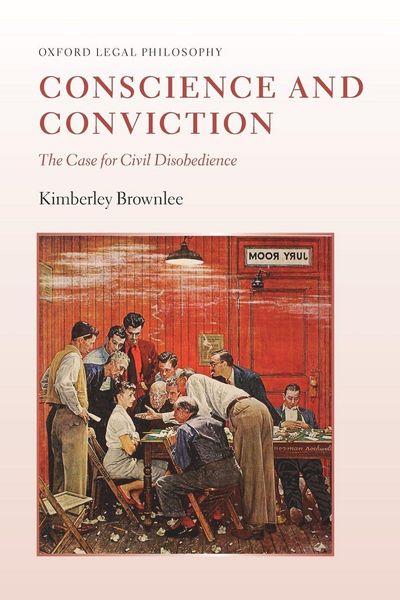
Conscience and Conviction The Case for Civil Disobedience
-
- Hardcover
- Taschenbuch ausgewählt
- eBook
-
Sprache:Englisch
63,99 €
inkl. gesetzl. MwSt.,
Beschreibung
Produktdetails
Einband
Taschenbuch
Erscheinungsdatum
08.10.2015
Verlag
Oxford University PressSeitenzahl
280
Maße (L/B/H)
23,4/15,6/1,6 cm
Gewicht
430 g
Sprache
Englisch
ISBN
978-0-19-875946-1
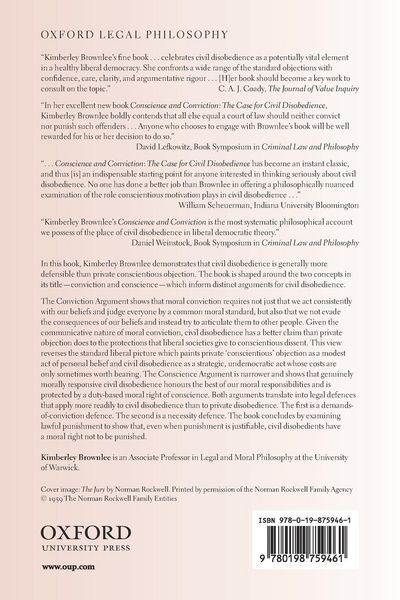
Oxford Legal Philosophy publishes the best new work in philosophically-oriented legal theory. It commissions and solicits monographs in all branches of the subject, including works on philosophical issues in all areas of public and private law, and in the national, transnational, and international realms; studies of the nature of law, legal institutions, and legal reasoning; treatments of problems in political morality as they bear on law; and explorations in the nature and development of legal philosophy itself. The series represents diverse traditions of thought but always with an emphasis on rigour and originality. It sets the standard in contemporary jurisprudence. This book shows that civil disobedience is generally more defensible than private conscientious objection. Part I explores the morality of conviction and conscience. Each of these concepts informs a distinct argument for civil disobedience. The conviction argument begins with the communicative principle of conscientiousness (CPC). According to the CPC, having a conscientious moral conviction means not just acting consistently with our beliefs and judging ourselves and others by a common moral standard. It also means not seeking to evade the consequences of our beliefs and being willing to communicate them to others. The conviction argument shows that, as a constrained, communicative practice, civil disobedience has a better claim than private objection does to the protections that liberal societies give to conscientious dissent. This view reverses the standard liberal picture which sees private 'conscientious' objection as a modest act of personal belief and civil disobedience as a strategic, undemocratic act whose costs are only sometimes worth bearing. The conscience argument is narrower and shows that genuinely morally responsive civil disobedience honours the best of our moral responsibilities and is protected by a duty-based moral right of conscience. Part II translates the conviction argument and conscience argument into two legal defences. The first is a demands-of-conviction defence. The second is a necessity defence. Both of these defences apply more readily to civil disobedience than to private disobedience. Part II also examines lawful punishment, showing that, even when punishment is justifiable, civil disobedients have a moral right not to be punished.
Noch keine Bewertungen vorhanden
Verfassen Sie die erste Bewertung zu diesem Artikel
Helfen Sie anderen Kundinnen und Kunden durch Ihre Meinung.
Kurze Frage zu unserer Seite
Vielen Dank für Ihr Feedback
Wir nutzen Ihr Feedback, um unsere Produktseiten zu verbessern. Bitte haben Sie Verständnis, dass wir Ihnen keine Rückmeldung geben können. Falls Sie Kontakt mit uns aufnehmen möchten, können Sie sich aber gerne an unseren Kund*innenservice wenden.
zum Kundenservice