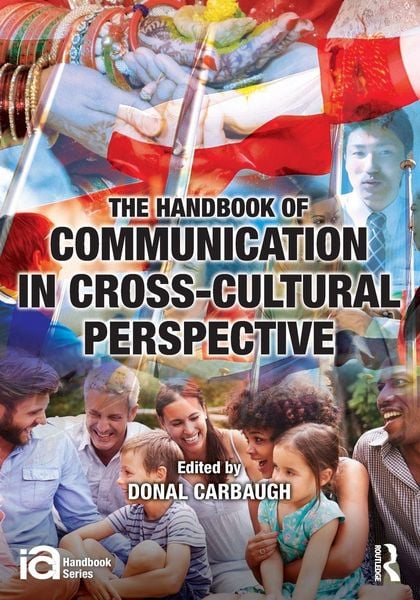
Dedication
Table of Contents
Series Editor's Foreword, Robert T. Craig
Editorial Team
Contributors
Acknowledgments
Introduction: The Handbook
Chapter 1: Donal Carbaugh, Communication in Cross-cultural Perspective
Unit One: The Idea(l)s of Communication in Cultural Context
Chapter 2: Donal Carbaugh, Terms for Talk, Take 2: Theorizing Communication through its Cultural Terms and Practices
Chapter 3: Igor Klyukanov and Olga Leontovich, Russian Perspectives on Communication
Chapter 4: Camelia Suleiman, Arabic Language Ideology and Communication: An Image from Egypt
Unit Two: Critical Inquiry through Plaintive Forms of Cultural Communication, National Identity
Chapter 5: Nadezhda Sotirova, Oplakvane [complaining] and what it teaches us about Communication in Bulgarian Discourse
Chapter 6: Michaela Winchatz, Jammern [whining] as a German Way of Speaking
Chapter 7: Shi-xu, Cultural Assumptions about Chinese Communication
Unit Three: Cultural Styles of Communication with special attention to Identity
Chapter 8: Cliff Goddard and Rahel Cramer, "Laid back" and "irreverent": An ethno-pragmatic analysis of two cultural themes in Australian English communication
Chapter 9: Michael Haugh, Mockery and (non-) seriousness in initial interactions amongst American and Australian speakers of English
Chapter 10: Todd Sandel, Hsin-I Yueh and Peih-ying Lu, Some Distinctive Taiwanese Communication Practices and their Cultural Meanings
Chapter 11: Richard Wilkins, The Optimal Form and its use in Cross-Cultural Analysis: A British "Stiff Upper Lip" and a Finnish Matter-of-fact Style
Chapter 12: Saskia Witteborn and Qian Huang, Diaosi [expressing the underdog] as a Way of Relating in Contemporary China
Unit Four: Electronic and Written Media, Mobile Communication
Chapter 13: Haiyong Liu and Mary Garrett, A Perilous Journey: Intercultural Communication through Translated Novels
Chapter 14: Saila Poutiainen, Finnish Terms for Talk about Communication on a Mobile Phone
Chapter 15: Kwesi Yankah, Mobile Phone Technology: Coping Strategies in African Cultural Practice
Unit Five: Interpersonal Communication, Gender, Respect, Sociability
Chapter 16: Benjamin Bailey, Piropos [amorous flattery] as a cultural term for talk in the Spanish-speaking world
Chapter 17: Patricia Covarrubias, Respeto [respect] in Disrespect: Clashing Cultural Themes withinMexican Immigration Discourses
Chapter 18: Wenshan Jia and Dexin Tian, Chinese Conceptualizations of Communication:Terms for Talk and Practice
Chapter 19: Elena Nuciforo, "Sitting" as a Communication Ritual with special attention to Alcohol Consumption inRussian Culture
Unit Six: Organizational Communication
Chapter 20: Tovar Cerulli, "Ma'iingan is our brother": Ojibwe and non-Ojibwe ways of speaking about wolves
Chapter 21: Leah Sprain, Cultural Communication within Nicaraguan Cooperative Meetings
Chapter 22: Alena Vasilyeva, Mediation Discourse in the United States and Belarus: Culturally Shaped Interactions
Unit Seven: Political Communication
Chapter 23: David Boromisza-Habashi and Gábor Pál, The discourse of dictatorship in Central Eastern Europe, and the case of Hungarian "hate speech"
Chapter 24: Gonen Dori-Hacohen, Israeli online political commenting: Tokbek [talk-back] in between griping and hate-speech
Chapter 25: Zohar Kampf & Tamar Katriel, Political Condemnations: Public Speech Acts and the Moralization of Discourse
Unit Eight: Religious-based Communication
Chapter 26: Abdrabo Abu Alyan The Friday Sermon 'Khutbah' at the Mosque: Messages and Emotions
Chapter 27: Sunny Lie, Effective Evangelism: Discourse about Best Evangelical Practices in a Chinese Indonesian Evangelical Christian (CIEC) Community in New England
Chapter 28: Elizabeth Molina-Markham, "Drawing Back to a Sense of the Whole":
Positioning Practices in Quaker Administrative Meetings
Epilogue, Gerry Philipsen