Gutscheinbedingungen

**Gültig bis 14.09.2026 auf Spielzeug, Schreibwaren, Filme, Geschenke & Trends, Musik, tolino eReader & Zubehör, Hörbücher, nicht preisgebundene Bücher und Kalender in der Thalia App. Einzelne Artikel können ausgeschlossen sein. Aufgrund der Buchpreisbindung sind deutschsprachige Bücher und eBooks ausgenommen. Zusätzlich ausgenommen sind Abos & Flatrates, Games, Geschenkkarten/-boxen, Shelfies, Software, Zeitschriften sowie einzelne Artikel von tonies®. Pro Einkauf einmal einlösbar. Nur gültig mit im Onlineshop hinterlegter Bonuscard. Click & Collect nur bei Onlinevorabzahlung möglich. Keine Barauszahlung. Nicht kombinierbar mit anderen Aktionen und Gutscheinen. Gutschein wird auf max. 500€ Bestellwert angerechnet. Nicht gültig für Versandkosten und Services.

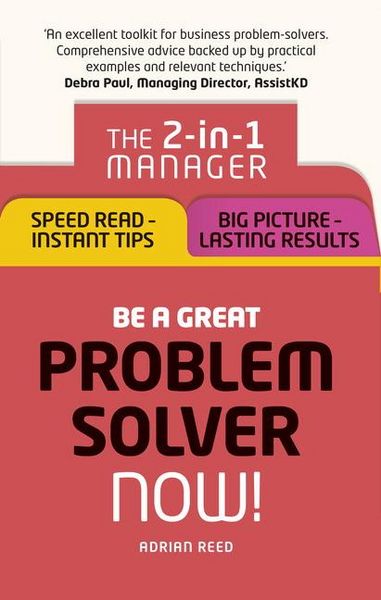
Produktbild: Be a Great Problem Solver - Now!

Be a Great Problem Solver - Now! The 2-in-1 Manager: Speed Read - Instant Tips; Big Picture - Lasting Results

18,99 €

inkl. gesetzl. MwSt., zzgl. Versandkosten


  • Kostenlose Lieferung ab 30 € Einkaufswert
  • Versandkostenfrei für Bonuscard-Kund*innen

Beschreibung

Produktdetails

Einband

Taschenbuch

Erscheinungsdatum

25.05.2016

Abbildungen

w. ill.

Verlag

Pearson Academic

Seitenzahl

272

Maße (L/B/H)

14/21,6/1,5 cm

Gewicht

334 g

Auflage

1. Auflage

Sprache

Englisch

ISBN

978-1-292-11962-5

Beschreibung

Produktdetails

Einband

Taschenbuch

Erscheinungsdatum

25.05.2016

Abbildungen

w. ill.

Verlag

Pearson Academic

Seitenzahl

272

Maße (L/B/H)

14/21,6/1,5 cm

Gewicht

334 g

Auflage

1. Auflage

Sprache

Englisch

ISBN

978-1-292-11962-5

Herstelleradresse

Libri GmbH
Europaallee 1
36244 Bad Hersfeld
DE

Email: gpsr@libri.de

Noch keine Bewertungen vorhanden

Verfassen Sie die erste Bewertung zu diesem Artikel

Helfen Sie anderen Kundinnen und Kunden durch Ihre Meinung.

Kundinnen und Kunden meinen

Bewertungen (0)

  • Produktbild: Be a Great Problem Solver - Now!
  • Introduction
    About the Author
    Acknowledgements

    Chapter 1. Avoid the Solution Trap

    Speed Read
    1.1 What s wrong with a knee-jerk solution?
    1.2 Think Holistically
    1.3 Structure your problem solving
    1.4 Scour the stakeholder landscape
    1.5 Slow down to speed up
    1.6 Uncover constraints
    1.7 Be concise yet precise: Introducing the one page Problem Canvas

    Big Picture
    1.1 What s wrong with a knee-jerk solution?
    1.2 Think Holistically
    1.3 Structure your problem solving approach
    1.4 Scour the stakeholder landscape
    1.5 Slow down to speed up : Be prepared for challenge
    1.6 Uncover Constraints
    1.7 Be concise yet precise: Introducing the one-page Problem Canvas

    Chapter 2. Think Problem before Solution

    Speed Read
    2.1 The importance of Why
    2.2 Defining a problem or opportunity statement
    2.3 Encourage Divergent and Convergent Thinking
    2.4 Get to the root of the problem
    2.5 Consider the External Environment
    2.6 Consider Multiple Perspectives on the Problem
    2.7 Gain Consensus and Move Forward

    Big Picture
    2.1 The importance of Why
    2.2. Defining a problem or opportunity statement
    2.3 Encourage Divergent and Convergent Thinking
    2.4 Get to the root of the problem
    2.5 Consider the External Environment
    2.6 Consider Multiple Perspectives on the Problem
    2.7 Gain Consensus and Move Forward

    Chapter 3. Defining the Outcomes: What Does Success Look Like?

    Speed Read
    3.1 Encourage Outcome Based Thinking
    3.2 Start With the End in Mind: Define Critical Success Factor
    3.3 Make it measurable with Key Performance Indicators
    3.4 Attain Balance with the Balanced Business Scorecards
    3.5 Revisit and Consider Constraints
    3.6 Ensuring Organisational Alignment
    3.7 Assess different perspectives on outcomes

    Big Picture
    3.1 Encourage outcome-based thinking
    3.2 Start With the End in Mind: Define Critical Success Factors
    3.3 Make it measurable with Key Performance Indicators
    3.4 Attain Balance with the Balanced Business Scorecard
    3.5 Revisit and Consider Constraints
    3.6 Ensuring Organisational Alignment
    3.7 Assess different perspectives on outcomes

    Chapter 4. Assessing Scope and Impact

    Speed Read
    4.1 The danger of Scope Creep
    4.2 Know the difference: Impacted, Interested and Involved
    4.3 Understand the problem situation
    4.4 Find the Roles & Goals
    4.5 Make it visual with a Business Use Case Model
    4.6 Set the priorities
    4.7 Set the boundaries of scope

    Big Picture
    4.1 The danger of Scope Creep
    4.2 Know the difference: Impacted, Interested and Involved
    4.3 Understand the problem situation
    4.4 Find the Roles & Goals
    4.5 Make it visual with a Business Use Case Model
    4.6 Set the priorities
    4.7 Set the boundaries of scope

    Chapter 5. Solutioneering: Generating Solution Options

    Speed Read
    5.1 Keep the outcomes clearly in mind
    5.2 Get Together and Imagine Multiple Solutions
    5.3 Start evaluating solutions: Create a long list
    5.4 Getting Specific: Short list the best
    5.5 Consider Doing Nothing
    5.6 Compare the short listed options
    5.7 Validate and make a recomme