KI-Beratung Beta

Gutscheinbedingungen

**Gültig bis 30.11.2026 auf Spielzeug, Schreibwaren, Filme, Geschenke & Trends, Musik, tolino eReader & Zubehör, Hörbücher und Hörbuch-Downloads, nicht preisgebundene Bücher und Kalender online auf thalia.at und in der Thalia App. Einzelne Artikel können ausgeschlossen sein. Aufgrund der Buchpreisbindung sind deutschsprachige Bücher und eBooks ausgenommen. Zusätzlich ausgenommen sind Abos & Flatrates, Games, Geschenkkarten/-boxen, Shelfies, Software, Zeitschriften sowie einzelne Artikel von tonies®. Pro Einkauf einmal einlösbar. Nur gültig mit im Onlineshop hinterlegter Bonuscard. Click & Collect nur bei Onlinevorabzahlung möglich. Keine Barauszahlung. Nicht kombinierbar mit anderen Aktionen und Gutscheinen. Gutschein wird auf max. 500€ Bestellwert angerechnet. Nicht gültig für Versandkosten und Services.

  • Produktbild: Algeria Revisited
  • Produktbild: Algeria Revisited

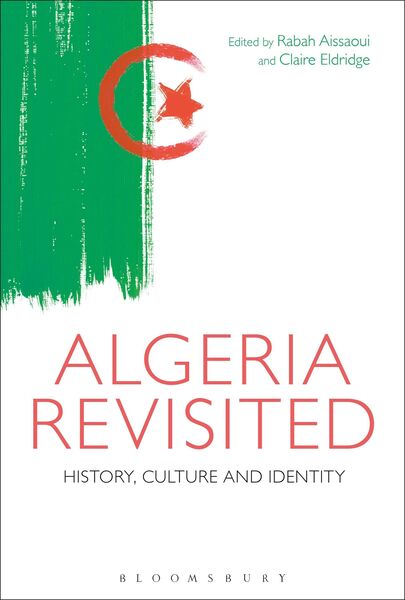
Algeria Revisited History, Culture and Identity

157,99 €

inkl. gesetzl. MwSt., Versandkostenfrei


Beschreibung

On 5 July 1962, Algeria became an independent nation, bringing to an end 132 years of French colonial rule. Algeria Revisited provides an opportunity to critically re-examine the colonial period, the iconic war of decolonisation that brought it to an end and the enduring legacies of these years. Given...

Beschreibung

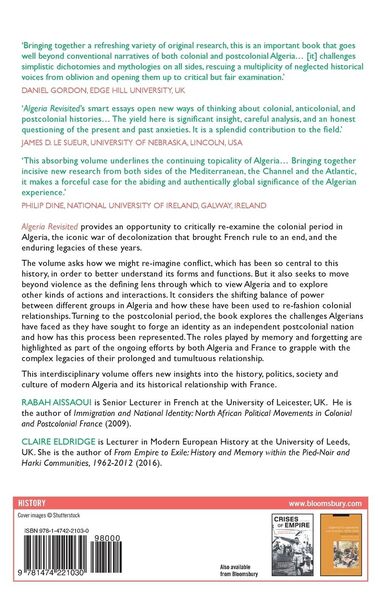
On 5 July 1962, Algeria became an independent nation, bringing to an end 132 years of French colonial rule. Algeria Revisited provides an opportunity to critically re-examine the colonial period, the iconic war of decolonisation that brought it to an end and the enduring legacies of these years. Given the apparent centrality of violence in this history, this volume asks how we might re-imagine conflict so as to better understand its forms and functions in both the colonial and postcolonial eras. It considers the constantly shifting balance of power between different groups in Algeria and how these have been used to re-fashion colonial relationships. Turning to the postcolonial period, the book explores the challenges Algerians have faced as they have sought to forge an identity as an independent postcolonial nation and how has this process been represented. The roles played by memory and forgetting are highlighted as part of the ongoing efforts by both Algeria and France to grapple with the complex legacies of their prolonged and tumultuous relationship. This interdisciplinary volume sheds light on these and other issues, offering new insights into the history, politics, society and culture of modern Algeria and its historical relationship with France.

Produktdetails

Einband

Gebundene Ausgabe

Erscheinungsdatum

09.03.2017

Herausgeber Rabah Aissaoui + weitere
Verlag Bloomsbury 3PL

Produktdetails

Einband

Gebundene Ausgabe

Erscheinungsdatum

09.03.2017

Herausgeber
Verlag Bloomsbury 3PL
Seitenzahl

280

Maße (L/B/H)

24/16,1/2 cm

Gewicht

587 g

Sprache

Englisch

ISBN

978-1-4742-2103-0

Herstelleradresse

Libri GmbH
Europaallee 1
36244 Bad Hersfeld
DE

Email: gpsr@libri.de

Noch keine Bewertungen vorhanden

Verfassen Sie die erste Bewertung zu diesem Artikel

Helfen Sie anderen Kundinnen und Kunden durch Ihre Meinung.

Kundinnen und Kunden meinen

Bewertungen (0)

Die Leseprobe wird geladen.
  • Produktbild: Algeria Revisited
  • Produktbild: Algeria Revisited
  • List of Illustrations
    Acknowledgements
    List of Contributors
    Map of Algeria

    Introduction: Revisiting Algeria (Rabah Aissaoui, University of Leicester, UK and Claire Eldridge, University of Leeds, UK)

    Part 1: Re-imagining Colonial Conflicts and Relationships
    1. Criminalising Dissent: Policing Banditry in the Constantinois, 1914-18 (Samuel Kalman, St Francis Xavier University, Canada)
    2. The Young Algerians and the Question of the Muslim Draft, 1900-14 (Michelle Mann, Brandeis University, USA)
    3. 'Between Two Worlds': Emir Khaled and the Young Algerians at the Beginning of the Twentieth Century in Algeria (Rabah Aissaoui, University of Leicester, UK)
    4. Weapons of Mass Representation: Algerians in the French Parliament, 1958-62 (Arthur Asseraf, University of Oxford, UK)

    Part 2: Identity Construction and Contestation
    5. Individual and Collective Identity in Algerian Francophone Literature: Jean Sénac's 'Poetry on All Fronts' (Blandine Valfort, Université de Lyon II, France)
    6. Algerian Female Identity Re-constitution and Colonial Language: A Postcolonial Malaise in Assia Djebar's L'Amour, la Fantasia (Rachida Yassine, Ibn Zohr University, Morocco)
    7. 'Encounters' of Frustration and Hope in the Writing of Maïssa Bey (Samira Farhoud, St Thomas University, Canada and Carey Watt, St Thomas University, Canada)
    8. On the Shifting Significance of 'Algerian Cinema' as a Category of Analysis (Patricia Caillé, Université de Strasbourg, France)
    9. The Algerian Woman in Conflict in The Battle of Algiers (Gillo Pontecorvo, 1966) (Sophie Bélot, University of Sheffield, UK)

    Part 3: Remembering Algeria
    10. The Entangled Politics of Postcolonial Commemoration (Jennifer E. Sessions, University of Iowa, USA)
    11. Passing the Torch: Memory Transmission and Activism within the Pied-Noir Community Fifty Years after Algerian Independence (Claire Eldridge, University of Leeds, UK)

    Conclusion: Culture as War by Other Means: Community, Conflict and Cultural Revolution, 1967-81 (James McDougall, University of Oxford, UK)

    Index