Gutscheinbedingungen

**Gültig bis 06.07.2026 auf fremdsprachige Bücher online auf thalia.at, in der Thalia App ab einem Mindestbestellwert von 30€ und in allen Thalia Buchhandlungen in Österreich. In den Buchhandlungen nur gültig auf lagernde Ware. Einzelne Artikel können ausgeschlossen sein. Ausgenommen sind preisgebundene Artikel & eBooks. Pro Einkauf einmal einlösbar. Nur gültig gegen Vorlage oder im Onlineshop hinterlegter Bonuscard. Infos zur Einlösung in der Buchhandlung sind auf der Bonuscard-Vorteilspreisseite zu finden. Click & Collect nur bei Onlinevorabzahlung möglich. Keine Einlösung bei Scan & Go-Bezahlung. Keine Barauszahlung. Nicht kombinierbar mit anderen Aktionen und Gutscheinen. Gutschein wird auf max. 500€ Bestellwert angerechnet. Nicht gültig für Versandkosten und Services.

  • Produktbild: Exercises in Practical Physics
  • Produktbild: Exercises in Practical Physics

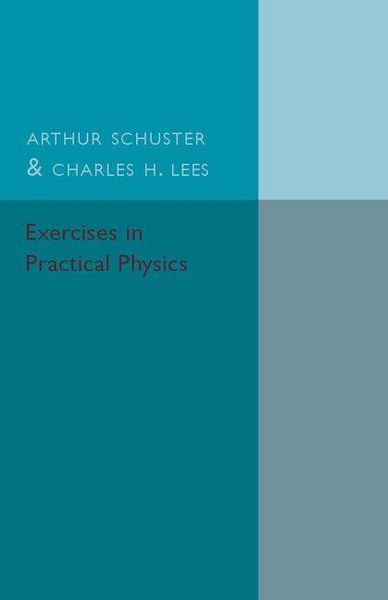
Exercises in Practical Physics

79,99 €

inkl. gesetzl. MwSt., Versandkostenfrei


Beschreibung

Produktdetails

Einband

Taschenbuch

Erscheinungsdatum

30.06.2015

Verlag

Cambridge Academic

Seitenzahl

384

Maße (L/B/H)

21,6/14/2,3 cm

Gewicht

490 g

Sprache

Englisch

ISBN

978-1-107-55987-5

Beschreibung

Produktdetails

Einband

Taschenbuch

Erscheinungsdatum

30.06.2015

Verlag

Cambridge Academic

Seitenzahl

384

Maße (L/B/H)

21,6/14/2,3 cm

Gewicht

490 g

Sprache

Englisch

ISBN

978-1-107-55987-5

Herstelleradresse

Libri GmbH
Europaallee 1
36244 Bad Hersfeld
DE

Email: gpsr@libri.de

Noch keine Bewertungen vorhanden

Verfassen Sie die erste Bewertung zu diesem Artikel

Helfen Sie anderen Kundinnen und Kunden durch Ihre Meinung.

Kundinnen und Kunden meinen

Bewertungen (0)

  • Produktbild: Exercises in Practical Physics
  • Produktbild: Exercises in Practical Physics
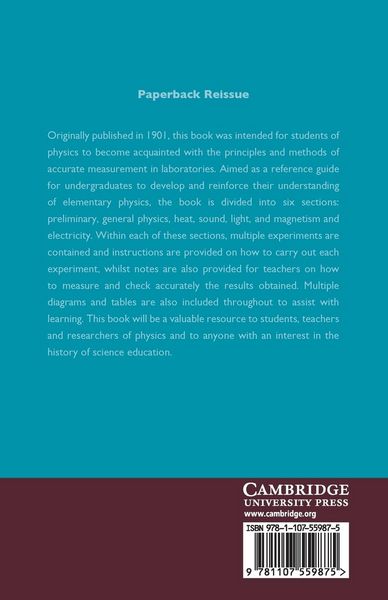
  • Preface; Preface to the fifth edition; Part I. Preliminary: 1. Treatment of observations; 2. Measurement of length; 3. Measurement of intervals of time; 4. Calibration of a spirit level; 5. Calibration of a graduated tube; Part II. General Physics: 6. The balance; 7. Accurate weighing with the balance; 8. Density of a solid; 9. Density of a liquid; 10. Moments of inertia; 11. Gravitational acceleration by reversible pendulum; 12. Young's modulus by the bending of beams; 13. Modulus of rigidity; 14. Viscosity; 15. Surface tension; Part III. Heat: 16. Coefficient of expansion of a solid; 17. Thermal expansion of a liquid; 18. Coefficient of increase of pressure of a gas with temperature; 19. Coefficient of expansion of a gas as constant pressure; 20. Effect of pressure on the boiling point of a liquid; 21. Laws of cooling; 22. Cooling correction in calorimetry; 23. Specific heat of quartz; 24. Latent heat of water; 25. Latent heat of steam; 26. Heat of solution of a salt; 27. The mechanical equivalent of heat; Part IV. Sound: 28. Frequency of a tuning fork by the syren; 29. The velocity of sound in air and other bodies by Kundt's method; 30. Study of vibrations of tuning forks by means of Lissajous' figures; Part V. Light: 31. Angles by the optical method; 32. The sextant; 33. Curvatures and powers of lenses; 34. Index of refraction by total reflection; 35. Resolving power of a lens; 36. The prism spectroscope; 37. Reduction of spectroscopic measurements to an absolute scale; 38. The spectrometer; 39. Refractive index and dispersion of a solid by the spectrometer; 40. Refractive index and dispersion of a liquid. Specific refractive powers; 41. Photometry; 42. Interference of light. The biprism; 43. Newton's rings; 44. Wave length of light by the diffraction grating; 45. Rotation of plane by polarisation; 46. Saccharimetry; Part VI. Magnetism and Electricity: 47. Horizontal components of magnetic fields; 48. Magnetic dip; 49. Magnetisation curves; 50. The water voltameter; 51. The copper voltameter; 52. Adjustment and standardisation of galvanometers; 53. The Post Office resistance bridge; 54. High resistances; 55. Low resistances; 56. The resistance of a galvanometer; 57. The resistance of a cell; 58. Comparison of resistance standards; 59. Change of resistance with temperature; 60. The resistance of electrolytes; 61. Construction of a standard cell; 62. Electromotive forces; 63. The potentiometer method of measuring currents; 64. Thermo-electric circuits; 65. The mechanical equivalent of heat by the electric method; 66. Induction of electric currents; 67. Standardisation of a ballistic galvanometer; 68. The self-inductance of a coil; 69. Comparison of self and mutual inductances; 70. Leakage and absorption in condensers; 71. Comparison of condensers; 72. The capacitance of a condenser; 73. High resistance by condenser; 74. The characteristic curves of a triode tube; 75. The quadrant electrometer; 76. Ionisation currents by electrometer; Appendix. Details of dimensions of apparatus; Index.