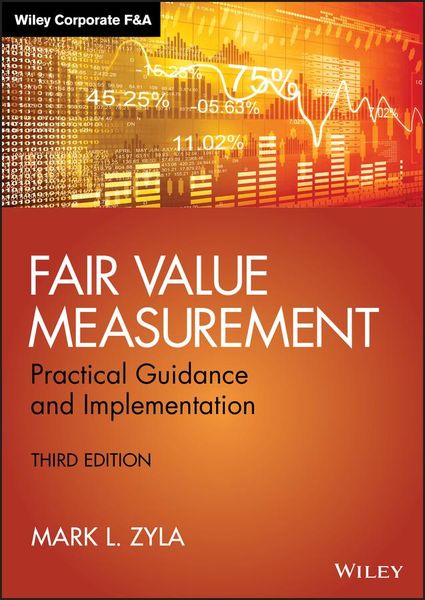
Fair Value Measurement Practical Guidance and Implementation
-
- Englisch ausgewählt
108,99 €
inkl. gesetzl. MwSt.,
Beschreibung
Produktdetails
Einband
Gebundene Ausgabe
Erscheinungsdatum
02.01.2020
Verlag
John Wiley & Sons IncSeitenzahl
512
Maße (L/B/H)
26,1/18,4/4,5 cm
Gewicht
1073 g
Auflage
3rd edition
Sprache
Englisch
ISBN
978-1-119-19123-0
Fair Value Measurement provides hands-on guidance and the latest best practices for measuring fair value in financial reporting. The Financial Accounting Standards Board (FASB), the U.S. Securities and Exchange Commission (SEC), and the American Institute of CPAs (AICPA) have all updated their guidelines for practitioners, and this book details the changes from a practical perspective. This new third edition includes a discussion on Private Company Council accounting alternatives for business combinations and impairment testing, with a detailed example of the Market Participant Acquisition Premium (MPAP), including European and Asian examples and expanded discussion of IFRS.
Fair value measurement guidelines continue to evolve, and this comprehensive reference provides a valuable, up-to-date resource for preparers, auditors, and valuation specialists.
* Adopt the best practices for implementing the FASB's Topic 820
* Learn the latest reporting requirements for fair value measurements
* Understand accounting alternatives for business combinations
* Examine the details of MPAP in Europe and Asia
Applying fair value measurements to financial statements requires a move away from rules-based standards and toward application of professional judgment. This controversial shift has led to a reliance on valuation specialists, who face their own challenges in applying Topic 820 amidst an economic downturn and recovery, leading to an ever evolving set of best practices. Practitioners must stay up to date, and be aware of the changes as they occur. Fair Value Measurement provides the most recent information and a practical approach to this area of financial reporting.
Noch keine Bewertungen vorhanden
Verfassen Sie die erste Bewertung zu diesem Artikel
Helfen Sie anderen Kundinnen und Kunden durch Ihre Meinung.
Kurze Frage zu unserer Seite
Vielen Dank für Ihr Feedback
Wir nutzen Ihr Feedback, um unsere Produktseiten zu verbessern. Bitte haben Sie Verständnis, dass wir Ihnen keine Rückmeldung geben können. Falls Sie Kontakt mit uns aufnehmen möchten, können Sie sich aber gerne an unseren Kund*innenservice wenden.
zum Kundenservice