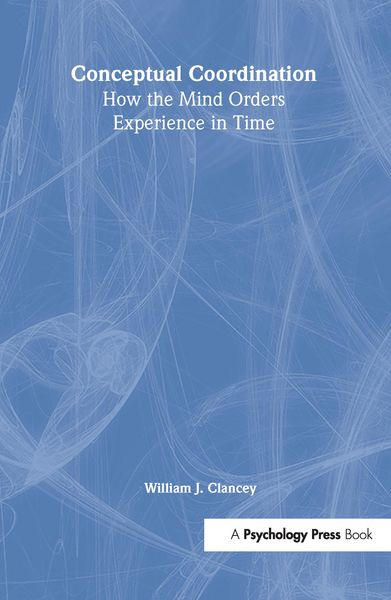
Conceptual Coordination How the Mind Orders Experience in Time
-
- Hardcover
- Taschenbuch
- eBook ausgewählt
-
Form:Einzelkauf Download
-
Sprache:Englisch
-
eBook Format:PDF
- PDF 86,40 € ausgewählt
- ePUB 86,40 €
86,40 €
inkl. gesetzl. MwSt.Beschreibung
Produktdetails
Format
Kopierschutz
Ja
Family Sharing
Nein
Text-to-Speech
Nein
Erscheinungsdatum
01.08.1999
Verlag
Taylor & Francis eBooksSeitenzahl
424 (Printausgabe)
Dateigröße
27011 KB
Sprache
Englisch
EAN
9781135672584
This book bridges the gap between models of human behavior that are based on cognitive task analysis and those based on neural networks. The author argues that these approaches are incomplete and not properly related to each other. His synthesis reconciles the very different conceptualizations of human memory assumed by these two approaches by assuming that 'what the brain remembers' is not a collection of symbols or neurons or even networks of either of these, but rather how to coordinate behavior in time, relating different modalities of conception and movement. A second premise is that behavior sequences are categorized, with perceptual categorizations (sounds, images) comprising the first order of categorization and conceptual categorizations of perceptions and actions in time comprising the second order. The conceptual categorizations are themselves sequenced and categorized, corresponding to the familiar classification hierarchies in cognitive models.
Inspired by Bartlett's work, the author seeks to develop a theory of "process memory"--memory for experience in time. Following the methodology of situated cognition, he finds clues in the particulars of human activity, such as typing errors, how a computer interface is used, how a child learns to play in a swimming pool, odd limitations in language comprehension, and so on. Throughout, he examines existing (and often famous) cognitive and neural models with respect to these phenomena. In each case, he attempts to show that the experienced behavior can be understood as sequences of categories being reactivated, substituted, and composed. Ultimately, this analysis is shown to be the link that may lead to improvement of both symbolic and neurally based models of memory and behavior, with concomitant implications for cognitive psychology, artificial intelligence, and cognitive science as a whole.
Noch keine Bewertungen vorhanden
Verfassen Sie die erste Bewertung zu diesem Artikel
Helfen Sie anderen Kundinnen und Kunden durch Ihre Meinung.
Kurze Frage zu unserer Seite
Vielen Dank für Ihr Feedback
Wir nutzen Ihr Feedback, um unsere Produktseiten zu verbessern. Bitte haben Sie Verständnis, dass wir Ihnen keine Rückmeldung geben können. Falls Sie Kontakt mit uns aufnehmen möchten, können Sie sich aber gerne an unseren Kund*innenservice wenden.
zum Kundenservice