Gutscheinbedingungen

**Gültig bis 06.07.2026 auf fremdsprachige Bücher online auf thalia.at, in der Thalia App ab einem Mindestbestellwert von 30€ und in allen Thalia Buchhandlungen in Österreich. In den Buchhandlungen nur gültig auf lagernde Ware. Einzelne Artikel können ausgeschlossen sein. Ausgenommen sind preisgebundene Artikel & eBooks. Pro Einkauf einmal einlösbar. Nur gültig gegen Vorlage oder im Onlineshop hinterlegter Bonuscard. Infos zur Einlösung in der Buchhandlung sind auf der Bonuscard-Vorteilspreisseite zu finden. Click & Collect nur bei Onlinevorabzahlung möglich. Keine Einlösung bei Scan & Go-Bezahlung. Keine Barauszahlung. Nicht kombinierbar mit anderen Aktionen und Gutscheinen. Gutschein wird auf max. 500€ Bestellwert angerechnet. Nicht gültig für Versandkosten und Services.

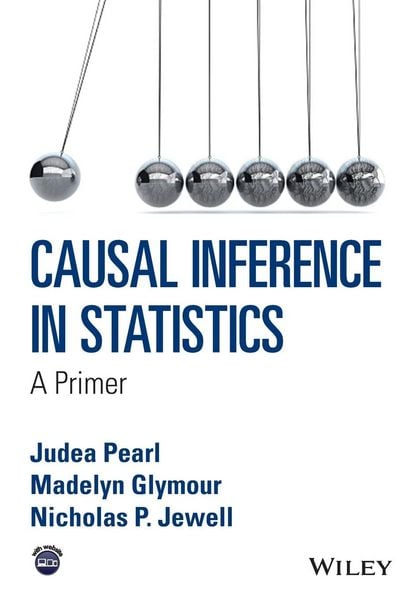
Produktbild: Causal Inference in Statistics

Causal Inference in Statistics A Primer

47,99 €

inkl. gesetzl. MwSt., Versandkostenfrei


Beschreibung

Produktdetails

Einband

Taschenbuch

Erscheinungsdatum

28.09.2017

Verlag

John Wiley & Sons Inc

Seitenzahl

156

Maße (L/B/H)

24,4/17,2/1,5 cm

Gewicht

227 g

Auflage

1. Auflage

Sprache

Englisch

ISBN

978-1-119-18684-7

Beschreibung

Produktdetails

Einband

Taschenbuch

Erscheinungsdatum

28.09.2017

Verlag

John Wiley & Sons Inc

Seitenzahl

156

Maße (L/B/H)

24,4/17,2/1,5 cm

Gewicht

227 g

Auflage

1. Auflage

Sprache

Englisch

ISBN

978-1-119-18684-7

Herstelleradresse

Libri GmbH
Europaallee 1
36244 Bad Hersfeld
DE

Email: gpsr@libri.de

Noch keine Bewertungen vorhanden

Verfassen Sie die erste Bewertung zu diesem Artikel

Helfen Sie anderen Kundinnen und Kunden durch Ihre Meinung.

Kundinnen und Kunden meinen

Bewertungen (0)

Die Leseprobe wird geladen.
  • Produktbild: Causal Inference in Statistics
  • About the Authors ix
     
    Preface xi
     
    List of Figures xv
     
    About the Companion Website xix
     
    1 Preliminaries: Statistical and Causal Models 1
     
    1.1 Why Study Causation 1
     
    1.2 Simpson's Paradox 1
     
    1.3 Probability and Statistics 7
     
    1.3.1 Variables 7
     
    1.3.2 Events 8
     
    1.3.3 Conditional Probability 8
     
    1.3.4 Independence 10
     
    1.3.5 Probability Distributions 11
     
    1.3.6 The Law of Total Probability 11
     
    1.3.7 Using Bayes' Rule 13
     
    1.3.8 Expected Values 16
     
    1.3.9 Variance and Covariance 17
     
    1.3.10 Regression 20
     
    1.3.11 Multiple Regression 22
     
    1.4 Graphs 24
     
    1.5 Structural Causal Models 26
     
    1.5.1 Modeling Causal Assumptions 26
     
    1.5.2 Product Decomposition 29
     
    2 Graphical Models and Their Applications 35
     
    2.1 Connecting Models to Data 35
     
    2.2 Chains and Forks 35
     
    2.3 Colliders 40
     
    2.4 d-separation 45
     
    2.5 Model Testing and Causal Search 48
     
    3 The Effects of Interventions 53
     
    3.1 Interventions 53
     
    3.2 The Adjustment Formula 55
     
    3.2.1 To Adjust or not to Adjust? 58
     
    3.2.2 Multiple Interventions and the Truncated Product Rule 60
     
    3.3 The Backdoor Criterion 61
     
    3.4 The Front-Door Criterion 66
     
    3.5 Conditional Interventions and Covariate-Specific Effects 70
     
    3.6 Inverse Probability Weighing 72
     
    3.7 Mediation 75
     
    3.8 Causal Inference in Linear Systems 78
     
    3.8.1 Structural versus Regression Coefficients 80
     
    3.8.2 The Causal Interpretation of Structural Coefficients 81
     
    3.8.3 Identifying Structural Coefficients and Causal Effect 83
     
    3.8.4 Mediation in Linear Systems 87
     
    4 Counterfactuals and Their Applications 89
     
    4.1 Counterfactuals 89
     
    4.2 Defining and Computing Counterfactuals 91
     
    4.2.1 The Structural Interpretation of Counterfactuals 91
     
    4.2.2 The Fundamental Law of Counterfactuals 93
     
    4.2.3 From Population Data to Individual Behavior - An Illustration 94
     
    4.2.4 The Three Steps in Computing Counterfactuals 96
     
    4.3 Nondeterministic Counterfactuals 98
     
    4.3.1 Probabilities of Counterfactuals 98
     
    4.3.2 The Graphical Representation of Counterfactuals 101
     
    4.3.3 Counterfactuals in Experimental Settings 103
     
    4.3.4 Counterfactuals in Linear Models 106
     
    4.4 Practical Uses of Counterfactuals 107
     
    4.4.1 Recruitment to a Program 107
     
    4.4.2 Additive Interventions 109
     
    4.4.3 Personal Decision Making 111
     
    4.4.4 Sex Discrimination in Hiring 113
     
    4.4.5 Mediation and Path-disabling Interventions 114
     
    4.5 Mathematical Tool Kits for Attribution and Mediation 116
     
    4.5.1 A Tool Kit for Attribution and Probabilities of Causation 116
     
    4.5.2 A Tool Kit for Mediation 120
     
    References 127
     
    Index 133