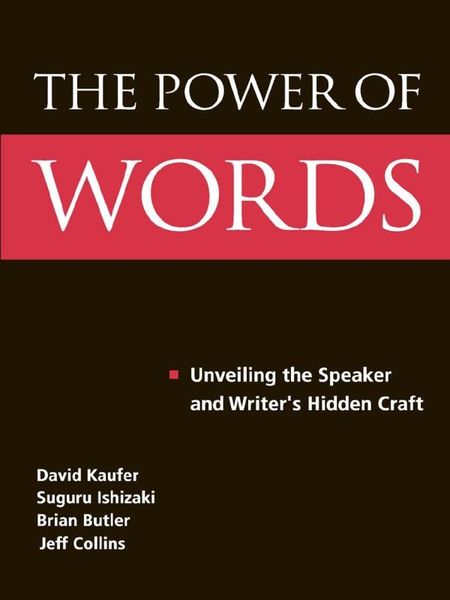
The Power of Words Unveiling the Speaker and Writer's Hidden Craft
-
- Hardcover
- Taschenbuch
- eBook ausgewählt
-
Form:Einzelkauf Download
-
Sprache:Englisch
-
eBook Format:PDF
- PDF 76,60 € ausgewählt
- ePUB 76,60 €
76,60 €
inkl. gesetzl. MwSt.Beschreibung
Produktdetails
Format
Kopierschutz
Ja
Family Sharing
Nein
Text-to-Speech
Nein
Erscheinungsdatum
04.02.2004
Verlag
Taylor & Francis eBooksSeitenzahl
272 (Printausgabe)
Dateigröße
1543 KB
Sprache
Englisch
EAN
9781135618124
In 1888, Mark Twain reflected on the writer's special feel for words to his correspondent, George Bainton, noting that "the difference between the almost-right word and the right word is really a large matter." We recognize differences between a politician who is "willful" and one who is "willing" even though the difference does not cross word-stems or parts of speech. We recognize that being "held up" evokes different experiences depending upon whether its direct object is a meeting, a bank, or an example. Although we can notice hundreds of examples in the language where small differences in wording produce large reader effects, the authors of The Power of Words argue that these examples are random glimpses of a hidden systematic knowledge that governs how we, as writers or speakers, learn to shape experience for other human beings.
Over the past several years, David Kaufer and his colleagues have developed a software program for analyzing writing called DocuScope. This book illustrates the concepts and rhetorical theory behind the software analysis, examining patterns in writing and showing writers how their writing works in different categories to accomplish varying objectives. Reflecting the range and variety of audience experience that contiguous words of surface English can prime, the authors present a theory of language as an instrument of rhetorically priming audiences and a catalog of English strings to implement the theory. The project creates a comprehensive map of the speaker and writer's implicit knowledge about predisposing audience experience at the point of utterance.
The book begins with an explanation of why studying language from the standpoint of priming--not just meaning--is vital to non-question begging theories of close reading and to language education in general. The remaining chapters in Part I detail the steps taken to prepare a catalog study of English strings for their properties as priming instruments. Part II describes in detail the catalog of priming categories, including enough examples to help readers see how individual words and strings of English fit into the catalog. The final part describes how the authors have applied the catalog of English strings as priming tools to conduct textual research.
Noch keine Bewertungen vorhanden
Verfassen Sie die erste Bewertung zu diesem Artikel
Helfen Sie anderen Kundinnen und Kunden durch Ihre Meinung.
Kurze Frage zu unserer Seite
Vielen Dank für Ihr Feedback
Wir nutzen Ihr Feedback, um unsere Produktseiten zu verbessern. Bitte haben Sie Verständnis, dass wir Ihnen keine Rückmeldung geben können. Falls Sie Kontakt mit uns aufnehmen möchten, können Sie sich aber gerne an unseren Kund*innenservice wenden.
zum Kundenservice