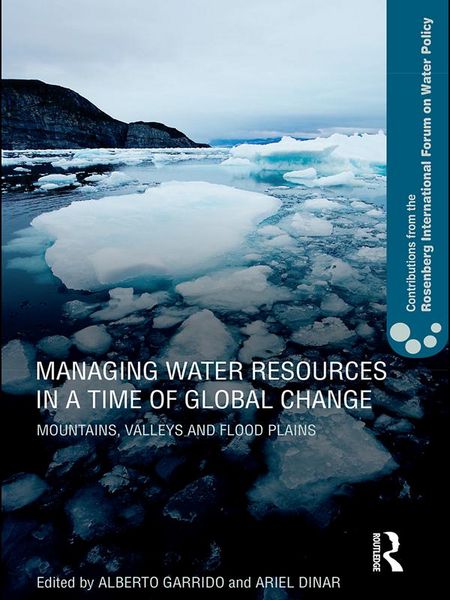
Managing Water Resources in a Time of Global Change Contributions from the Rosenberg International Forum on Water Policy
-
- Hardcover
- Taschenbuch
- eBook ausgewählt
-
Form:Einzelkauf Download
-
Sprache:Englisch
-
eBook Format:PDF
- PDF 69,40 € ausgewählt
- ePUB 69,40 €
69,40 €
inkl. gesetzl. MwSt.Beschreibung
Produktdetails
Format
Kopierschutz
Ja
Family Sharing
Nein
Text-to-Speech
Nein
Erscheinungsdatum
13.01.2009
Herausgeber
Alberto Garrido + weitereVerlag
Taylor & Francis eBooksSeitenzahl
288 (Printausgabe)
Dateigröße
9244 KB
Sprache
Englisch
EAN
9781135968892
Global change possesses serious challenges for water managers and scientists. In mountain areas, where water supplies for half of the world population originate, climate and hydrologic models are still subject to considerable uncertainty. And yet, critical decisions have to be taken to ensure adequate and safe water supplies to billions of people, millions of farmers and industries, without further deteriorating rivers and water bodies. While global warming is known to cause glaciers' retreat and reduced snow packs around the world, it is not clear that mountain discharge will be lower. What is widely recognised is that water management must be adapted to accommodate significant regime changes. However, this inevitably involves managing transboundary rivers, adding further complexity to putting principles in practice.
This book takes global warming and the importance of mountain areas in world water resources as the starting point. First, it provides detailed reviews of the processes going on in several rivers systems and world regions in Europe (Rhône and Ebro), North America (Canadian Rockies, Western US and Mexico), the Middle East (Jordan), Africa (Tunisia, Kenya and South Africa). These contexts provide case studies and examples that show the difficulties and potential for adaptation to global change. Land-use, economics, numerous modeling approaches are some of the cross-cutting issues covered in the chapters. The volume also includes the views of water practitioners, with two chapters authored by members of the US-Canada International Joint Commission, an industrialist from Western Canada and an environmental leader in Spain.
By combining a rich set of contexts and approaches, the volume succeeds in offering a view of the global challenges faced by water agencies, international donors and researchers around the world. A case is made in some chapters to seek adaptive strategies rather than trying to reduce or control resources variability. This requires factoring in land-use, social and economic aspects, especially in developing countries. Another conclusion is that complex problems can and must be posed and negotiated with the help of models, mapping techniques and science-based facts. However complex these may be, there are ways to translate them to easily interpretable and visualisations of alternative scenarios and courses of action. This book provides numerous examples of the potential of such approaches to draft environmental programmes solve transboundary disputes and reduce the economic consequences of droughts and climate instability.
Noch keine Bewertungen vorhanden
Verfassen Sie die erste Bewertung zu diesem Artikel
Helfen Sie anderen Kundinnen und Kunden durch Ihre Meinung.
Kurze Frage zu unserer Seite
Vielen Dank für Ihr Feedback
Wir nutzen Ihr Feedback, um unsere Produktseiten zu verbessern. Bitte haben Sie Verständnis, dass wir Ihnen keine Rückmeldung geben können. Falls Sie Kontakt mit uns aufnehmen möchten, können Sie sich aber gerne an unseren Kund*innenservice wenden.
zum Kundenservice