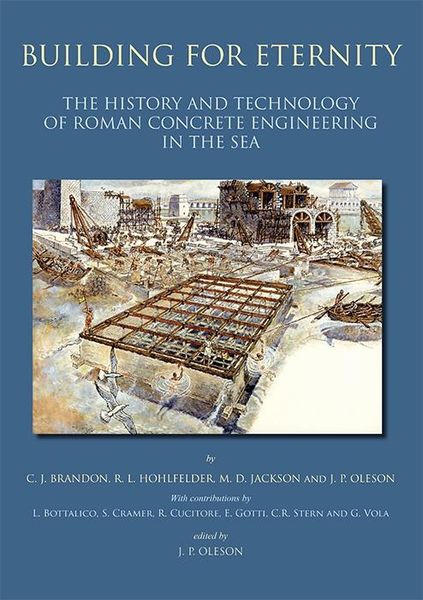
Building for Eternity the History and Technology of Roman Concrete Engineering in the Sea
-
- Taschenbuch
- eBook ausgewählt
-
Form:Einzelkauf Download
-
Sprache:Englisch
-
eBook Format:PDF
- PDF 42,70 € ausgewählt
- ePUB 42,70 €
42,70 €
inkl. gesetzl. MwSt.Beschreibung
Produktdetails
Format
Kopierschutz
Ja
Family Sharing
Ja
Text-to-Speech
Nein
Erscheinungsdatum
29.08.2014
Verlag
Oxbow BooksSeitenzahl
368 (Printausgabe)
Dateigröße
20656 KB
Sprache
Englisch
EAN
9781782974239
One marker of the majesty of ancient Rome is its surviving architectural legacy, the stunning remains of which are scattered throughout the circum-Mediterranean landscape. Surprisingly, one truly remarkable aspect of this heritage remains relatively unknown. There exists beneath the waters of the Mediterranean the physical remnants of a vast maritime infrastructure that sustained and connected the western world's first global empire and economy. The key to this incredible accomplishment and to the survival of structures in the hostile environment of the sea for two thousand years was maritime concrete, a building material invented and then employed by Roman builders on a grand scale to construct harbor installations anywhere they were needed, rather than only in locations with advantageous geography or topography.
This book explains how the Romans built so successfully in the sea with their new invention. The story is a stimulating mix of archaeological, geological, historical and chemical research, with relevance to both ancient and modern technology. It also breaks new ground in bridging the gap between science and the humanities by integrating analytical materials science, history, and archaeology, along with underwater exploration. The book will be of interest to anyone interested in Roman architecture and engineering, and it will hold special interest for geologists and mineralogists studying the material characteristics of pyroclastic volcanic rocks and their alteration in seawater brines. The demonstrable durability and longevity of Roman maritime concrete structures may be of special interest to engineers working on cementing materials appropriate for the long-term storage of hazardous substances such as radioactive waste.
A pioneering methodology was used to bore into maritime structures both on land and in the sea to collect concrete cores for testing in the research laboratories of the CTG Italcementi Group, a leading cement producer in Italy, the University of Berkeley, and elsewhere. The resulting mechanical, chemical and physical analysis of 36 concrete samples taken from 11 sites in Italy and the eastern Mediterranean have helped fill many gaps in our knowledge of how the Romans built in the sea. To gain even more knowledge of the ancient maritime technology, the directors of the Roman Maritime Concrete Study (ROMACONS) engaged in an ambitious and unique experimental archaeological project - the construction underwater of a reproduction of a Roman concrete pier or pila. The same raw materials and tools available to the ancient builders were employed to produce a reproduction concrete structure that appears to be remarkably similar to the ancient one studied during ROMACON's fieldwork between 2002-2009.
This volume reveals a remarkable and unique archaeological project that highlights the synergy that now exists between the humanities and science in our continuing efforts to understand the past. It will quickly become a standard research tool for all interested in Roman building both in the sea and on land, and in the history and chemistry of marine concrete. The authors also hope that the data and observations it presents will stimulate further research by scholars and students into related topics, since we have so much more to learn in the years ahead.
This book explains how the Romans built so successfully in the sea with their new invention. The story is a stimulating mix of archaeological, geological, historical and chemical research, with relevance to both ancient and modern technology. It also breaks new ground in bridging the gap between science and the humanities by integrating analytical materials science, history, and archaeology, along with underwater exploration. The book will be of interest to anyone interested in Roman architecture and engineering, and it will hold special interest for geologists and mineralogists studying the material characteristics of pyroclastic volcanic rocks and their alteration in seawater brines. The demonstrable durability and longevity of Roman maritime concrete structures may be of special interest to engineers working on cementing materials appropriate for the long-term storage of hazardous substances such as radioactive waste.
A pioneering methodology was used to bore into maritime structures both on land and in the sea to collect concrete cores for testing in the research laboratories of the CTG Italcementi Group, a leading cement producer in Italy, the University of Berkeley, and elsewhere. The resulting mechanical, chemical and physical analysis of 36 concrete samples taken from 11 sites in Italy and the eastern Mediterranean have helped fill many gaps in our knowledge of how the Romans built in the sea. To gain even more knowledge of the ancient maritime technology, the directors of the Roman Maritime Concrete Study (ROMACONS) engaged in an ambitious and unique experimental archaeological project - the construction underwater of a reproduction of a Roman concrete pier or pila. The same raw materials and tools available to the ancient builders were employed to produce a reproduction concrete structure that appears to be remarkably similar to the ancient one studied during ROMACON's fieldwork between 2002-2009.
This volume reveals a remarkable and unique archaeological project that highlights the synergy that now exists between the humanities and science in our continuing efforts to understand the past. It will quickly become a standard research tool for all interested in Roman building both in the sea and on land, and in the history and chemistry of marine concrete. The authors also hope that the data and observations it presents will stimulate further research by scholars and students into related topics, since we have so much more to learn in the years ahead.
Noch keine Bewertungen vorhanden
Verfassen Sie die erste Bewertung zu diesem Artikel
Helfen Sie anderen Kundinnen und Kunden durch Ihre Meinung.
Kurze Frage zu unserer Seite
Vielen Dank für Ihr Feedback
Wir nutzen Ihr Feedback, um unsere Produktseiten zu verbessern. Bitte haben Sie Verständnis, dass wir Ihnen keine Rückmeldung geben können. Falls Sie Kontakt mit uns aufnehmen möchten, können Sie sich aber gerne an unseren Kund*innenservice wenden.
zum Kundenservice