Beschreibung
This story of a child prodigy and his unique upbringing is "
an engrossing journey to the outer realms of science and parenting" (Paul Greenberg, author of
Four Fish).
A PEN/E. O. Wilson Literary Science Writing Award Finalist
Like many young children, Taylor Wilson dreamed of becoming an astronaut. Only Wilson mastered the science of rocket propulsion by the age of nine. When he was eleven, he tried to cure his grandmother's cancer-and discovered new ways to produce medical isotopes. Then, at fourteen, Wilson became the youngest person in history to achieve nuclear fusion, building a 500-million-degree reactor-in his parents' garage.
In
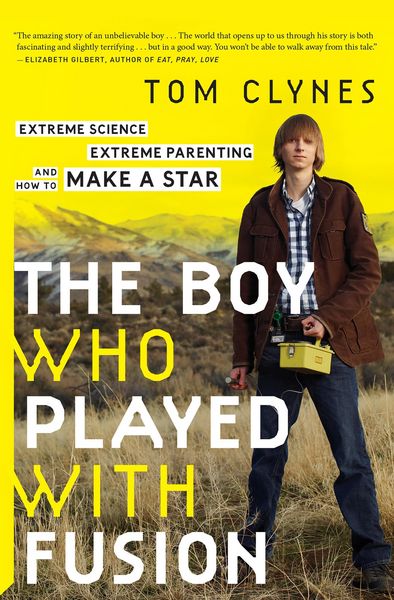
The Boy Who Played with Fusion,science journalist Tom Clynes narrates Wilson's extraordinary story. Born in Texarkana, Arkansas, Wilson quickly displayed an advanced intellect. Recognizing their son's abilities and the limitations of their local schools, his parents took a bold leap and moved the family to Reno, Nevada. There, Wilson could attend a unique public high school created specifically for academic superstars. Wilson is now designing devices to prevent terrorists from shipping radioactive material and inspiring a new generation to take on the challenges of science.
If you're wondering how someone so young can achieve so much,
The Boy Who Played with Fusion has the answer. Along the way, Clynes' narrative teaches parents, teachers, and society how and why we urgently need to support high-achieving kids.
"An essential contribution to our understanding of the most important underlying questions about the development of giftedness, talent, creativity, and intelligence." -
Psychology Today
"A compelling study of the thrills-and burdens-of being born with an alpha intellect." -
Financial Times
Rezension
"Here is
the amazing story of an unbelievable boy — somebody who seems more like a figure out of fiction (science fiction, to be specific) than reality. But the story is true, the boy is true, and the science is true. And the world that opens up to us through his story is both
fascinating and slightly terrifying...but in a good way. You won't be able to walk away from this tale." —Elizabeth Gilbert, author of Eat, Pray, Love and The Signature of All Things "Imagine if cartoon whiz-kid Jimmy Neutron were real and had a brainchild with MacGyver and his adolescence got told as
a rollicking bildungsroman about American prodigies and DIY nuclear reactors—well, that’s this book." —Jack Hitt, author of Bunch of Amateurs. "Clynes guides us on
an engrossing journey to the outer realms of science and parenting, "The Boy Who Played with Fusion" is
a fascinating exploration of "giftedness" and all its consequences. —Paul Greenberg, author of Four Fish and American Catch Popular Science contributing editor Clynes (Music Festivals From Bach to Blues: A Travellers Guide, 1996, etc.) uses the story of Taylor Wilson—who, at age 14, became "one of only thirty-two individuals on the planet to build a working fusion reactor, a miniature sun on Earth"—to illustrate the potential for improving our educational system. "What does it take to identify and develop the raw material of talent and turn it into exceptional accomplishment? How do we parent and educate extraordinarily determined and intelligent children and help them reach their potential?" These are the questions the author seeks to answer in this
enlightening book. Clynes first learned about Taylor in 2010 when he was interviewing members of a small community of "nuclear physics enthusiasts." At the time, Taylor was attending the Davidson Academy, an experimental secondary school in Reno that offered students the opportunity to attend classes at the University of Nevada-Reno. Taylor enrolled in physics seminars and had successfully completed a project to build a tabletop fusion reactor that allowed him to study the properties of different materials. The family had moved to Reno so that Taylor could take advantage of the Davidson opportunity. His father was a successful entrepreneur who had fostered Taylor's developing interest in science, beginning at age 6, with his fascination with rocket propulsion. Although he had no technical training himself, Wilson enlisted the help of more knowledgeable friends from the community to help his son safely pursue experiments with rockets. Clynes chronicles Taylor's development since their first meeting, during which time he invented a prototype for a "hundred-thousand-dollar tabletop nuclear fusion device that could produce medical isotopes as precisely as the multimillion-dollar cyclotron or linear accelerator facilities could," as well as a highly sensitive, low-dose device for identifying nuclear terrorists.
Clynes makes a persuasive case for allowing gifted children the freedom and resources to pursue their interests. —-KIRKUS Reviews