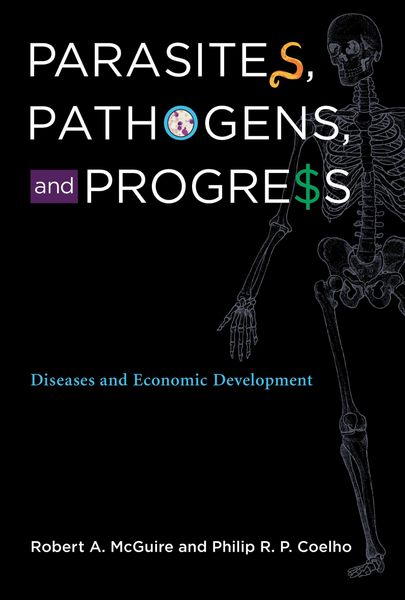
Parasites, Pathogens, and Progress Diseases and Economic Development
-
- Einzelkauf Download ausgewählt
-
Sprache:Englisch
32,40 €
inkl. gesetzl. MwSt.Beschreibung
Produktdetails
Format
ePUB
Kopierschutz
Ja
Family Sharing
Ja
Text-to-Speech
Ja
Erscheinungsdatum
30.09.2011
Verlag
Mit PressSeitenzahl
352 (Printausgabe)
Dateigröße
5784 KB
Sprache
Englisch
EAN
9780262297493
In Parasites, Pathogens, and Progress, Robert McGuire and Philip Coelho integrate biological and economic perspectives into an explanation of the historical development of humanity and the economy, paying particular attention to the American experience, its history and development. In their path-breaking examination of the impact of population growth and parasitic diseases, they contend that interpretations of history that minimize or ignore the physical environment are incomplete or wrong.
The authors emphasize the paradoxical impact of population growth and density on progress. An increased population leads to increased market size, specialization, productivity, and living standards. Simultaneously, increased population density can provide an ecological niche for pathogens and parasites that prey upon humanity, increasing morbidity and mortality. The tension between diseases and progress continues, with progress dominant since the late 1800s. Integral to their story are the differential effects of diseases on different ethnic (racial) groups. McGuire and Coelho show that the Europeanization of the Americas, for example, was caused by Old World diseases unwittingly brought to the New World, not by superior technology and weaponry. The decimation of Native Americans by pathogens vastly exceeded that caused by war and human predation.
The authors combine biological and economic analyses to explain the concentration of African slaves in the American South. African labor was more profitable in the South because Africans' evolutionary heritage enabled them to resist the diseases that became established there; conversely, Africans' ancestral heritage made them susceptible to northern cold-weather diseases. European disease resistance and susceptibilities were the opposite regionally. Differential regional disease ecologies thus led to a heritage of racial slavery and racism.
Noch keine Bewertungen vorhanden
Verfassen Sie die erste Bewertung zu diesem Artikel
Helfen Sie anderen Kundinnen und Kunden durch Ihre Meinung.
Kurze Frage zu unserer Seite
Vielen Dank für Ihr Feedback
Wir nutzen Ihr Feedback, um unsere Produktseiten zu verbessern. Bitte haben Sie Verständnis, dass wir Ihnen keine Rückmeldung geben können. Falls Sie Kontakt mit uns aufnehmen möchten, können Sie sich aber gerne an unseren Kund*innenservice wenden.
zum Kundenservice