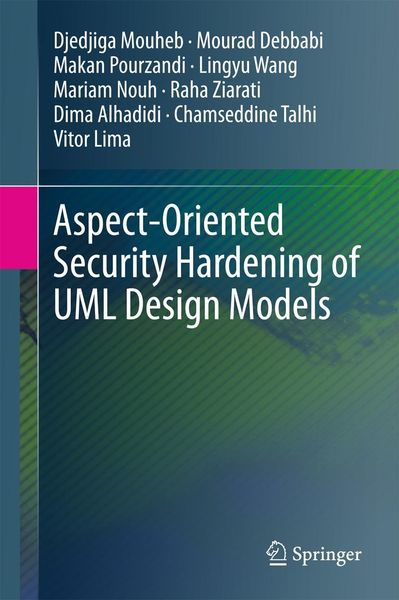
Aspect-Oriented Security Hardening of UML Design Models
-
- Hardcover
- Taschenbuch
- eBook ausgewählt
-
Form:Einzelkauf Download
-
Sprache:Englisch
54,99 €
inkl. gesetzl. MwSt.Beschreibung
Produktdetails
Format
Kopierschutz
Nein
Family Sharing
Nein
Text-to-Speech
Nein
Erscheinungsdatum
22.04.2015
Verlag
SpringerSeitenzahl
237 (Printausgabe)
Dateigröße
9406 KB
Sprache
Englisch
EAN
9783319161068
This book comprehensively presents a novel approach to the systematic security hardening of software design models expressed in the standard UML language. It combines model-driven engineering and the aspect-oriented paradigm to integrate security practices into the early phases of the software development process. To this end, a UML profile has been developed for the specification of security hardening aspects on UML diagrams. In addition, a weaving framework, with the underlying theoretical foundations, has been designed for the systematic injection of security aspects into UML models.
The work is organized as follows: chapter 1 presents an introduction to software security, model-driven engineering, UML and aspect-oriented technologies. Chapters 2 and 3 provide an overview of UML language and the main concepts of aspect-oriented modeling (AOM) respectively. Chapter 4 explores the area of model-driven architecture with a focus on model transformations. The main approaches that are adopted in the literature for security specification and hardening are presented in chapter 5. After these more general presentations, chapter 6 introduces the AOM profile for security aspects specification. Afterwards, chapter 7 details the design and the implementation of the security weaving framework, including several real-life case studies to illustrate its applicability. Chapter 8 elaborates an operational semantics for the matching/weaving processes in activity diagrams, while chapters 9 and 10 present a denotational semantics for aspect matching and weaving in executable models following a continuation-passing style. Finally, a summary and evaluation of the work presented are provided in chapter 11.
The book will benefit researchers in academia and industry as well as students interested in learning about recent research advances in the field of software security engineering.Noch keine Bewertungen vorhanden
Verfassen Sie die erste Bewertung zu diesem Artikel
Helfen Sie anderen Kundinnen und Kunden durch Ihre Meinung.
Kurze Frage zu unserer Seite
Vielen Dank für Ihr Feedback
Wir nutzen Ihr Feedback, um unsere Produktseiten zu verbessern. Bitte haben Sie Verständnis, dass wir Ihnen keine Rückmeldung geben können. Falls Sie Kontakt mit uns aufnehmen möchten, können Sie sich aber gerne an unseren Kund*innenservice wenden.
zum Kundenservice