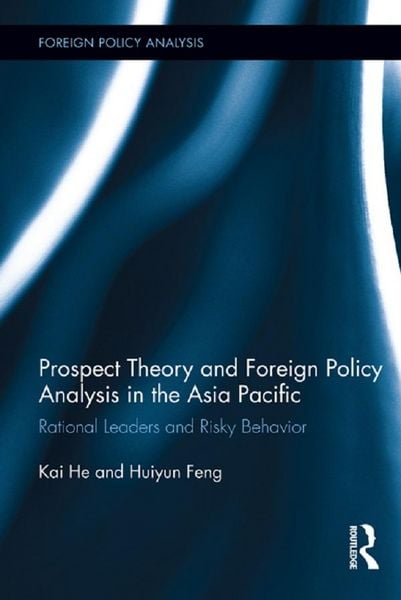
Prospect Theory and Foreign Policy Analysis in the Asia Pacific Rational Leaders and Risky Behavior
-
- Hardcover
- Taschenbuch
- eBook ausgewählt
-
Form:Einzelkauf Download
-
Sprache:Englisch
-
eBook Format:PDF
- PDF 69,90 € ausgewählt
- ePUB 70,50 €
69,90 €
inkl. gesetzl. MwSt.Beschreibung
Produktdetails
Format
Kopierschutz
Ja
Family Sharing
Nein
Text-to-Speech
Nein
Erscheinungsdatum
17.01.2013
Verlag
Taylor & Francis eBooksSeitenzahl
172 (Printausgabe)
Dateigröße
1745 KB
Sprache
Englisch
EAN
9781135131203
Why does North Korea behave erratically in pursuing its nuclear weapons program? Why did the United States prefer bilateral alliances to multilateral ones in Asia after World War II? Why did China become "nice"-no more military coercion-in dealing with the pro-independence Taiwan President Chen Shuibian after 2000? Why did China compromise in the negotiation of the Chunxiao gas exploration in 2008 while Japan became provocative later in the Sino-Japanese disputes in the East China Sea? North Korea's nuclear behavior, U.S. alliance strategy, China's Taiwan policy, and Sino-Japanese territorial disputes are all important examples of seemingly irrational foreign policy decisions that have determined regional stability and Asian security.
By examining major events in Asian security, this book investigates why and how leaders make risky and seemingly irrational decisions in international politics. The authors take the innovative step of integrating the neoclassical realist framework in political science and prospect theory in psychology. Their analysis suggests that political leaders are more likely to take risky actions when their vital interests and political legitimacy are seriously threatened. For each case, the authors first discuss the weaknesses of some of the prevailing arguments, mainly from rationalist and constructivist theorizing, and then offer an alternative explanation based on their political legitimacy-prospect theory model.
This pioneering book tests and expands prospect theory to the study of Asian security and challenges traditional, expected-utility-based, rationalist theories of foreign policy behavior.
Noch keine Bewertungen vorhanden
Verfassen Sie die erste Bewertung zu diesem Artikel
Helfen Sie anderen Kundinnen und Kunden durch Ihre Meinung.
Kurze Frage zu unserer Seite
Vielen Dank für Ihr Feedback
Wir nutzen Ihr Feedback, um unsere Produktseiten zu verbessern. Bitte haben Sie Verständnis, dass wir Ihnen keine Rückmeldung geben können. Falls Sie Kontakt mit uns aufnehmen möchten, können Sie sich aber gerne an unseren Kund*innenservice wenden.
zum Kundenservice