• Produktbild: Hearing Eye II
  • Produktbild: Hearing Eye II

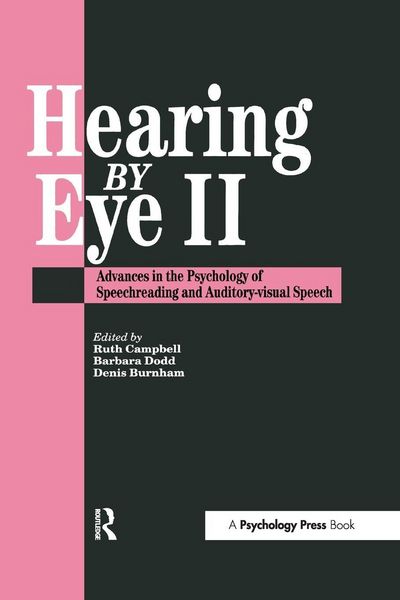
Hearing Eye II The Psychology Of Speechreading And Auditory-Visual Speech

58,99 €

inkl. gesetzl. MwSt., Versandkostenfrei


Beschreibung

Produktdetails

Einband

Taschenbuch

Erscheinungsdatum

05.03.2019

Herausgeber

Douglas Burnham + weitere

Verlag

Taylor & Francis

Seitenzahl

336

Maße (L/B/H)

23,4/15,6/1,8 cm

Gewicht

453 g

Sprache

Englisch

ISBN

978-1-138-87714-6

Beschreibung

Produktdetails

Einband

Taschenbuch

Erscheinungsdatum

05.03.2019

Herausgeber

Verlag

Taylor & Francis

Seitenzahl

336

Maße (L/B/H)

23,4/15,6/1,8 cm

Gewicht

453 g

Sprache

Englisch

ISBN

978-1-138-87714-6

Noch keine Bewertungen vorhanden

Verfassen Sie die erste Bewertung zu diesem Artikel

Helfen Sie anderen Kundinnen und Kunden durch Ihre Meinung.

Kundinnen und Kunden meinen

Bewertungen (0)

Die Leseprobe wird geladen.
  • Produktbild: Hearing Eye II
  • Produktbild: Hearing Eye II
  • Part 1 Audiovisual speech processing - implications for theories of speech perception: the use of auditory and visual information during phonetic processing - implications for theories of speech perception, K.P. Green; language specificity in the development of auditory-visual speech perception, D. Burnham; time varying information for visual speech perception, L.D. Rosenblum, H.M. Saldana. Part 2 Engineering models of visible and audiovisual speech: ten years after Summerfield - a taxonomy of models for audiovisual fusion in speech perception, J.-L. Schwartz et al; computational aspects of visual speech - machines that can speechread and simualte talking faces, M. Brooke; the moving face during speech Communication, K.G. Munhall, E. Vatikiotis-Bateson. Part 3 Psychological and neuropsychological factors in speechreading: conceptual constraints in sentence-based lipreading in the hearing-impaired, J. Roennberg et al; effects of facial image size on visual and audiovisual speech recognition, T.R. Jordan, P.C. Sergeant; how brains see speech - the cortical localization of speechreading in hearing people, R. Campbell; impaired speechreading and auditory-visual speech integration in prosopagnosia, B. de Gelder et al. Part 4 Deafness, language and speechreading - speech-based approaches: what makes a good speechreader? - first you have to find one, L. Bernstein et al; early lipreading ability and speech and language development of hearing-impaired pre-schoolers, B. Dodd et al. Part 5 Deafness, language and speechreading - sign and augmentation: mouth movement and signed communication, M. Marschark et al; touch and auditory-visual speech perception, M. Oerlemans, P. Blamey; effect of exposure to phonetically augmented lipspeech in the prelingual deaf, J. Leybaert et al.