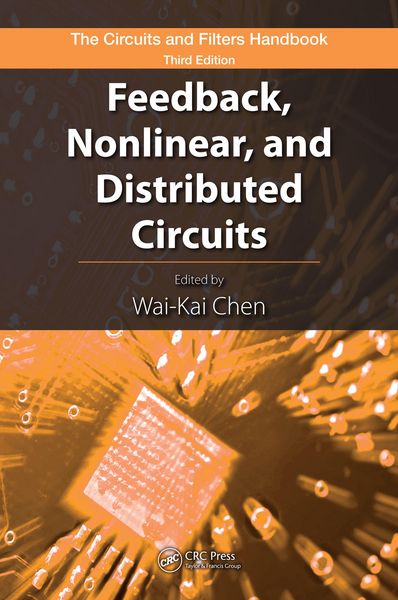
Feedback, Nonlinear, and Distributed Circuits
-
- Hardcover
- Taschenbuch
- eBook ausgewählt
-
Form:Einzelkauf Download
-
Sprache:Englisch
-
eBook Format:PDF
- ePUB 3 117,20 €
- PDF 117,20 € ausgewählt
117,20 €
inkl. gesetzl. MwSt.Beschreibung
Produktdetails
Format
Kopierschutz
Ja
Family Sharing
Nein
Text-to-Speech
Nein
Erscheinungsdatum
08.10.2018
Herausgeber
Wai-Kai ChenVerlag
Taylor & Francis eBooksSeitenzahl
466 (Printausgabe)
Dateigröße
9532 KB
Sprache
Englisch
EAN
9781420058826
Upon its initial publication, the Handbook of Circuits and Filters broke new ground. It quickly became the resource for comprehensive coverage of issues and practical information that can be put to immediate use. Not content to rest on his laurels, editor Wai-kai Chen divided the second edition into volumes, making the information easily accessible and digestible. In the third edition, these volumes have been revised, updated, and expanded so that they continue to provide solid coverage of standard practices and enlightened perspectives on new and emerging techniques.
Feedback, Nonlinear, and Distributed Circuits draws together international contributors who discuss feedback amplifier theory and then move on to explore feedback amplifier configurations. They develop Bode's feedback theory as an example of general feedback theory. The coverage then moves on to the importance of complementing numerical analysis with qualitative analysis to get a global picture of a circuit's performance. After reviewing a wide range of approximation techniques and circuit design styles for discreet and monolithic circuits, the book presents a comprehensive description of the use of piecewise-linear methods in modeling, analysis, and structural properties of nonlinear circuits highlighting the advantages. It describes the circuit modeling in the frequency domain of uniform MTL based on the Telegrapher's equations and covers frequency and time domain experimental characterization techniques for uniform and nonuniform multiconductor structures.
This volume will undoubtedly take its place as the engineer's first choice in looking for solutions to problems encountered in the analysis and behavior predictions of circuits and filters.
Noch keine Bewertungen vorhanden
Verfassen Sie die erste Bewertung zu diesem Artikel
Helfen Sie anderen Kundinnen und Kunden durch Ihre Meinung.
Kurze Frage zu unserer Seite
Vielen Dank für Ihr Feedback
Wir nutzen Ihr Feedback, um unsere Produktseiten zu verbessern. Bitte haben Sie Verständnis, dass wir Ihnen keine Rückmeldung geben können. Falls Sie Kontakt mit uns aufnehmen möchten, können Sie sich aber gerne an unseren Kund*innenservice wenden.
zum Kundenservice