Gutscheinbedingungen

**Gültig bis 04.08.2026 ab einem Mindestbestellwert von 30€ auf Spielzeug, Schreibwaren, Filme, Geschenke & Trends, Musik, tolino eReader & Zubehör, Hörbücher und Hörbuch-Downloads (außer Abo), nicht preisgebundene Bücher und Kalender online auf thalia.at und in der Thalia App. Einzelne Artikel können ausgeschlossen sein. Aufgrund der Buchpreisbindung sind deutschsprachige Bücher und eBooks ausgenommen. Zusätzlich ausgenommen sind preisgebundene Artikel, Abos & Flatrates, eBooks, Games, Geschenkkarten/-boxen, Shelfies, Software, Zeitschriften sowie einzelne Artikel von tonies®. Pro Einkauf einmal einlösbar. Click & Collect nur bei Onlinevorabzahlung möglich. Keine Barauszahlung. Nicht kombinierbar mit anderen Aktionen und Gutscheinen. Gutschein wird auf max. 500€ Bestellwert angerechnet. Nicht gültig für Versandkosten und Services. Preisgebundene Artikel sind vom Mindestbestellwert ausgeschlossen.

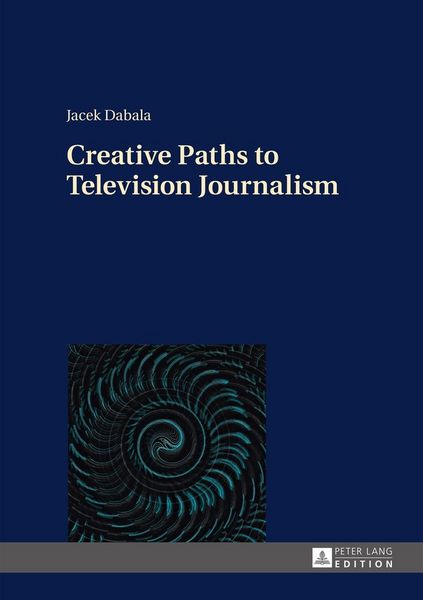
  • Produktbild: Creative Paths to Television Journalism
  • Produktbild: Creative Paths to Television Journalism

Creative Paths to Television Journalism

55,45 €

inkl. gesetzl. MwSt., Versandkostenfrei


Beschreibung

Produktdetails

Einband

Gebundene Ausgabe

Erscheinungsdatum

26.05.2015

Verlag

Peter Lang GmbH, Internationaler Verlag der Wissenschaften

Seitenzahl

184

Maße (L/B/H)

21,6/15,3/1,5 cm

Gewicht

360 g

Auflage

1. Auflage

Sprache

Englisch

ISBN

978-3-631-66145-1

Beschreibung

Rezension

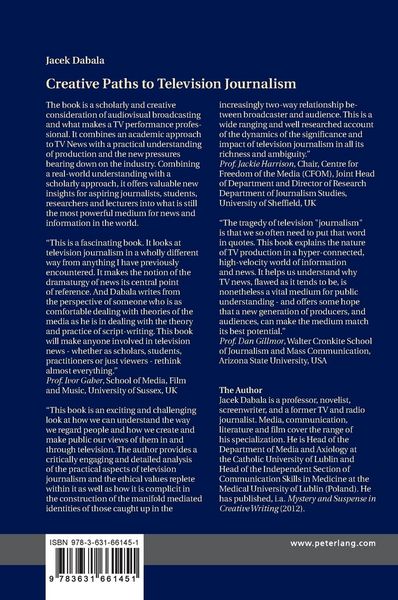
«This is a fascinating book. It looks at television journalism in a wholly different way from anything I have previously encountered. It makes the notion of the dramaturgy of news its central point of reference. And Dabala writes from the perspective of someone who is as comfortable dealing with theories of the media as he is in dealing with the theory and practice of script-writing. This book will make anyone involved in television news - whether as scholars, students, practitioners or just viewers - rethink almost everything.» (Prof. Ivor Gaber, School of Media, Film and Music, University of Sussex, UK)

«The tragedy of television 'journalism' is that we so often need to put that word in quotes. This book explains the nature of TV production in a hyper-connected, high-velocity world of information and news. It helps us understand why TV news, flawed as it tends to be, is nonetheless a vital medium for public understanding - and offers some hope that a new generation of producers, and audiences, can make the medium match its best potential.»
(Prof. Dan Gillmor, Walter Cronkite School of Journalism and Mass Communication, Arizona State University, USA)

«This new book combines a scholastic approach to TV News with a practical understanding of production and the new pressures bearing down on the industry. As such it combines a real-world understanding with an objective, academic perspective and offers valuable new insights into what is still the most powerful medium for news and information in the world.»
(Prof. Richard Sambrook, Director, Centre for Journalism, Cardiff University, UK)

«This book takes a new and much more comprehensive approach to Television and its production and role in society. It looks at the production of television both as an art form in which how the presentations are done plays a major role in how their messages are understood and as a technical production process. This new, dual approach is critical for our understanding of the roles television and those who appear in it and produce it as well as for its attraction and its impact both in post-Soviet societies and in traditional Western societies».
(Prof. Jane. L. Curry, Department of Political Science, Santa Clara University, USA)

«In an age when the TV business is a global exchange of images and cultural connections, Jacek Dabala has examined the phenomenon with an internationalist's eye. He connects American observers with intellectuals from Europe to examine the dynamics, the ethics and the demands of journalism in the 21st Century. This is the kind of book that demands thinking on the part of young visual journalists and one that can stimulate an interesting debate involving theory and practice.» (Prof. Susan King, Dean, John Thomas Kerr Distinguished Professor School of Journalism and Mass Communication, UNC Chapel Hill, USA)

Zitat

«This is a fascinating book. It looks at television journalism in a wholly different way from anything I have previously encountered. It makes the notion of the dramaturgy of news its central point of reference. And Dabala writes from the perspective of someone who is as comfortable dealing with theories of the media as he is in dealing with the theory and practice of script-writing. This book will make anyone involved in television news - whether as scholars, students, practitioners or just viewers - rethink almost everything.» (Prof. Ivor Gaber, School of Media, Film and Music, University of Sussex, UK)

«The tragedy of television 'journalism' is that we so often need to put that word in quotes. This book explains the nature of TV production in a hyper-connected, high-velocity world of information and news. It helps us understand why TV news, flawed as it tends to be, is nonetheless a vital medium for public understanding - and offers some hope that a new generation of producers, and audiences, can make the medium match its best potential.»
(Prof. Dan Gillmor, Walter Cronkite School of Journalism and Mass Communication, Arizona State University, USA)

«This new book combines a scholastic approach to TV News with a practical understanding of production and the new pressures bearing down on the industry. As such it combines a real-world understanding with an objective, academic perspective and offers valuable new insights into what is still the most powerful medium for news and information in the world.»
(Prof. Richard Sambrook, Director, Centre for Journalism, Cardiff University, UK)

«This book takes a new and much more comprehensive approach to Television and its production and role in society. It looks at the production of television both as an art form in which how the presentations are done plays a major role in how their messages are understood and as a technical production process. This new, dual approach is critical for our understanding of the roles television and those who appear in it and produce it as well as for its attraction and its impact both in post-Soviet societies and in traditional Western societies».
(Prof. Jane. L. Curry, Department of Political Science, Santa Clara University, USA)

«In an age when the TV business is a global exchange of images and cultural connections, Jacek Dabala has examined the phenomenon with an internationalist’s eye. He connects American observers with intellectuals from Europe to examine the dynamics, the ethics and the demands of journalism in the 21st Century. This is the kind of book that demands thinking on the part of young visual journalists and one that can stimulate an interesting debate involving theory and practice.» (Prof. Susan King, Dean, John Thomas Kerr Distinguished Professor School of Journalism and Mass Communication, UNC Chapel Hill, USA)

Produktdetails

Einband

Gebundene Ausgabe

Erscheinungsdatum

26.05.2015

Verlag

Peter Lang GmbH, Internationaler Verlag der Wissenschaften

Seitenzahl

184

Maße (L/B/H)

21,6/15,3/1,5 cm

Gewicht

360 g

Auflage

1. Auflage

Sprache

Englisch

ISBN

978-3-631-66145-1

EU-Ansprechpartner

Zeitfracht Medien GmbH
Ferdinand-Jühlke-Straße 7
99095 Erfurt
DE
produktsicherheit@zeitfracht.de

Herstelleradresse

Peter Lang
Avenue du Théâtre 7
1005 Lausanne
CH
orders@peterlang.com

Noch keine Bewertungen vorhanden

Verfassen Sie die erste Bewertung zu diesem Artikel

Helfen Sie anderen Kundinnen und Kunden durch Ihre Meinung.

Kundinnen und Kunden meinen

Bewertungen (0)

Weitere Artikel finden Sie in

  • Produktbild: Creative Paths to Television Journalism
  • Produktbild: Creative Paths to Television Journalism
  • Contents: The priority of dramaturgy – The essence of media thinking – Plot and suspense in the news – The quasi-dramaturgy localness – Between sound and picture – The changing style of presenting information – Initiative and creativity in television journalism – Affirmation of the art of presentation – The value of TV presenters – Telegenity – Pitfalls – Self-presentation – The Future.