Gutscheinbedingungen

**Gültig bis 06.07.2026 auf fremdsprachige Bücher online auf thalia.at, in der Thalia App ab einem Mindestbestellwert von 30€ und in allen Thalia Buchhandlungen in Österreich. In den Buchhandlungen nur gültig auf lagernde Ware. Einzelne Artikel können ausgeschlossen sein. Ausgenommen sind preisgebundene Artikel & eBooks. Pro Einkauf einmal einlösbar. Nur gültig gegen Vorlage oder im Onlineshop hinterlegter Bonuscard. Infos zur Einlösung in der Buchhandlung sind auf der Bonuscard-Vorteilspreisseite zu finden. Click & Collect nur bei Onlinevorabzahlung möglich. Keine Einlösung bei Scan & Go-Bezahlung. Keine Barauszahlung. Nicht kombinierbar mit anderen Aktionen und Gutscheinen. Gutschein wird auf max. 500€ Bestellwert angerechnet. Nicht gültig für Versandkosten und Services.

  • Produktbild: Handbook of Qualitative Health Research for Evidence-Based Practice
  • Produktbild: Handbook of Qualitative Health Research for Evidence-Based Practice
Band 4 - 13%

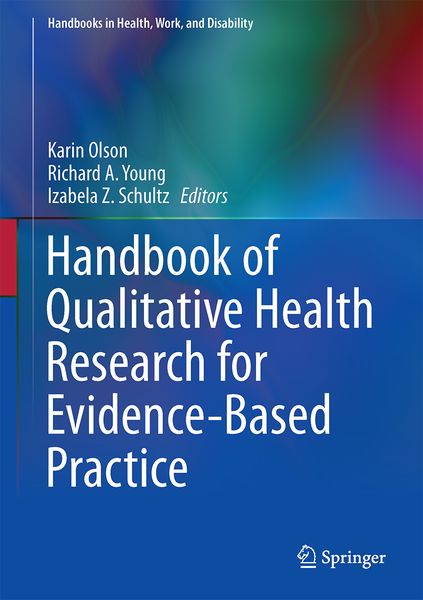
Handbook of Qualitative Health Research for Evidence-Based Practice

13% sparen

285,99 € UVP 329,99 €

inkl. gesetzl. MwSt., Versandkostenfrei


Beschreibung

Produktdetails

Einband

Gebundene Ausgabe

Erscheinungsdatum

13.10.2015

Abbildungen

XX, 15 illus., 7 illus. in color., schwarz-weiss Illustrationen, farbige Illustrationen

Herausgeber

Karin Olson + weitere

Verlag

Springer Us

Seitenzahl

567

Maße (L/B/H)

26/18,3/3,8 cm

Gewicht

1285 g

Auflage

1st ed. 2016

Sprache

Englisch

ISBN

978-1-4939-2919-1

Beschreibung

Portrait

Karin Olson completed a B. Sc. in Nursing at the University of Alberta (1976), a Masters in Health Science with a focus in Health Promotion at the University of Toronto (1981), and a PhD in Educational Psychology at the University of Alberta (1990). She is a Professor in the Faculty of Nursing at the University of Alberta where she is also a Distinguished Scholar at the International Institute for Qualitative Methodology. Dr. Olson also holds an adjunct appointment to the Division of Palliative Medicine, Faculty of Medicine and Dentistry, University of Alberta. Her research focuses on use of qualitative and quantitative methods to develop an etiological model of fatigue in advanced cancer.

Richard Young is Professor of Counselling Psychology at the University of British Columbia. He is a Fellow of both the Canadian Psychological Association and the American Psychological Association and a Registered Psychologist in British Columbia, Canada. His current research interests include the application of action theory and the qualitative action-project method to a variety of research topics, including the transition to adulthood, families, career development, counselling, health, and suicide. He is the author of over 75 articles published in scholarly journals, and a number of other publications, including five co-edited or co-authored books. His most recent co-authored book is Transition to adulthood: Actions, projects, and counseling (Springer-Science, 2011). He is the past-president of Division 16 (Counselling Psychology) of the International Association of Applied Psychology.

Dr. Izabela Z. Schultz is Professor of Rehabilitation Psychology and Director of Graduate Program in Vocational Rehabilitation Counselling in the Department of Educational and Counselling and Special Education at the University of British Columbia. Dr. Schultz is doubly board certified as diplomate in clinical psychology, American Board of Professional Psychology and as diplomate of the American Board of Vocational Experts. She has received international awards for her innovative research on prediction of occupational disability and professional leadership awards for major contributions to medico-legal aspects of rehabilitation psychology. She has published several books and numerous seminal papers and book chapters in the field of occupational disability and rehabilitation. She is an editor of the Work and Disability Section of Springer’s Psychological Injury and the Law and a founding member of this international journal. Recently, she completed, with Dr. Sally Rogers, the pioneering Work Accommodation and Retention in Mental Health (Springer). Dr. Schultz is also a co-chair of the American Psychological Association’s Task Force on Assessment and Treatment of Persons with Disabilities. She has been leading development of best-evidence-informed practice guidelines in early musculoskeletal pain interventions, in work accommodation and retention in mental health, and in assessment and treatment of persons with disabilities.

Psychological Injury and the Law and a founding member of this international journal. Recently, she completed, with Dr. Sally Rogers, the pioneering Work Accommodation and Retention in Mental Health (Springer). Dr. Schultz is also a co-chair of the American Psychological Association’s Task Force on Assessment and Treatment of Persons with Disabilities. She has been leading development of best-evidence-informed practice guidelines in early musculoskeletal pain interventions, in work accommodation and retention in mental health, and in assessment and treatment of persons with disabilities.

Produktdetails

Einband

Gebundene Ausgabe

Erscheinungsdatum

13.10.2015

Abbildungen

XX, 15 illus., 7 illus. in color., schwarz-weiss Illustrationen, farbige Illustrationen

Herausgeber

Verlag

Springer Us

Seitenzahl

567

Maße (L/B/H)

26/18,3/3,8 cm

Gewicht

1285 g

Auflage

1st ed. 2016

Sprache

Englisch

ISBN

978-1-4939-2919-1

Herstelleradresse

Springer-Verlag GmbH
Tiergartenstr. 17
69121 Heidelberg
DE

Email: GPSR Kontakt

Noch keine Bewertungen vorhanden

Verfassen Sie die erste Bewertung zu diesem Artikel

Helfen Sie anderen Kundinnen und Kunden durch Ihre Meinung.

Kundinnen und Kunden meinen

Bewertungen (0)

  • Produktbild: Handbook of Qualitative Health Research for Evidence-Based Practice
  • Produktbild: Handbook of Qualitative Health Research for Evidence-Based Practice
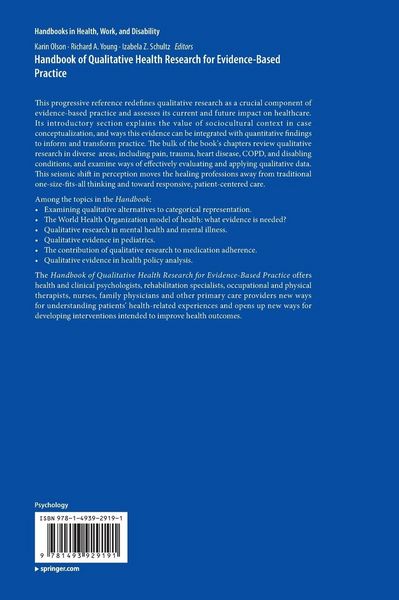
  • Part 1 Setting the Stage.- Using Qualitative Health Research to Transform the Nature of Evidence.- Social Context of Health and Diversity Issues.- Examining Qualitative Alternatives to Categorical Representation:The Case of Culture and Health.- Contextual Action Theory: An Integrative Framework for Qualitative Health Research.- The World Health Organization Model of Health: What Evidence is Needed?.- Qualitative and Quantitative Evidence in Health - The Critics View.- Part  2:  Reviews of Qualitative Health Research.- Evaluating Qualitative Health Research from Inside and Outside.- The Contributions of Qualitative Research to Cardiac Conditions.- Qualitative Evidence in Pain.- Qualitative Evidence on Psychological Trauma.- Qualitative Evidence and the Development of Sexuality Education Materials: The Case of Family Planning New Zealand.- Qualitative Evidence in Addictions.- Qualitative Research in Mental Health and Mental Illness.- Qualitative Evidence in Occupational Health.- Qualitative Evidence in Health Promotion.- Qualitative Evidence in Pediatrics.- Qualitative Evidence in Working with Cognitively Impaired Older Adults.- Qualitative Evidence in Chronic Obstructive Pulmonary Disease.- Qualitative Evidence in the Study of HIV/AIDS and Sensitive Topics: The contribution of online qualitative research.- Qualitative Evidence in Suicide Ideation, Attempts, and Suicide Prevention.- Qualitative Evidence in Suicide: Findings from Qualitative Psychological Autopsy Studies.- Qualitative Evidence in Treatment Adherence.- Disability as a Dimension of Diversity.- Qualitative Evidence in Chronic, Disabling Conditions (Childhood or Early Onset Physical Impairment).- Part 3:  Using Qualitative Health Research to Improve Health.- What use is it anyway?  Considering Modes of Application and Contributions of Qualitative InquiryBeyond Dissemination: Generating and Applying Qualitative Evidence Through Community-Based Participatory Research.- Using Qualitative Evidence to Develop an Intervention for Enabling People with Chronic Disabling Conditions to be More Physically Active.-The Contribution of Qualitative Research to Medication Adherence.- At Diagnosis and at Death: Using Qualitative Evidence to Inform Psychosocial Interventions in OncologyChange Process Research.- Qualitative Evidence in Health Policy Analysis.- Generating New Health Knowledge.