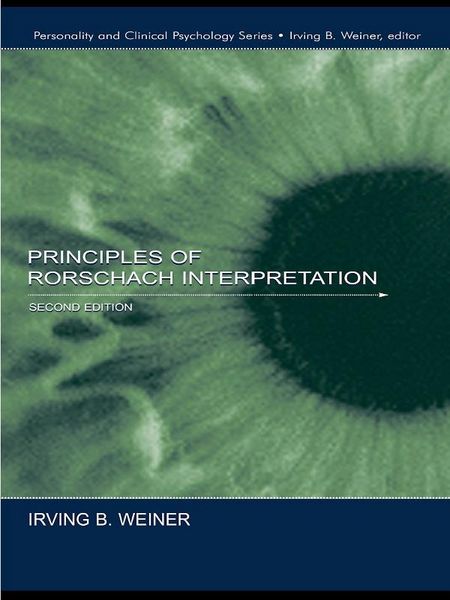
Principles of Rorschach Interpretation
-
- Hardcover
- Taschenbuch
- eBook ausgewählt
-
Form:Einzelkauf Download
-
Sprache:Englisch
-
eBook Format:PDF
- PDF 87,40 € ausgewählt
- ePUB 87,40 €
87,40 €
inkl. gesetzl. MwSt.Beschreibung
Produktdetails
Format
Kopierschutz
Ja
Family Sharing
Nein
Text-to-Speech
Nein
Erscheinungsdatum
18.07.2003
Verlag
Taylor & Francis eBooksSeitenzahl
448 (Printausgabe)
Dateigröße
3595 KB
Auflage
2. Auflage
Sprache
Englisch
EAN
9781135634506
This second edition of Irving Weiner's classic comprehensive, clinician-friendly guide to utilizing the Rorschach for personality description has been revised to reflect both recent modifications in the Rorschach Comprehensive System and new evidence concerning the soundness and utility of Rorschach assessment. It integrates the basic ingredients of structural, thematic, behavioral, and sequence analysis strategies into systematic guidelines for describing personality functioning. It is divided into three parts.
Part I concerns basic considerations in Rorschach testing and deals with conceptual and empirical foundations of the inkblot method and with critical issues in formulating and justifying Rorschach inferences.
Part II is concerned with elements of interpretation that contribute to thorough utilization of data in a Rorschach protocol: the Comprehensive System search strategy; the complementary roles of projection and card pull in determining response characteristics; and the interpretive significance of structural variables, content themes, test behaviors, and the sequence in which various response characteristics occur. Each of the chapters presents and illustrates detailed guidelines for translating Rorschach findings into descriptions of structural and dynamic aspects of personality functioning. The discussion throughout emphasizes the implications of Rorschach data for personality assets and liabilities, with specific respect to adaptive and maladaptive features of the manner in which people attend to their experience, use ideation, modulate affect, manage stress, view themselves, and relate to others.
Part III presents 10 case illustrations of how the interpretive principles delineated in Part II can be used to identify assets and liabilities in personality functioning and apply this information in clinical practice. These cases represent persons from diverse demographic backgrounds and demonstrate a broad range of personality styles and clinical issues. Discussion of these cases touches on numerous critical concerns in arriving at different diagnoses, formulating treatment plans, and elucidating structural and dynamic determinants of behavior.
Noch keine Bewertungen vorhanden
Verfassen Sie die erste Bewertung zu diesem Artikel
Helfen Sie anderen Kundinnen und Kunden durch Ihre Meinung.
Kurze Frage zu unserer Seite
Vielen Dank für Ihr Feedback
Wir nutzen Ihr Feedback, um unsere Produktseiten zu verbessern. Bitte haben Sie Verständnis, dass wir Ihnen keine Rückmeldung geben können. Falls Sie Kontakt mit uns aufnehmen möchten, können Sie sich aber gerne an unseren Kund*innenservice wenden.
zum Kundenservice