KI-Beratung Beta

Produktbild: Environmental Contaminants
Band 18

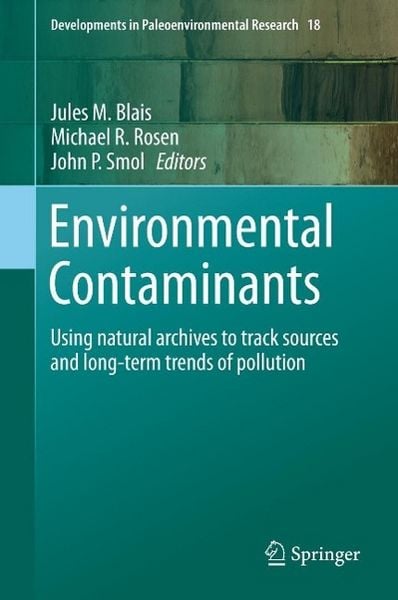
Environmental Contaminants Using natural archives to track sources and long-term trends of pollution

54,99 €

inkl. gesetzl. MwSt.

Beschreibung

Produktdetails

Format

PDF

Kopierschutz

Nein

Family Sharing

Nein

Text-to-Speech

Nein

Erscheinungsdatum

27.03.2015

Herausgeber

Jules M. Blais + weitere

Verlag

Springer Netherlands

Seitenzahl

509 (Printausgabe)

Dateigröße

15042 KB

Sprache

Englisch

EAN

9789401795418

Beschreibung

Portrait

Jules M. Blais, PhD is Professor of Biology and Environmental Toxicology at the University of Ottawa. He has published over 120 scientific articles on environmental chemistry and toxicology dealing especially with the behavior and fate of environmental contaminants and their impacts on lakes and northern communities. He is currently leading several projects on the effects of warming temperatures and resource extraction on freshwaters in Canada's north, and is also working closely with federal regulators to investigate risks to northern populations by exposure to environmental contaminants from northern traditional diets and contaminated soils. He was recently named Environmental Scientist of the Year by the Royal Canadian Geographical Society (2008), and is co-recipient of the 2013 Brockhouse Canada Prize for outstanding contributions to interdisciplinary research, awarded by the Natural Sciences and Engineering Research Council of Canada. He is Associate Editor of Environmental Reviews, and serves on the editorial board of other journals. He founded and co-directs the Laboratory for the Analysis of Natural and Synthetic Environmental Toxicants, a major laboratory for the analysis of organic and metallic contaminants at the University of Ottawa. He is currently President of the Society of Canadian Limnologists, which is committed to the advancement of aquatic science and water issues in Canada. Michael R. Rosen, PhD is Water Quality Specialist for the Western United States within the Water Science Field Team of the U.S. Geological Survey. He has been a research scientist with the U.S. Geological Survey since 2001. Before this, he was the Groundwater Quality Programme Leader at the Institute of Geological and Nuclear Sciences (now known as GNS Science), New Zealand, a research scientist at CSIRO, Australia, the Limnological Research Center, University of Minnesota, and Curtin University of Technology, Western Australia. He has published more than 175 journal articles and reports on topics ranging from limnogeology and limnology of lakes, groundwater and lake pollution, geothermal water chemical evolution and sinter formation, and tufa formation. He has also edited 3 books on groundwater in New Zealand, limnogeology of playas, and the ecosystem and limnology of Lake Mead. He has been an associate editor for the journals Ground Water and Sedimentology and currently is the editor of the Journal of the Nevada Water Resources Association and serves on the Board of Directors. He was elected as a fellow of the Geological Society of America in 2010. John P. Smol, OC, PhD, FRSC is professor of biology (cross-appointed with the School of Environmental Studies) at Queen's University (Kingston, Ontario), where he also holds the Canada Research Chair in Environmental Change. He founded and co-directs the Paleoecological Environmental Assessment and Research Lab (PEARL), a group of ~30 students and other scientists dedicated to the study of long-term global environmental change, and especially as it relates to lake ecosystems. He has authored ~500 journal publications and chapters since 1980, as well as completed 20 books. He was the founding Editor of the international Journal of Paleolimnology (1987-2007) and is the current Editor of the journal Environmental Reviews. Since 1990, he has been awarded over 45 research and teaching awards and fellowships, including the 2004 NSERC Herzberg Gold Medal as Canada's top scientist or engineer. Recently, he was named an Officer of the Order of Canada, the country's highest civilian honour. He is currently Chair of the International Paleolimnology Association (IPA).

Produktdetails

Format

PDF

eBooks im PDF-Format haben eine festgelegte Seitengröße und eignen sich daher nur bedingt zum Lesen auf einem tolino eReader oder Smartphone. Für den vollen Lesegenuss empfehlen wir Ihnen bei PDF-eBooks die Verwendung eines Tablets oder Computers.

Kopierschutz

Nein

Dieses eBook können Sie uneingeschränkt auf allen Geräten der tolino Familie, allen sonstigen eReadern und am PC lesen. Das eBook ist nicht kopiergeschützt und kann ein personalisiertes Wasserzeichen enthalten. Weitere Hinweise zum Lesen von eBooks mit einem personalisierten Wasserzeichen finden Sie unter Hilfe/Downloads.

Family Sharing

Nein

Mit Family Sharing können Sie eBooks innerhalb Ihrer Familie (max. sechs Mitglieder im gleichen Haushalt) teilen. Sie entscheiden selbst, welches Buch Sie mit welchem Familienmitglied teilen möchten. Auch das parallele Lesen durch verschiedene Familienmitglieder ist durch Family Sharing möglich. Um eBooks zu teilen oder geteilt zu bekommen, muss jedes Familienmitglied ein Konto bei Thalia oder einem anderen tolino-Buchhändler haben. Weitere Informationen finden Sie unter Hilfe/Family-Sharing.

Text-to-Speech

Nein

Bedeutet Ihnen Stimme mehr als Text? Mit der Funktion Text-to-Speech können Sie sich im tolino webReader und in der aktuellen Thalia – Lesen & Hören App das eBook vorlesen lassen. Weitere Informationen finden Sie unter Hilfe/Text-to-Speech.

Barrierefreiheit

  • keine Information zur Barrierefreiheit bekannt

Erscheinungsdatum

27.03.2015

Herausgeber

Verlag

Springer Netherlands

Seitenzahl

509 (Printausgabe)

Dateigröße

15042 KB

Sprache

Englisch

EAN

9789401795418

Noch keine Bewertungen vorhanden

Verfassen Sie die erste Bewertung zu diesem Artikel

Helfen Sie anderen Kundinnen und Kunden durch Ihre Meinung.

Kundinnen und Kunden meinen

Bewertungen (0)

Weitere Artikel finden Sie in

  • Produktbild: Environmental Contaminants
  • Using Natural Archives to Track Sources and Long-Term Trends of Pollution: An Introduction. Jules M. Blais, Michael R. Rosen, John P. Smol

    The Influence of Hydrology on Lacustrine Sediment Contaminant Records. Michael R. Rosen

    The Stability of Metal Profiles in Freshwater and Marine Sediments. P. M. Outridge and F. Wang

    Calculating Rates and Dates and Interpreting Contaminant Profiles in Biomixed Sediments. Zou Zou A. Kuzyk, Robie W. Macdonald, Sophia C. Johannessen

    Contaminants in Marine Sedimentary Deposits from Coal Fly Ash During the Latest Permian Extinction. Hamed Sanei, Stephen E. Grasb, and Benoit Beauchamp

    Lake Sediment Records of Preindustrial Metal Pollution. Colin A. Cooke and Richard Bindler

    Lacustrine Archives of Metals from Mining and Other Industrial Activities-A Geochemical Approach. John Boyle, Richard Chiverrell and Dan Schillereff

    Organic Pollutants in Sediment Core Archives. Jennifer B. Korosi, Wenhan Cheng and Jules M. Blais

    Environmental Archives of Contaminant Particles. Neil L. Rose and Meri Ruppel

    Tracking Long-range Atmospheric Transport of Contaminants in Arctic Regions Using Lake Sediments. Jane Kirk and Amber Gleason

    Tracking Long-Range Atmospheric Transport of Trace Metals, Polycyclic Aromatic Hydrocarbons, and Organohalogen Compounds Using Lake Sediments of Mountain Regions. Jordi Catalan

    Using Peat Records as Natural Archives of Past Atmospheric Metal Deposition. Sophia V. Hansson, Richard Bindler and François De Vleeschouwer

    Historical Contaminant Records from Sclerochronological Archives. Jessica Carilli, Branwen Williams, Bernd R. Schöne, Richard A. Krause and Stewart J. Fallon

    Contaminant Records in Ice Cores. Paolo Gabrielli and Paul Vallelonga

    Use of Catalogued Long-term Biological Collections and Samples for Determining Changes in Contaminant Exposure to Organisms. Linda M. Campbell and Paul Drevnick 

    Tracking Contaminant Transport From Biovectors. Roland Kallenborn and Jules M. Blais

    Using Natural Archives to Track Sources and Long-Term Trends of Pollution: Some Final Thoughts and Suggestions for Future Directions. Jules M. Blais, Michael R. Rosen, and John P. Smol