KI-Beratung Beta

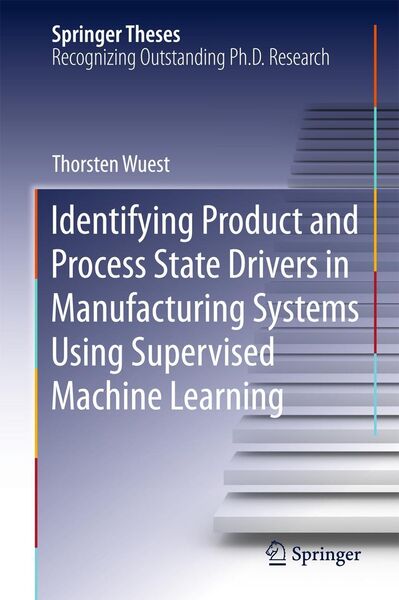
Produktbild: Identifying Product and Process State Drivers in Manufacturing Systems Using Supervised Machine Learning

Identifying Product and Process State Drivers in Manufacturing Systems Using Supervised Machine Learning

Aus der Reihe Springer Theses

98,99 €

inkl. gesetzl. MwSt.

Beschreibung

The book reports on a novel approach for holistically identifying the relevant state drivers of complex, multi-stage manufacturing systems. This approach is able to utilize complex, diverse and high-dimensional data sets, which often occur in manufacturing applications, and to integrate the important...

Beschreibung

The book reports on a novel approach for holistically identifying the relevant state drivers of complex, multi-stage manufacturing systems. This approach is able to utilize complex, diverse and high-dimensional data sets, which often occur in manufacturing applications, and to integrate the important process intra- and interrelations. The approach has been evaluated using three scenarios from different manufacturing domains (aviation, chemical and semiconductor). The results, which are reported in detail in this book, confirmed that it is possible to incorporate implicit process intra- and interrelations on both a process and programme level by applying SVM-based feature ranking. In practice, this method can be used to identify the most important process parameters and state characteristics, the so-called state drivers, of a manufacturing system. Given the increasing availability of data and information, this selection support can be directly utilized in, e.g., quality monitoring and advanced process control. Importantly, the method is neither limited to specific products, manufacturing processes or systems, nor by specific quality concepts.

Produktdetails

Format

PDF

Kopierschutz

Nein

Family Sharing

Nein

Text-to-Speech

Nein

Produktdetails

Format

PDF

Format

eBooks im PDF-Format haben eine festgelegte Seitengröße und eignen sich daher nur bedingt zum Lesen auf einem tolino eReader oder Smartphone. Für den vollen Lesegenuss empfehlen wir Ihnen bei PDF-eBooks die Verwendung eines Tablets oder Computers.

Kopierschutz

Nein

Kopierschutz

Dieses eBook können Sie uneingeschränkt auf allen Geräten der tolino Familie, allen sonstigen eReadern und am PC lesen. Das eBook ist nicht kopiergeschützt und kann ein personalisiertes Wasserzeichen enthalten. Weitere Hinweise zum Lesen von eBooks mit einem personalisierten Wasserzeichen finden Sie unter Hilfe/Downloads.

Family Sharing

Nein

Family Sharing

Mit Family Sharing können Sie eBooks innerhalb Ihrer Familie (max. sechs Mitglieder im gleichen Haushalt) teilen. Sie entscheiden selbst, welches Buch Sie mit welchem Familienmitglied teilen möchten. Auch das parallele Lesen durch verschiedene Familienmitglieder ist durch Family Sharing möglich. Um eBooks zu teilen oder geteilt zu bekommen, muss jedes Familienmitglied ein Konto bei Thalia oder einem anderen tolino-Buchhändler haben. Weitere Informationen finden Sie unter Hilfe/Family-Sharing.

Text-to-Speech

Nein

Text-to-Speech

Bedeutet Ihnen Stimme mehr als Text? Mit der Funktion Text-to-Speech können Sie sich im tolino webReader und in der aktuellen Thalia – Lesen & Hören App das eBook vorlesen lassen. Weitere Informationen finden Sie unter Hilfe/Text-to-Speech.

Erscheinungsdatum

20.04.2015

Verlag Springer
Seitenzahl

272 (Printausgabe)

Dateigröße

11554 KB

Sprache

Englisch

EAN

9783319176116

Barrierefreiheit
  • keine Information zur Barrierefreiheit bekannt

Noch keine Bewertungen vorhanden

Verfassen Sie die erste Bewertung zu diesem Artikel

Helfen Sie anderen Kundinnen und Kunden durch Ihre Meinung.

Kundinnen und Kunden meinen

Bewertungen (0)

Weitere Artikel finden Sie in

  • Produktbild: Identifying Product and Process State Drivers in Manufacturing Systems Using Supervised Machine Learning
  • Introduction.- Developments of manufacturing systems with a focus on product and process quality.- Current approaches with a focus on holistic information management in manufacturing.- Development of the product state concept.- Application of machine learning to identify state drivers.- Application of SVM to identify relevant state drivers.- Evaluation of the developed approach.- Recapitulation.