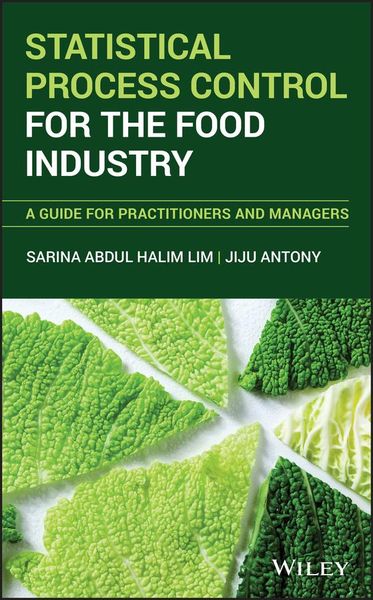
Statistical Process Control for the Food Industry A Guide for Practitioners and Managers
-
- Englisch ausgewählt
101,99 €
inkl. gesetzl. MwSt.,
Beschreibung
Produktdetails
Einband
Gebundene Ausgabe
Erscheinungsdatum
04.06.2019
Verlag
John Wiley & Sons IncSeitenzahl
200
Maße (L/B/H)
23,1/15,2/1,5 cm
Gewicht
408 g
Auflage
1. Auflage
Sprache
Englisch
ISBN
978-1-119-15198-2
This book provides managers, engineers, and practitioners with an overview of necessary and relevant tools of Statistical Process Control, a roadmap for their implementation, the importance of engagement and teamwork, SPC leadership, success factors of the readiness and implementation, and some of the key lessons learned from a number of food companies. Illustrated with numerous examples from global real-world case studies, this book demonstrates the power of various SPC tools in a comprehensive manner. The final part of the book highlights the critical challenges encountered while implementing SPC in the food industry globally.
Statistical Process Control for the Food Industry: A Guide for Practitioners and Managers explores the opportunities to deliver customized SPC training programs for local food companies. It offers insightful chapter covering everything from the philosophy and fundamentals of quality control in the food industry all the way up to case studies of SPC application in the food industry on both the quality and safety aspect, making it an excellent "cookbook" for the managers in the food industry to assess and initiating the SPC application in their respective companies.
* Covers concise and clear guidelines for the application of SPC tools in any food companies' environment
* Provides appropriate guidelines showing the organizational readiness level before the food companies adopt SPC
* Explicitly comments on success factors, motivations, and challenges in the food industry
* Addresses quality and safety issues in the food industry
* Presents numerous, global, real-world case studies of SPC in the food industry
Statistical Process Control for the Food Industry: A Guide for Practitioners and Managers can be used to train upper middle and senior managers in improving food quality and reducing food waste using SPC as one of the core techniques. It's also an excellent book for graduate students of food engineering, food quality management and/or food technology, and process management.
Noch keine Bewertungen vorhanden
Verfassen Sie die erste Bewertung zu diesem Artikel
Helfen Sie anderen Kundinnen und Kunden durch Ihre Meinung.
Kurze Frage zu unserer Seite
Vielen Dank für Ihr Feedback
Wir nutzen Ihr Feedback, um unsere Produktseiten zu verbessern. Bitte haben Sie Verständnis, dass wir Ihnen keine Rückmeldung geben können. Falls Sie Kontakt mit uns aufnehmen möchten, können Sie sich aber gerne an unseren Kund*innenservice wenden.
zum Kundenservice