Gutscheinbedingungen

**Gültig bis 15.06.2026 auf Spiele & Spielzeug online auf thalia.at, in der Thalia App ab einem Mindestbestellwert von 30€ und in allen Thalia Buchhandlungen in Österreich. In den Buchhandlungen nur gültig auf lagernde Ware. Einzelne Artikel können ausgeschlossen sein. Ausgenommen sind preisgebundene Artikel sowie online auf thalia.at und in der Thalia App einzelne Artikel von tonies®. Pro Einkauf einmal einlösbar. Nur gültig gegen Vorlage oder im Onlineshop hinterlegter Bonuscard. Infos zur Einlösung in der Buchhandlung sind auf der Bonuscard-Vorteilspreisseite zu finden. Click & Collect nur bei Onlinevorabzahlung möglich. Keine Einlösung bei Scan & Go-Bezahlung. Keine Barauszahlung. Nicht kombinierbar mit anderen Aktionen und Gutscheinen. Gutschein wird auf max. 500€ Bestellwert angerechnet. Nicht gültig für Geschenkkarten, Versandkosten und Services.

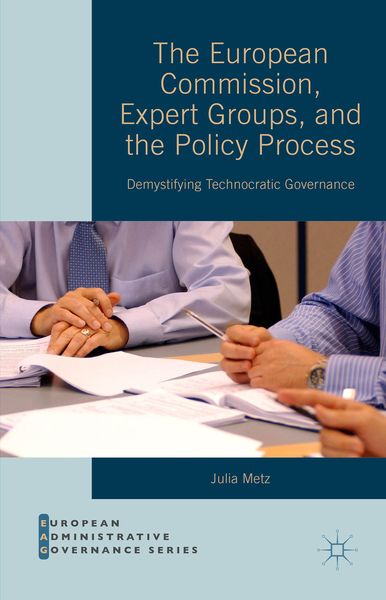
  • Produktbild: The European Commission, Expert Groups, and the Policy Process
  • Produktbild: The European Commission, Expert Groups, and the Policy Process
- 12%

The European Commission, Expert Groups, and the Policy Process Demystifying Technocratic Governance

12% sparen

95,99 € UVP 109,99 €

inkl. gesetzl. MwSt., Versandkostenfrei


Beschreibung

Produktdetails

Einband

Gebundene Ausgabe

Erscheinungsdatum

03.08.2015

Verlag

Palgrave Macmillan UK

Seitenzahl

243

Maße (L/B/H)

21,6/14/1,6 cm

Gewicht

449 g

Auflage

2015 edition

Sprache

Englisch

ISBN

978-1-137-43722-8

Beschreibung

Rezension

'This book provides a comprehensive analysis of the European Commission's expert committees, drawing on quantitative data as well as on case studies. The expert group system has so far been seen as one of the main indicators of the Commission's predominantly technocratic nature. Metz challenges this view, showing that expert groups are parts of a basically political process, thus portraying the Commission more as a 'normal' political executive than as a technocratic body.' Professor Morten Egeberg, Department of Political Science, University of Oslo, Norway


'Julia Metz has produced a path-breaking study of an under-researched dimension of committee governance: the European Commission's expert groups. Drawing on resource dependency theory, and offering in-depth empirical findings, the book sheds light on the different ways (instrumental, consensus-building and substantiating) in which the Commission makes use of external expertise.' Professor Michelle Cini, Jean Monnet Chair in European Politics, University of Bristol, UK

Produktdetails

Einband

Gebundene Ausgabe

Erscheinungsdatum

03.08.2015

Verlag

Palgrave Macmillan UK

Seitenzahl

243

Maße (L/B/H)

21,6/14/1,6 cm

Gewicht

449 g

Auflage

2015 edition

Sprache

Englisch

ISBN

978-1-137-43722-8

Herstelleradresse

Libri GmbH
Europaallee 1
36244 Bad Hersfeld
DE

Email: gpsr@libri.de

Kundinnen und Kunden meinen

0 Bewertungen

Informationen zu Bewertungen

Zur Abgabe einer Bewertung ist eine Anmeldung im Konto notwendig. Die Authentizität der Bewertungen wird von uns nicht überprüft. Wir behalten uns vor, Bewertungstexte, die unseren Richtlinien widersprechen, entsprechend zu kürzen oder zu löschen.

Die Bewertungen sind nach Format, Anzahl Sterne und Datum sortiert.

Verfassen Sie die erste Bewertung zu diesem Artikel

Helfen Sie anderen Kund*innen durch Ihre Meinung

Kundinnen und Kunden meinen

0 Bewertungen filtern

  • Produktbild: The European Commission, Expert Groups, and the Policy Process
  • Produktbild: The European Commission, Expert Groups, and the Policy Process
  • Figures and Tables
    Acknowledgements
    Abbreviations
    PART I: INTRODUCTION
    1.1. Expert groups: What do we know from the literature?
    1.2. Expert groups in the policy process and the role of resource dependencies
    1.3. Investigating European Commission expert groups
    1.4. Outline of the book
    PART II: A RELATIONSHIP OF RESOURCE DEPENDENCIES
    2.1. Resource dependence theory
    2.2. The European Commission as a resource-dependent organization
    2.3. The European Commission's demand for resources
    2.4. A typology of expert-group use
    2.5. Determinants of the European Commission's use of expert groups
    2.6. Conclusion
    PART III: A BIRD'S-EYE VIEW
    3.1. Expert groups explained
    3.2. Quantitative analysis: Challenging the myth of technocracy
    3.3. Conclusion
    PART IV: TECHNICAL ADVICE UNITED WITH POLITICAL AGENDA SETTING
    4.1. The Information Society Technologies Advisory Group
    4.2. Providing expertise to the Sixth Framework Programme
    4.3. Supporting DG Information Society's budget request for the Seventh Framework Programme
    4.4. Conclusion
    PARTV: POWERFULLY SHAPING THE COMMISSION'S RESEARCH AGENDA
    5.1. The European Research Advisory Board
    5.2. The expert group's strong impact on the Seventh Framework Programme
    5.3. Giving credence to DG Research's position on the European Institute of Technology
    5.4. Conclusion
    PART VI: A REALITY CHECK AND CLEARING HOUSE
    6.1. The Enterprise Policy Group
    6.2. A brief encounter between the expert group and the Competitiveness and Innovation Framework Programme
    6.3. Conclusion
    PART VII: ACCUMULATING POLITICAL AMMUNITION
    7.1. The European Research Area Expert Group on Research Infrastructures
    7.2. Defending the Commission's legal framework for a European Research Infrastructure
    7.3. Conclusion
    PART VIII: A CROSS-SECTORAL VIEW
    8.1. Insights from the case studies: Resource dependencies and administrative culture
    8.2. Expert-group use across policy areas
    8.3. Conclusion
    PART IX: CONCLUSION: TECHNOCRATIC GOVERNANCE BETWEEN MYTH AND REALITY
    9.1. Resource dependencies revisited
    9.2. The European Commission, expert groups, and the policy process: New insights
    9.3. Beyond the European Union: The relationship between policy makers and experts
    9.4. Expert groups, legitimacy, and transparency - and what to do about it
    Appendix
    References