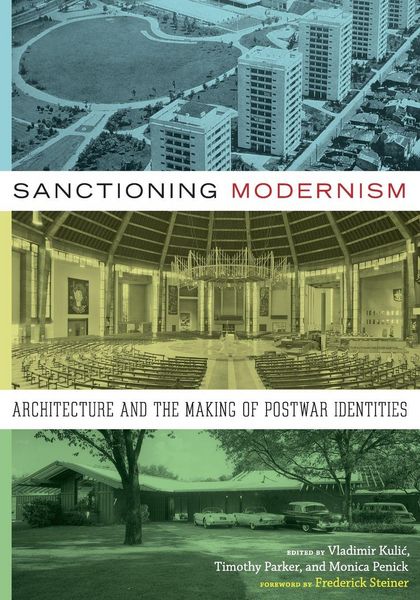
Sanctioning Modernism Architecture and the Making of Postwar Identities
-
- Taschenbuch ausgewählt
- eBook
-
Sprache:Englisch
39,99 €
inkl. gesetzl. MwSt.,
Beschreibung
Produktdetails
Einband
Taschenbuch
Erscheinungsdatum
01.06.2014
Abbildungen
55 b&w photos, 35 b&w illus.
Herausgeber
Vladimir Kulic + weitereVerlag
University Of Texas PressSeitenzahl
306
Maße (L/B/H)
25,4/17,8/1,7 cm
Gewicht
579 g
Sprache
Englisch
ISBN
978-1-4773-0759-5
With new research on building programs in political, religious, and domestic settings in the United States and Europe, this collection of essays offers a fresh look at postwar modernism and the role that architecture played in constructing modern identities.
In the decades following World War II, modern architecture spread around the globe alongside increased modernization, urbanization, and postwar reconstruction-and it eventually won widespread acceptance. But as the limitations of conventional conceptions of modernism became apparent, modern architecture has come under increasing criticism. In this collection of essays, experienced and emerging scholars take a fresh look at postwar modern architecture by asking what it meant to be "modern," what role modern architecture played in constructing modern identities, and who sanctioned (or was sanctioned by) modernism in architecture.
This volume presents focused case studies of modern architecture in three realms-political, religious, and domestic-that address our very essence as human beings. Several essays explore developments in Czechoslovakia, Romania, and Yugoslavia and document a modernist design culture that crossed political barriers, such as the Iron Curtain, more readily than previously imagined. Other essays investigate various efforts to reconcile the concerns of modernist architects with the traditions of the Roman Catholic Church and other Christian institutions. And a final group of essays looks at postwar homebuilding in the United States and demonstrates how malleable and contested the image of the American home was in the mid-twentieth century. These inquiries show the limits of canonical views of modern architecture and reveal instead how civic institutions, ecclesiastical traditions, individual consumers, and others sought to sanction the forms and ideas of modern architecture in the service of their respective claims or desires to be modern.
Noch keine Bewertungen vorhanden
Verfassen Sie die erste Bewertung zu diesem Artikel
Helfen Sie anderen Kundinnen und Kunden durch Ihre Meinung.
Kurze Frage zu unserer Seite
Vielen Dank für Ihr Feedback
Wir nutzen Ihr Feedback, um unsere Produktseiten zu verbessern. Bitte haben Sie Verständnis, dass wir Ihnen keine Rückmeldung geben können. Falls Sie Kontakt mit uns aufnehmen möchten, können Sie sich aber gerne an unseren Kund*innenservice wenden.
zum Kundenservice