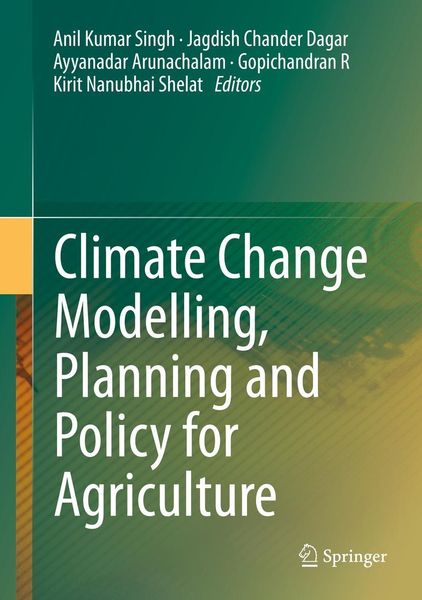
Climate Change Modelling, Planning and Policy for Agriculture
-
- Hardcover
- Taschenbuch
- eBook ausgewählt
-
Form:Einzelkauf Download
-
Sprache:Englisch
98,99 €
inkl. gesetzl. MwSt.Beschreibung
Produktdetails
Format
Kopierschutz
Nein
Family Sharing
Nein
Text-to-Speech
Nein
Erscheinungsdatum
16.03.2015
Herausgeber
Anil Kumar Singh + weitereVerlag
Springer IndiaSeitenzahl
245 (Printausgabe)
Dateigröße
10659 KB
Sprache
Englisch
EAN
9788132221579
It is well known that the impacts of climate change are tangible and hence there can be no debate about the need for appropriate adaptation measures, on a priority basis. However, it is equally important to recognize the fact that adaptation measures actually represent a dynamic synthesis of interventions pertaining to multiple systems. These are particularly of water, soil characteristics, genotypic and phenotypic variations and their expressions, age-correlated biochemical changes aligned with planting schedules and favorable weather/climate conditions. Nutrients, occurrence and distribution of associated vegetation including crop mixes also influence productivity. The overarching aspect of farming practice wields significant influence on the outcome and hence it is important to be clear about the particular focus of the investigations being carried out and reported in a suitable manner. It is essential to recognize that scientific research in agriculture in India has always produced valuable results of direct relevance to her people. Importantly, preparedness to tackle disasters due to inclement weather system has prominently featured on the agenda. The recent focus on climate change and impacts has provided the necessary impetus to reorganize the framework of investigation to capture the specifics of such impacts. In this context, the importance of micro climate variations too viz-a-viz the larger scales of impacts cannot be overemphasized. It will be useful to also help characterize natural variations versus artificially induced variations, helping us understand the complexities of individual and synergistic impacts too. Obviously, the limits and limitations of models could determine the spread and depth of the outcomes of investigations. Empirical evidences to reinforce assumptions have to also be documented with utmost care; guided by an understanding of the limits of tolerance, limiting factors, and the precautionary principle especially in the public policy interface. The present volume therefore, showcases these strands with the fond hope that they will stimulate further thinking and enable appropriate action.
Noch keine Bewertungen vorhanden
Verfassen Sie die erste Bewertung zu diesem Artikel
Helfen Sie anderen Kundinnen und Kunden durch Ihre Meinung.
Kurze Frage zu unserer Seite
Vielen Dank für Ihr Feedback
Wir nutzen Ihr Feedback, um unsere Produktseiten zu verbessern. Bitte haben Sie Verständnis, dass wir Ihnen keine Rückmeldung geben können. Falls Sie Kontakt mit uns aufnehmen möchten, können Sie sich aber gerne an unseren Kund*innenservice wenden.
zum Kundenservice