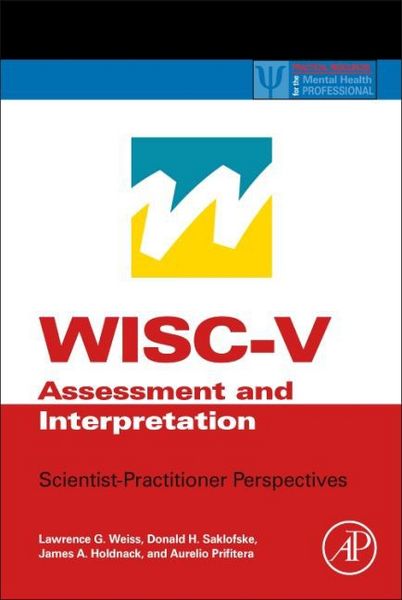
Produktbild: Weiss, L: WISC-V Assessment and Interpretation

Weiss, L: WISC-V Assessment and Interpretation Scientist-Practitioner Perspectives

44,99 €

inkl. gesetzl. MwSt., Versandkostenfrei


Beschreibung

Produktdetails

Einband

Gebundene Ausgabe

Erscheinungsdatum

01.06.2015

Verlag

Elsevier LTD, Oxford

Seitenzahl

456

Maße (L/B/H)

23,6/15,8/2,5 cm

Gewicht

840 g

Sprache

Englisch

ISBN

978-0-12-404697-9

Beschreibung

Rezension

"... a valuable addition to a practitioner's library... an important resource that will certainly help practitioners use these data to make meaningful interpretations, and to recommend targeted interventions and accommodations." --Journal of Psychoeducational Assessment

"WISC-V Assessment and Interpretation: Scientist-Practitioner Perspectives is a new book that provides comprehensive and detailed information on the use and interpretation of the Wechsler Intelligence Scale for Children-Fifth Edition (WISC-V; Wechsler, 2014).The book contains 12 chapters highlighting applied, theoretical, and clinical considerations related to the WISC-V and directions for research. Consistent with its title, the book provides practical resources for professionals regarding administration and interpretation of the WISC-V.

The authors offer insightful recommendations for best practices in cognitive assessment. Generally, the layout of the book is clear, concise, and written with a diverse audience in mind. In addition, the use of figures and tables throughout each chapter also helps enhance overall readability.

One particular area of strength in this book is the consistent use of examples and analogies to help deepen the understanding of complex concepts.The book also offers several features that may be particularly useful for less experienced professionals, such as the inclusion of a "Frequently Asked Questions" section, lists of interventions and accommodations recommended for specific areas of deficit/strength, and the inclusion of general and specific administration and scoring guidelines that are likely useful for student readers, new professionals, and those who are unfamiliar with the WISC-V. It can also be a handy resource in academic settings as a tool in the instruction of effective and appropriate cognitive assessment of children with diverse needs. The book also contains plenty of useful information for more experienced professionals, such as descriptions of each new WISC-V subtest and the appendix outlining major differences between the WISC-IV and WISC-V. The chapters are well organized and are written to be accessible to both students and seasoned clinicians. Another helpful feature of the book is the frequent suggestions of additional resources in situations where more extensive coverage of a particular topic may be desired. In addition, the inclusion and frequent reference to recently published literature is another strength. Given that the WISC-V was published fairly recently, this book is both timely and relevant, and it is the only resource on the WISC-V to date.

Taken together, this book provides readers with superior recommendations for best practice in the administration, scoring, and interpretation of the WISC-V. Based on the quality of information presented in this book, it is surely to be a valuable resource for a wide range of professionals using the WISC-V in professional practice." --Reviewed by Adam W. McCrimmon and Keely A. Murphy, University of Calgary for Canadian Journal of School Psychology

Produktdetails

Einband

Gebundene Ausgabe

Erscheinungsdatum

01.06.2015

Verlag

Elsevier LTD, Oxford

Seitenzahl

456

Maße (L/B/H)

23,6/15,8/2,5 cm

Gewicht

840 g

Sprache

Englisch

ISBN

978-0-12-404697-9

Noch keine Bewertungen vorhanden

Verfassen Sie die erste Bewertung zu diesem Artikel

Helfen Sie anderen Kundinnen und Kunden durch Ihre Meinung.

Kundinnen und Kunden meinen

Bewertungen (0)

  • Produktbild: Weiss, L: WISC-V Assessment and Interpretation
  • Part I: Applied Considerations

    Chapter 1: WISC-V: Advances in the Assessment of IntelligenceLawrence G. Weiss, Donald H. Saklofske, James A. Holdnack, and Aurelio Prifitera

    Chapter 2: Practical Issues in WISC-V Administration and ScoringDustin Wahlstrom, Lawrence G. Weiss and Donald H. Saklofske

    Chapter 3: Practical Considerations in WISC-V Interpretation and InterventionA. Lynne Beal, James A. Holdnack, Donald H. Saklofske, and Lawrence G. Weiss

    Part II: Theoretical Considerations

    Chapter 4: Theoretical and Clinical Foundations of the WISC-V Index ScoresLawrence G. Weiss, James A. Holdnack, Donald H. Saklofske, and Aurelio Prifitera

    Chapter 5: WISC-V Use in Societal ContextLawrence G. Weiss, Victoria Locke, Tianshu Pan, Jossette G. Harris, Donald H. Saklofske and Aurelio Prifitera

    Chapter 6: The Flynn Effect and its Clinical ImplicationsJacques Grégoire, Mark Daniel, Antolin M. Llorente and Lawrence G. Weiss

    Part III: Clinical Considerations

    Chapter 7: Testing Hispanics with WISC-V and WISC-IV SpanishLawrence G. Weiss, Maria R. Munoz, and Aurelio Prifitera

    Chapter 8: WISC-V and the Evolving Role of Intelligence Testing in the Assessment of Learning DisabilitiesDonald H. Saklofske, Lawrence G. Weiss, Kristina Breaux, and A. Lynne Beal

    Chapter 9: Translating Scientific Progress in Dyslexia into Twenty-first Century Diagnosis and InterventionsBennett A. Shaywitz, Lawrence G. Weiss, Donald H. Saklofske and Sally E. Shaywitz

    Chapter 10: Issues Related to the WISC-V Assessment of Cognitive Functioning in Clinical and Special GroupsJessie L. Miller, Donald H. Saklofske, Lawrence G. Weiss, Lisa Drozdick, Antolin M. Llorente, James A. Holdnack, and Aurelio Prifitera

    Part IV: Current and Future Directions

    Chapter 11: Digital Assessment with Q-InteractiveDustin Wahlstrom, Mark Daniel, Lawrence G. Weiss and Aurelio Prifitera

    Chapter 12: WISC-V and the Personalized Assessment ApproachJames A. Holdnack, Aurelio Prifitera, Lawrence G. Weiss, and Donald H. Saklofske