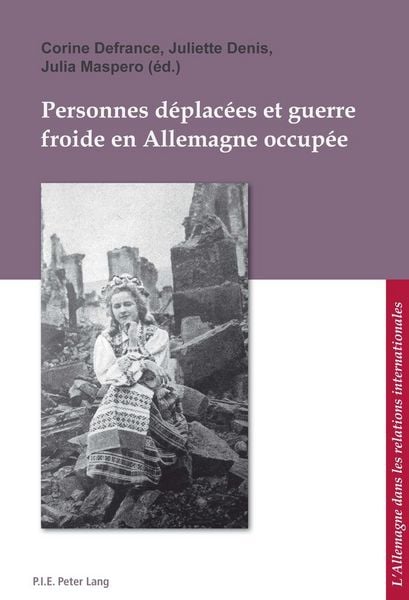
Personnes déplacées et guerre froide en Allemagne occupée
-
- Deutsch, Englisch, Französisch ausgewählt
72,50 €
inkl. gesetzl. MwSt.,
Beschreibung
Produktdetails
Einband
Taschenbuch
Erscheinungsdatum
28.02.2015
Herausgeber
Corine Defrance + weitereVerlag
Peter Lang AG, Internationaler Verlag der WissenschaftenSeitenzahl
424
Maße (L/B/H)
22/15/2,3 cm
Gewicht
579 g
Auflage
1. Auflage
Sprache
Deutsch, Englisch, Französisch
ISBN
978-2-87574-216-2
Cet ouvrage, rassemblant des contributions en trois langues (français, anglais, allemand), croise les perspectives entre histoire politique et internationale, histoire des migrations, analyses culturelles et études des représentations. Il permet de saisir les interactions entre les décisions internationales, les impératifs des pays d’origine des DPs mais aussi ceux des pays d’immigration, les réalités de l’Allemagne occupée et les besoins et espérances des DPs eux-mêmes. Entre sortie du conflit mondial et début de guerre froide se nouent autour des DPs les grandes problématiques politiques et humaines qui forgent l’histoire des déplacements et du refuge.
In the aftermath of the Second World War, millions of foreign civilians found themselves in the German territory. Among them, there were former forced laborers, survivors from the Nazi camps, many uprooted migrants who had all experienced the war in different ways. Most of them were repatriated after the German capitulation. However, almost one million of these «Displaced Persons» (DPs) refused to go back to their homeland. They were scarred by anti-Semitic violence, or by the rise of communist regimes in Eastern Europe. For a few months, even a few years, they remained mostly in the Western zones of occupied Germany, facing the harsh post-war conditions of defeated Germany. DPs became both targets and actors of global politics dealing with the refugee problem. This book puts together articles in three languages (French, English, and German). The contributions reveal the DPs’ history from different points of view. They rely on the history of international relations at the end of the war and of the various states involved in the DP question, as well as on social and cultural studies. The diversity of methodological patterns allows for a broad comprehension of this singular story at different scales, from the international debates and tensions to the needs and the hopes of the DPs themselves, in the social and political context of post-war occupied Germany. As the end of the war led to the Cold War, the DP question raised most of the political and humanitarian issues that would continue to interfere with the management of population displacements and refugees until the present day.
Am Ende des Zweiten Weltkrieges befanden sich einige Millionen Ausländer auf deutschem Boden: ehemalige Zwangsarbeiter, Überlebende der NS-Lager und andere entwurzelte Personen. Die meisten von ihnen kehrten nach der deutschen Kapitulation in ihre Heimat zurück; zurück blieben hingegen fast eine Million Displaced Persons (DPs), die den Antisemitismus in Osteuropa oder den Aufstieg der kommunistischen Regime in diesen Ländern fürchteten, so dass sie sich weigerten, in ihre Ursprungsländer zurückzukehren. Sie fanden sich schließlich für mehrere Monate oder gar Jahre in den drei westdeutschen Besatzungszonen wieder, die von den Kriegsfolgen gezeichnet waren und mehrere Millionen von Flüchtlingen aufnehmen mussten. Ihre Geschichte ist vielfältig; bisweilen wird
Noch keine Bewertungen vorhanden
Verfassen Sie die erste Bewertung zu diesem Artikel
Helfen Sie anderen Kundinnen und Kunden durch Ihre Meinung.
Kurze Frage zu unserer Seite
Vielen Dank für Ihr Feedback
Wir nutzen Ihr Feedback, um unsere Produktseiten zu verbessern. Bitte haben Sie Verständnis, dass wir Ihnen keine Rückmeldung geben können. Falls Sie Kontakt mit uns aufnehmen möchten, können Sie sich aber gerne an unseren Kund*innenservice wenden.
zum Kundenservice