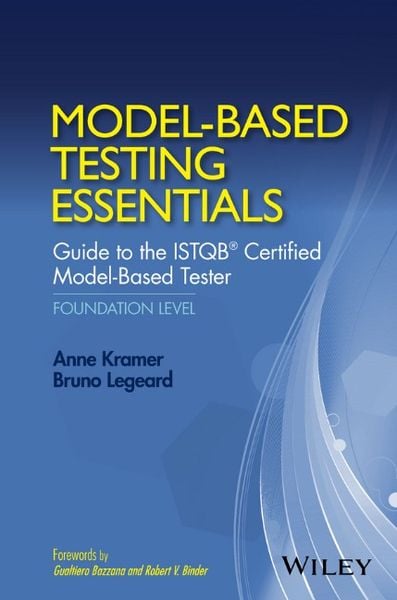
Model-Based Testing Essentials - Guide to the ISTQB Certified Model-Based Tester - Foundation Level Forwords: Bazzana, Gualtiero; Binder, Robert V.
-
- Englisch ausgewählt
109,99 €
inkl. gesetzl. MwSt.,
Beschreibung
Produktdetails
Einband
Gebundene Ausgabe
Erscheinungsdatum
11.04.2016
Verlag
John Wiley & SonsSeitenzahl
296
Maße (L/B/H)
24/16,1/2,1 cm
Gewicht
616 g
Auflage
1. Auflage
Sprache
Englisch
ISBN
978-1-119-13001-7
Provides a practical and comprehensive introduction to the key aspects of model-based testing as taught in the ISTQB(r) Model-Based Tester--Foundation Level Certification Syllabus
This book covers the essentials of Model-Based Testing (MBT) needed to pass the ISTQB(r) Foundation Level Model-Based Tester Certification. The text begins with an introduction to MBT, covering both the benefits and the limitations of MBT. The authors review the various approaches to model-based testing, explaining the fundamental processes in MBT, the different modeling languages used, common good modeling practices, and the typical mistakes and pitfalls. The book explains the specifics of MBT test implementation, the dependencies on modeling and test generation activities, and the steps required to automate the generated test cases. The text discusses the introduction of MBT in a company, presenting metrics to measure success and good practices to apply.
* Provides case studies illustrating different approaches to Model-Based Testing
* Includes in-text exercises to encourage readers to practice modeling and test generation activities
* Contains appendices with solutions to the in-text exercises, a short quiz to test readers, along with additional information
Model-Based Testing Essentials - Guide to the ISTQB(r) Certified Model-Based Tester - Foundation Level is written primarily for participants of the ISTQB(r) Certification: software engineers, test engineers, software developers, and anybody else involved in software quality assurance. This book can also be used for anyone who wants a deeper understanding of software testing and of the use of models for test generation.
This book covers the essentials of Model-Based Testing (MBT) needed to pass the ISTQB(r) Foundation Level Model-Based Tester Certification. The text begins with an introduction to MBT, covering both the benefits and the limitations of MBT. The authors review the various approaches to model-based testing, explaining the fundamental processes in MBT, the different modeling languages used, common good modeling practices, and the typical mistakes and pitfalls. The book explains the specifics of MBT test implementation, the dependencies on modeling and test generation activities, and the steps required to automate the generated test cases. The text discusses the introduction of MBT in a company, presenting metrics to measure success and good practices to apply.
* Provides case studies illustrating different approaches to Model-Based Testing
* Includes in-text exercises to encourage readers to practice modeling and test generation activities
* Contains appendices with solutions to the in-text exercises, a short quiz to test readers, along with additional information
Model-Based Testing Essentials - Guide to the ISTQB(r) Certified Model-Based Tester - Foundation Level is written primarily for participants of the ISTQB(r) Certification: software engineers, test engineers, software developers, and anybody else involved in software quality assurance. This book can also be used for anyone who wants a deeper understanding of software testing and of the use of models for test generation.
Kundinnen und Kunden meinen
Verfassen Sie die erste Bewertung zu diesem Artikel
Helfen Sie anderen Kund*innen durch Ihre Meinung
Kurze Frage zu unserer Seite
Vielen Dank für Ihr Feedback
Wir nutzen Ihr Feedback, um unsere Produktseiten zu verbessern. Bitte haben Sie Verständnis, dass wir Ihnen keine Rückmeldung geben können. Falls Sie Kontakt mit uns aufnehmen möchten, können Sie sich aber gerne an unseren Kund*innenservice wenden.
zum Kundenservice