Gutscheinbedingungen

**Gültig von 22.06.2026 ab 19 Uhr bis 23.06.2026 24 Uhr auf Spielzeug, Schreibwaren, Filme, Geschenke & Trends, Musik, tolino eReader & Zubehör, Hörbücher und Hörbuch-Downloads (außer Abo), nicht preisgebundene Bücher und Kalender online auf thalia.at und in der Thalia App. Einzelne Artikel können ausgeschlossen sein. Aufgrund der Buchpreisbindung sind deutschsprachige Bücher und eBooks ausgenommen. Zusätzlich ausgenommen sind preisgebundene Artikel, Abos & Flatrates, eBooks, Games, Geschenkkarten/-boxen, Shelfies, Software, Zeitschriften sowie einzelne Artikel von tonies®. Pro Einkauf einmal einlösbar. Click & Collect nur bei Onlinevorabzahlung möglich. Keine Barauszahlung. Nicht kombinierbar mit anderen Aktionen und Gutscheinen. Gutschein wird auf max. 500€ Bestellwert angerechnet. Nicht gültig für Versandkosten und Services.

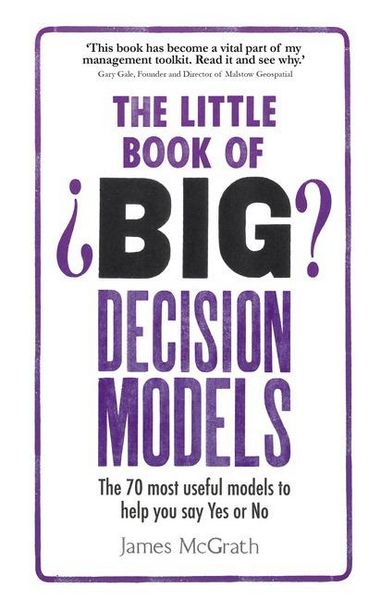
Produktbild: Little Book of Big Decision Models, The

Little Book of Big Decision Models, The The 70 most useful models to help you say Yes or No

15,99 €

inkl. gesetzl. MwSt., zzgl. Versandkosten


  • Kostenlose Lieferung ab 30 € Einkaufswert
  • Versandkostenfrei für Bonuscard-Kund*innen

Beschreibung

Produktdetails

Einband

Taschenbuch

Erscheinungsdatum

05.11.2015

Verlag

Pearson Academic

Seitenzahl

224

Maße (L/B/H)

21,5/13,6/1,7 cm

Gewicht

343 g

Auflage

1. Auflage

Sprache

Englisch

ISBN

978-1-292-09836-4

Beschreibung

Produktdetails

Einband

Taschenbuch

Erscheinungsdatum

05.11.2015

Verlag

Pearson Academic

Seitenzahl

224

Maße (L/B/H)

21,5/13,6/1,7 cm

Gewicht

343 g

Auflage

1. Auflage

Sprache

Englisch

ISBN

978-1-292-09836-4

Herstelleradresse

Libri GmbH
Europaallee 1
36244 Bad Hersfeld
DE

Email: gpsr@libri.de

Kundinnen und Kunden meinen

0 Bewertungen

Informationen zu Bewertungen

Zur Abgabe einer Bewertung ist eine Anmeldung im Konto notwendig. Die Authentizität der Bewertungen wird von uns nicht überprüft. Wir behalten uns vor, Bewertungstexte, die unseren Richtlinien widersprechen, entsprechend zu kürzen oder zu löschen.

Die Bewertungen sind nach Format, Anzahl Sterne und Datum sortiert.

Verfassen Sie die erste Bewertung zu diesem Artikel

Helfen Sie anderen Kund*innen durch Ihre Meinung

Kundinnen und Kunden meinen

0 Bewertungen filtern

Die Leseprobe wird geladen.
  • Produktbild: Little Book of Big Decision Models, The
    • Chapter 1 - The principles of decision making
    • Introduction
    • Model 1: Townsend’s rules of decision making
    • Model 2: The McNamara fallacy - The vital information that decision makers ignore
    • Model 3: Using quantitative (hard) and qualitative (soft) data in decision making
    • Model 4: Kreiner and Christensen the consequence model
    • Model 5: Tenenbaum and Schmid’s decision making spectrum
    • Model 6: Roger and Blenko’s rapid decision making model
    • Model 7: Cognitive mapping - understanding how your colleagues think
    • Model 8: Tacit knowledge and decision making
    • Model 9: The standard decision making model
    • Conclusion
    • Chapter 2 - Using data in decision making
    • Introduction
    • Model 10: The Pareto principle and the important vital few
    • Model 11: Lewin’s force field analysis of the support and opposition to a decision
    • Model 12: Scenario analysis and charting possible futures
    • Model 13: Delphic forecasting and how to firm up predictions
    • Model 14: Johnson, Scholes and Wittingham mapping stakeholder’s reactions
    • Model 15: Egan’s shadow side model - dealing with the politics of decisions
    • Model 16: The SCAMPER model and finding creative solutions
    • Model 17: De Bono’s six thinking hats - generating different perspectives
    • Conclusions
    • Chapter 3 - Enhancing your decision making skills
    • Intrduction
    • Model 18: The Eisenhower principle and the delegation of decisions
    • Model 19: The feedback and criticism grid
    • Model 20: Learning to think outside the box
    • Model 21: Goleman: Using emotional intelligence to make better decisions
    • Model 22: Sumantra and Bruch reclaiming your job
    • Conclusion
    • Chapter 4 - Decisions models about you
    • Introduction
    • Model 23: Christensen’s strategy for a happy life
    • Model 24: The making – of you model and how your past influences the present
    • Model 25: The rubber band model - what holds you back and pulls you forward?
    • Model 26: The crossroads model and which road to follow next
    • Model 27: The personal performance model and job satisfaction
    • Model 28: Csikzenmihalyi’s flow model and the joy of working in ‘the zone’
    • Model 29: Maslow’s Pyramids - what you want and what you need
    • Model 30: The Euffe Elbaek model - a guide to your personality
    • Model 31: Johari windows - a guide to your personality
    • Model 32: The personal potential trap and how to avoid becoming a prisoner of other peoples’ expectations
    • Model 33: Your attitude to risk
    • Conclusion
    • Chapter 5 - Decision Models about other people
    • Introduction
    • Model 34: Goffee and Jones - why should anyone be led by you?
    • Model 35: Hersey and Blanchard’s situational leadership model
    • Model 36: Manzoni and Barsoux - how managers set staff up to fail
    • Model 37: Denseraeu, Graen and Haga - how managers set staff up to succeed
    • Model 38: Herzberg’s motivation and hygiene theory - choosing the right carrots
    • Model 39: The feedback sandwich - delivering negative feedback
    • Model 40: McGregor’s features of effective and ineffective teams
    • Model 41: The team model - building a well balanced team
    • Conclusion
    • Cha