KI-Beratung Beta

Gutscheinbedingungen

**Gültig bis 30.11.2026 auf Spielzeug, Schreibwaren, Filme, Geschenke & Trends, Musik, tolino eReader & Zubehör, Hörbücher und Hörbuch-Downloads, nicht preisgebundene Bücher und Kalender online auf thalia.at und in der Thalia App. Einzelne Artikel können ausgeschlossen sein. Aufgrund der Buchpreisbindung sind deutschsprachige Bücher und eBooks ausgenommen. Zusätzlich ausgenommen sind Abos & Flatrates, Games, Geschenkkarten/-boxen, Shelfies, Software, Zeitschriften sowie einzelne Artikel von tonies®. Pro Einkauf einmal einlösbar. Nur gültig mit im Onlineshop hinterlegter Bonuscard. Click & Collect nur bei Onlinevorabzahlung möglich. Keine Barauszahlung. Nicht kombinierbar mit anderen Aktionen und Gutscheinen. Gutschein wird auf max. 500€ Bestellwert angerechnet. Nicht gültig für Versandkosten und Services.

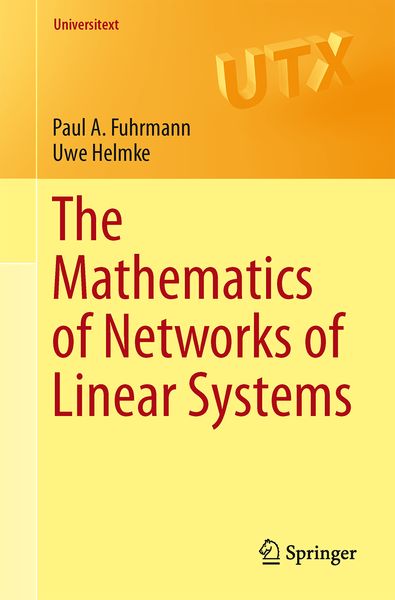
Produktbild: The Mathematics of Networks of Linear Systems

The Mathematics of Networks of Linear Systems

Aus der Reihe Universitext

72,99 €

inkl. gesetzl. MwSt., Versandkostenfrei


Beschreibung

This book provides the mathematical foundations of networks of linear control systems, developed from an algebraic systems theory perspective. This includes a thorough treatment of questions of controllability, observability, realization theory, as well as feedback control and observer theory. The potential...

Beschreibung

This book provides the mathematical foundations of networks of linear control systems, developed from an algebraic systems theory perspective. This includes a thorough treatment of questions of controllability, observability, realization theory, as well as feedback control and observer theory. The potential of networks for linear systems in controlling large-scale networks of interconnected dynamical systems could provide insight into a diversity of scientific and technological disciplines. The scope of the book is quite extensive, ranging from introductory material to advanced topics of current research, making it a suitable reference for graduate students and researchers in the field of networks of linear systems. Part I can be used as the basis for a first course in Algebraic System Theory, while Part II serves for a second, advanced, course on linear systems.

Finally, Part III, which is largely independent of the previous parts, is ideally suited for advanced research seminars aimed at preparing graduate students for independent research. “Mathematics of Networks of Linear Systems” contains a large number of exercises and examples throughout the text making it suitable for graduate courses in the area.

Rezension

“In the voluminous book under review the authors illustrate their perspective on modelling and control of networks of linear finite-dimensional systems. … This is an excellent book that can be appreciated both by readers familiar with the polynomial approach, and by readers unaccustomed to functional models. … The historical sections at the end of each chapter are helpful because they explain the broader context and suggest further reading to both types of readers.” (Paolo Rapisarda, Mathematical Reviews, March, 2016)

Produktdetails

Einband

Taschenbuch

Erscheinungsdatum

11.06.2015

Abbildungen

XIV, 662 p. 53 illus.

Verlag Springer

Produktdetails

Einband

Taschenbuch

Erscheinungsdatum

11.06.2015

Abbildungen

XIV, 662 p. 53 illus.

Verlag Springer
Seitenzahl

662

Maße (L/B/H)

23,5/15,5/3,7 cm

Gewicht

1007 g

Sprache

Englisch

ISBN

978-3-319-16645-2

Herstelleradresse

Springer-Verlag KG
Sachsenplatz 4-6
1201 Wien
AT

Email: ProductSafety@springernature.com

Noch keine Bewertungen vorhanden

Verfassen Sie die erste Bewertung zu diesem Artikel

Helfen Sie anderen Kundinnen und Kunden durch Ihre Meinung.

Kundinnen und Kunden meinen

Bewertungen (0)

Die Leseprobe wird geladen.
  • Produktbild: The Mathematics of Networks of Linear Systems
  • Introduction.-Rings and Modules of Polynomials.- Functional Models and Shift Spaces.- Linear Systems.- Tensor Products, Bezoutians and Stability.-State Feedback and Output Injection.-Observer Theory.- Nonnegative Matrices and Graph Theory.- Interconnected Systems.-Control of Standard Interconnections.- Synchronization and Consensus.- Control of Ensembles.- References.- Index.