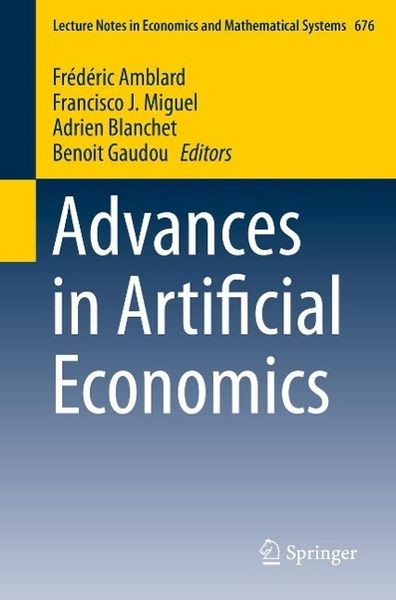
Produktbild: Advances in Artificial Economics
Band 676

Advances in Artificial Economics

98,99 €

inkl. gesetzl. MwSt.

Beschreibung

Produktdetails

Format

PDF

Kopierschutz

Nein

Family Sharing

Nein

Text-to-Speech

Nein

Erscheinungsdatum

08.11.2014

Herausgeber

Frédéric Amblard + weitere

Verlag

Springer

Seitenzahl

243 (Printausgabe)

Dateigröße

6683 KB

Sprache

Englisch

EAN

9783319095783

Beschreibung

Portrait

Fre¿de¿ric Amblard was awarded a PhD degree (agent-based social simulation) in 2003 from the University Blaise Pascal, Clermont-Ferrand. He then spend one year as a post-doc at the ENS-Ulm. In 2004, he became associate professor in Computer Science at the University Toulouse 1 Capitole and joined the IRIT-SMAC team. He has been implied in several European projects (FP6 IMAGES, FP7 COSIN, FP7 QLectives) and ANR projects (MAGeo, COSMAGEMS) and currently participates in the coordination of the MAELIA project, dedicated to the multi-agent simulation for the management of water resources. He coordinated several industrial projects with major actors (EDF R&D, France Te¿le¿com R&D). In 2013 he received an award for scientific excellence (PES). Francesc Josep Miguel holds a PhD in Sociology from the Universitat Autònoma de Barcelona (UAB) and a University Specialist Degree in Sociology of Consumption from the Universidad Complutense de Madrid. Miguel Quesada is an Associate Professor at UAB responsible for courses in Methodology for the Social Sciences, Sociology of Consumption and Applied Statistics for Marketing Analysis. He has conducted research in the fields of sociology of consumption, social indicators in relation to the situation of women in contemporary society, and the analysis of school-to-work transitions. At present he mainly works in the domain of "computational sociology" - an applied branch of artificial intelligence that merges social science and computer simulation techniques to model complex policy issues and societal dynamics - and, as GSADI member and as Director of the "Laboratory for Socio-Historical Dynamics Simulation" (LSDS) he is involved in several projects about the use of agent-based social simulation for the modelling of social networks dynamics and evolution of social behavior. Adrien Blanchet became Associate Professor at the GREMAQ in 2008. He earned a PhD degree in 2005 from the University Paris Dauphine. With a background in mathematical physics, Adrien focused at the end of his PhD degree on models coming from Biology. From his recruitment at the GREMAQ in 2008, he worked on the applications of partial differential equations in Economics. In 2009 he received an award for scientific excellence (PES) as well as an Outstanding Viae Award of the Toulouse School of Economics (TSE) in 2010. Benoit Gaudou was awarded a PhD degree in Artificial Intelligence in 2008 from the Toulouse University. In 2010, he became Associate Professor at the University Toulouse 1 Capitole and joined the IRIT-SMAC research team. His research topics are the agent-based modeling and simulation of social environmental systems including complex agents.

Produktdetails

Format

PDF

eBooks im PDF-Format haben eine festgelegte Seitengröße und eignen sich daher nur bedingt zum Lesen auf einem tolino eReader oder Smartphone. Für den vollen Lesegenuss empfehlen wir Ihnen bei PDF-eBooks die Verwendung eines Tablets oder Computers.

Kopierschutz

Nein

Dieses eBook können Sie uneingeschränkt auf allen Geräten der tolino Familie, allen sonstigen eReadern und am PC lesen. Das eBook ist nicht kopiergeschützt und kann ein personalisiertes Wasserzeichen enthalten. Weitere Hinweise zum Lesen von eBooks mit einem personalisierten Wasserzeichen finden Sie unter Hilfe/Downloads.

Family Sharing

Nein

Mit Family Sharing können Sie eBooks innerhalb Ihrer Familie (max. sechs Mitglieder im gleichen Haushalt) teilen. Sie entscheiden selbst, welches Buch Sie mit welchem Familienmitglied teilen möchten. Auch das parallele Lesen durch verschiedene Familienmitglieder ist durch Family Sharing möglich. Um eBooks zu teilen oder geteilt zu bekommen, muss jedes Familienmitglied ein Konto bei Thalia oder einem anderen tolino-Buchhändler haben. Weitere Informationen finden Sie unter Hilfe/Family-Sharing.

Text-to-Speech

Nein

Bedeutet Ihnen Stimme mehr als Text? Mit der Funktion Text-to-Speech können Sie sich im tolino webReader und in der aktuellen Thalia – Lesen & Hören App das eBook vorlesen lassen. Weitere Informationen finden Sie unter Hilfe/Text-to-Speech.

Barrierefreiheit

  • keine Information zur Barrierefreiheit bekannt

Erscheinungsdatum

08.11.2014

Herausgeber

Verlag

Springer

Seitenzahl

243 (Printausgabe)

Dateigröße

6683 KB

Sprache

Englisch

EAN

9783319095783

Noch keine Bewertungen vorhanden

Verfassen Sie die erste Bewertung zu diesem Artikel

Helfen Sie anderen Kundinnen und Kunden durch Ihre Meinung.

Kundinnen und Kunden meinen

Bewertungen (0)

Weitere Artikel finden Sie in

  • Produktbild: Advances in Artificial Economics
  • Does Collaboration Pay? An Investigation for the Domain of Distributed Investment Decisions.- Why Do Firms Exist?- The "Win-Continue, Lose-Reverse" Rule in Cournot Oligopolies: Robustness of Collusive Outcomes.- Organizational Change for Its Own Sake? Results of an Agent-Based Simulation.- Best Practices in Programming Agent-Based Models in Economics and Finance.- Building Artificial Economies: From Aggregate Data to Experimental Microstructure. A Methodological Survey.- Spontaneous Segregation of Agents Across Double Auction Markets.- The J-Curve and Transaction Taxes: Insights from an Artificial Stock Market.- What Is the Impact of Heterogeneous Knowledge About Fundamentals on Market Liquidity and Efficiency: an ABM Approach.- An Agent Based Propagation Model of Bank Failures.- Direct vs. Side Effects in Financial Contagion: What Weights More?- Saudis and Expats - an Agent-Based Model of the Saudi Arabian Labor Market.- Forbidding Fixed Duration Contracts: Unfolding the Opposing Consequences with a Multi-agent Model of the French Labor Market.- ¿Shadow Economy and Wealth Distribution.- Distribution Effects of Extortion Racket Systems.- Impacts on Stability of Interdependencies Between Markets in a Cobweb Model.- Detecting Key Variables in System Dynamics Modelling by Using Social Network Metrics.- Trade-in Programs in the Context of Technological Innovation with Herding.- Evaluating Scenarios for Upgrading Sustainability of the Meat Supply Chain.