Gutscheinbedingungen

**Gültig bis 06.07.2026 auf fremdsprachige Bücher online auf thalia.at, in der Thalia App ab einem Mindestbestellwert von 30€ und in allen Thalia Buchhandlungen in Österreich. In den Buchhandlungen nur gültig auf lagernde Ware. Einzelne Artikel können ausgeschlossen sein. Ausgenommen sind preisgebundene Artikel & eBooks. Pro Einkauf einmal einlösbar. Nur gültig gegen Vorlage oder im Onlineshop hinterlegter Bonuscard. Infos zur Einlösung in der Buchhandlung sind auf der Bonuscard-Vorteilspreisseite zu finden. Click & Collect nur bei Onlinevorabzahlung möglich. Keine Einlösung bei Scan & Go-Bezahlung. Keine Barauszahlung. Nicht kombinierbar mit anderen Aktionen und Gutscheinen. Gutschein wird auf max. 500€ Bestellwert angerechnet. Nicht gültig für Versandkosten und Services.

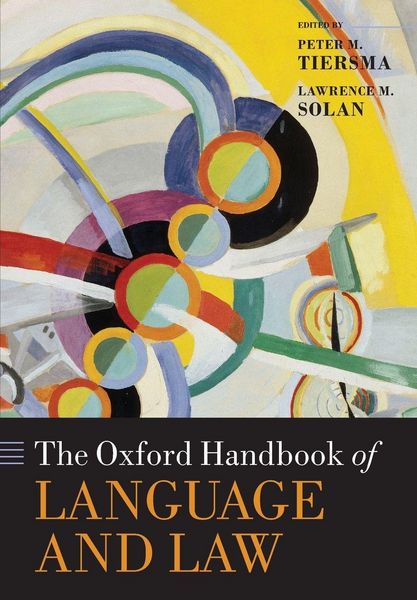
Produktbild: Oxford Handbook of Language and Law

Oxford Handbook of Language and Law

77,99 €

inkl. gesetzl. MwSt., Versandkostenfrei


Beschreibung

Produktdetails

Einband

Taschenbuch

Erscheinungsdatum

24.12.2015

Herausgeber

Tiersma Peter M. + weitere

Verlag

Oxford University Press

Seitenzahl

664

Maße (L/B/H)

24,4/17/3,6 cm

Gewicht

1120 g

Sprache

Englisch

ISBN

978-0-19-874496-2

Beschreibung

Produktdetails

Einband

Taschenbuch

Erscheinungsdatum

24.12.2015

Herausgeber

Verlag

Oxford University Press

Seitenzahl

664

Maße (L/B/H)

24,4/17/3,6 cm

Gewicht

1120 g

Sprache

Englisch

ISBN

978-0-19-874496-2

Herstelleradresse

Libri GmbH
Europaallee 1
36244 Bad Hersfeld
DE

Email: gpsr@libri.de

Noch keine Bewertungen vorhanden

Verfassen Sie die erste Bewertung zu diesem Artikel

Helfen Sie anderen Kundinnen und Kunden durch Ihre Meinung.

Kundinnen und Kunden meinen

Bewertungen (0)

  • Produktbild: Oxford Handbook of Language and Law
    • Part I: Legal Language

    • 1: Peter Tiersma: A History of the Language of the Law

    • 2: Heikki E. S. Mattila: Legal Vocabulary

    • 3: Risto Hiltunen: The Grammar and Structure of Legal Texts

    • 4: Maurizio Gotti: Text and Genre

    • 5: Mark Adler: The Plain Language Movement

    • Part II: The Interpretation of Legal Texts

    • 6: Lawrence M. Solan: Linguistic Issues in Statutory Interpretation

    • 7: Sanford Schane: Contract Formation as a Speech Act

    • 8: Robert W. Bennett: Constitutional Interpretation

    • 9: Ralf Poscher: Ambiguity and Vagueness in Legal Interpretation

    • 10: Brian H. Bix: Legal Interpretation and the Philosophy of Language

    • Part III: Multilingualism and Translation

    • 11: Michel Bastarache: Bilingual Interpretation Rules as a Component of Language Rights in Canada

    • 12: Jan Engberg: Word Meaning and the Problem of a Globalized Legal Order

    • 13: Susan Sarcevic: Challenges to the Legal Translator

    • 14: Karen McAuliffe: Language and Law in the European Union

    • 15: Cornelis J. W. Baaij: Fifty years of Multilingual Interpretation in the European Union

    • Part IV: Language Rights

    • 16: Tove Skutnabb-Kangas: Linguistic Human Rights

    • 17: Peter Tiersma: Language Policy in the United States

    • 18: Durk Gorter and Jasone Cenoz: Legal Rights of Linguistic Minorities in the EU

    • 19: Tunde Olusola Opeibi: Investigating the Language Situation in Africa

    • Part V: Language and Criminal Law

    • 20: Janet Ainsworth: The Meaning of Silence in The Right to Remain Silent

    • 21: Naomi E. S. Goldstein, Sharon Messenheimer, Christina Riggs L. Romaine, and Heather Zelle: Potential Impact of Juvenile Suspects' Linguistic Abilities on Miranda Understanding and Appreciation

    • 22: Frances Rock: The "Caution" in England and Wales

    • 23: Janice Nadler and J. D. Trout: The Language of Consent in Police Encounters

    • 24: Peter Tiersma and Lawrence M. Solan: The Language of Crime

    • 25: Deborah Davis and Richard A. Leo: Interrogation Through Pragmatic Implication: Sticking to the Letter of the Law While Violating Its Intent

    • Part VI: Courtroom Discourse

    • 26: Gail Stygall: Discourse in the U.S. Courtroom

    • 27: Mami Hiraike Okawara: Courtroom Discourse in Japan's New Judicial Order

    • 28: Liao Meizhen: Courtroom Discourse in China

    • 29: Martha L. Komter and Marijke Malsch: The Language of Trials in an Inquisitorial Criminal Law System

    • 30: Susan Berk-Saligson: Linguistic Issues in Courtroom Interpretation

    • 31: Nancy S. Marder: Instructing the Jury

    • Part VII: Intellectual Property

    • 32: Roger W. Shuy: Using Linguistics in Trademark Cases

    • 33: Ronald R. Butters: Language and Copyright Law

    • 34: Syugo Hotta and Masahiro Fujita: The Psycholinguistic Basis of Distinctions in Trademark Law

    • Part VIII: Identification of Authorship and Deception

    • 35: Carole E. Chaski: Authorship Identification in the Forensic Setting

    • 36: Krzysztof Kredens and Malcolm Coulthard: Corpus Linguistics in Authorship Identification

    • 37: David Wools: Detecting Plagiarism

    • Part IX: Speaker Identification

    • 38: Peter L. Patrick: Language Analysis for Determination of Origin

    • 39: A. Daniel Yarmey: Factors Affecting Lay Person's Identification of Speakers

    • 40: Paul Foulkes and Peter French: Forensic Speaker Comparison