Gutscheinbedingungen

**Gültig nur für Bestellungen an die Wunsch-Poststation bis 10.06.2026 auf Spielzeug, Schreibwaren, Filme, Geschenke & Trends, Musik, tolino eReader & Zubehör, Hörbücher und Hörbuch-Downloads (außer Abo), nicht preisgebundene Bücher und Kalender online auf thalia.at und in der Thalia App. Einzelne Artikel können ausgeschlossen sein. Aufgrund der Buchpreisbindung sind deutschsprachige Bücher und eBooks ausgenommen. Zusätzlich ausgenommen sind preisgebundene Artikel, Abos & Flatrates, eBooks, Games, Geschenkkarten/-boxen, Shelfies, Software, Zeitschriften sowie einzelne Artikel von tonies®. Pro Einkauf einmal einlösbar. Kein Click & Collect möglich. Keine Barauszahlung. Nicht kombinierbar mit anderen Aktionen und Gutscheinen. Gutschein wird auf max. 500€ Bestellwert angerechnet. Nicht gültig für Versandkosten und Services.

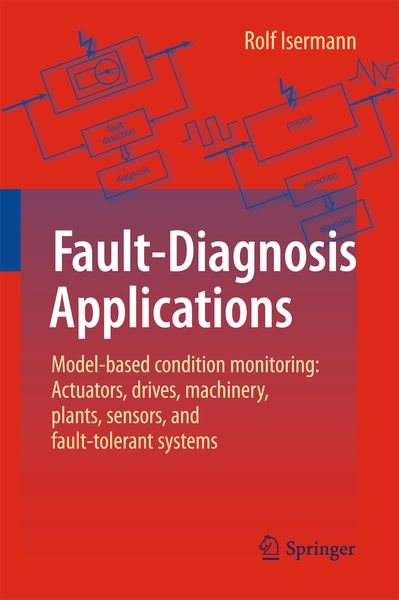
  • Produktbild: Fault-Diagnosis Applications
  • Produktbild: Fault-Diagnosis Applications
- 11%

Fault-Diagnosis Applications Model-Based Condition Monitoring: Actuators, Drives, Machinery, Plants, Sensors, and Fault-tolerant Systems

11% sparen

96,99 € UVP 109,99 €

inkl. gesetzl. MwSt., Versandkostenfrei


Beschreibung

Produktdetails

Einband

Taschenbuch

Erscheinungsdatum

23.11.2014

Verlag

Springer Berlin

Seitenzahl

354

Maße (L/B/H)

23,5/15,5/2,1 cm

Gewicht

563 g

Auflage

2011

Sprache

Englisch

ISBN

978-3-642-43476-1

Beschreibung

Produktdetails

Einband

Taschenbuch

Erscheinungsdatum

23.11.2014

Verlag

Springer Berlin

Seitenzahl

354

Maße (L/B/H)

23,5/15,5/2,1 cm

Gewicht

563 g

Auflage

2011

Sprache

Englisch

ISBN

978-3-642-43476-1

Herstelleradresse

Springer-Verlag KG
Sachsenplatz 4-6
1201 Wien
AT

Email: ProductSafety@springernature.com

Kundinnen und Kunden meinen

0 Bewertungen

Informationen zu Bewertungen

Zur Abgabe einer Bewertung ist eine Anmeldung im Konto notwendig. Die Authentizität der Bewertungen wird von uns nicht überprüft. Wir behalten uns vor, Bewertungstexte, die unseren Richtlinien widersprechen, entsprechend zu kürzen oder zu löschen.

Die Bewertungen sind nach Format, Anzahl Sterne und Datum sortiert.

Verfassen Sie die erste Bewertung zu diesem Artikel

Helfen Sie anderen Kund*innen durch Ihre Meinung

Kundinnen und Kunden meinen

0 Bewertungen filtern

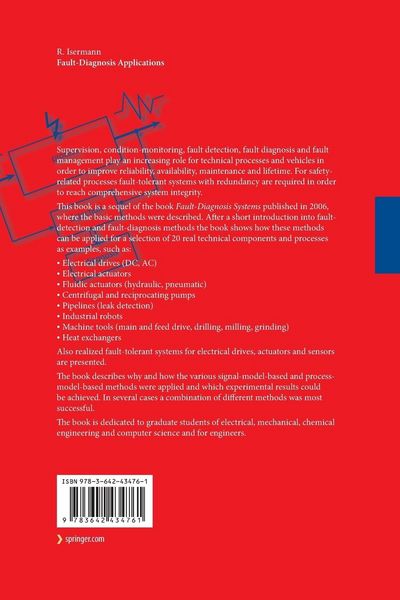
  • Produktbild: Fault-Diagnosis Applications
  • Produktbild: Fault-Diagnosis Applications
  • 1. Introduction

    1.1 Process automation and supervision

    1.2 Product life cycle and fault management (asset management)

    1.3 Contents

    I SUPERVISION, FAULT DETECTION AND DIAGNOSIS

    2. Supervision, fault detection and fault diagnosis methods

    2.1 Basic tasks of supervision

    2.2 Terminology

    2.2.1 Faults, failures, malfunctions

    2.2.2 Reliability, availability, safety

    2.2.3 Fault tolerance and redundancy

    2.3 Knowledge based fault detection and diagnosis

    2.4 Signal based fault detection methods

    2.4.1 Limit checking

    2.4.2 Trend checking

    2.4.3 Change detection

    2.4.4 Adaptive thresholds

    2.4.5 Plausibility checks

    2.4.6 Signal analysis methods

    2.5 Processmodel based fault detection methods

    2.5.1 Process models and fault modeling

    2.5.2 Fault detection with parameter estimation

    2.5.3 Fault detection with state observers and state estimation

    2.5.4 Fault detection with parity equations

    2.5.5 Direct reconstruction of not measurable variables

    2.6 Fault diagnosis methods

    2.6.1 Classification methods

    2.6.2 Inference methods

    2.7 Fault detection in closed loops

    2.8 Data flow structure for supervision

    II DRIVES AND ACTUATORS

    3. Fault diagnosis of electrical drives

    3.1 Direct current motor (DC)

    3.1.1 Structure and models of the DC motor

    3.1.2 Fault detection with parity equations

    3.1.3 Fault detection with parameter estimation

    3.1.4 Experimental results for fault detection

    3.1.5 Experimental results for fault diagnosis with SELECT

    3.1.6 Conclusions

    3.2 Alternating current motor (AC)

    3.2.1 Structure and models of induction motors

    3.2.2 Signal based fault detection of power electronics

    3.2.3 Model based fault detection of an AC motor

    3.2.4 Concusions

    4. Fault diagnosis of electrical actuators

    4.1 Electromagnetic actuator

    4.1.1 Position control

    4.1.2 Fault detection with parameter estimation

    4.2 Electromagnetic automotive throttle valve actuator

    4.2.1 Structure and models of the actuator

    4.2.2 Input test cycle for quality control

    4.2.3 Fault detection with parameter estimation

    4.2.4 Fault detection with parity equations

    4.2.5 Fault diagnosis

    4.2.6 Fault diagnosis equipment

    4.2.7 Conclusions

    4.3 Brushless DC motor actuator and aircraft cabin pressure valve

    4.3.1 Structure and models

    4.3.2 Fault detection with parameter estimation

    4.3.3 Fault detection with parity equations

    4.3.4 Conclusions

    5. Fault diagnosis of fluidic actuators

    5.1 Hydraulic servo axis

    5.1.1 Hydraulic servo axis structure

    5.1.2 Faults of hydraulic servo axes

    5.1.3 Models of the spool valve and cylinder

    5.1.4 Fault detection and diagnosis of the valve and cylinder

    5.1.5 Fault diagnosis

    5.1.6 Conclusions

    5.2 Pneumatic actuators

    5.2.1 Pneumatic flow valve structure and modeling

    5.2.2 Fault detection and diagnosis with local linear models

    5.2.3 Experimental results

    5.2.4 Conclusions

    III MACHINES AND PLANTS

    6. Fault diagnosis of pumps

    6.1 Centrifugal pumps

    6.1.1 Status of pump supervision and fault detection

    6.1.2 Models of a centrifugal pump and pipe system

    6.1.3 Fault detection with parameter estimation

    6.1.4 Fault detection with nonlinear parity equations and parameter estimation

    6.1.5 Conclusions

    6.2 Reciprocating pumps

    6.2.1 Structure of a diaphragm pump

    6.2.2 Models of a diaphragm pump

    6.2.3 Fault detection and diagnosis of the hydraulic part

    6.2.4 Fault detection of the pump drive
    6.2.5 Conclusions

    7. Leak diagnosis of pipelines

    7.1. Status of pipeline supervision

    7.2 Mathematical models of pipelines

    7.3 Model based leak detection

    7.3.1 Leak detection with state observers

    7.3.2 Leak detection with mass balance and correlation analysis for liquid pipelines

    7.3.3 Leak detection for gas pipelines

    7.4 Experimental results

    7.4.1 Gasoline pipeline

    7.4.2 Gas pipeline

    7.4.3 Conclusions

    8. Fault diagnosis of industrial robots

    8.1 Structure of a 6-axis robot

    8.2 Model af a robot axis

    8.3 Fault detection and diagnosis with parameter estimation

    8.4 Experimental results

    8.5 Conclusions

    9. Fault diagnosis of machine tools

    9.1 Structure of machine tools

    9.2 Status of machine tool supervision

    9.3 Main drive

    9.4 Feed drive

    9.5 Drilling machine

    9.3.1 Models of the drilling process

    9.3.2 Fault detection of drilling

    9.6 Milling machine

    9.6.1 Models of the milling process

    9.6.2 Fault detection of the cutter

    9.7 Grinding machine

    9.7.1 Grinding process and models

    9.7.2 Fault detection with parameter estimation

    9.7.3 Fault detection with signal analysis methods

    9.8 Conclusions

    10. Fault detection of heat exchangers

    10.1 Heat exchangers and their models

    10.1.1 Heat exchanger types

    10.1.2 Heat exchanger models for stationary behavior

    10.1.3 Dynamic models of heated tubes

    10.2 Fault detection from static behaviour

    10.2.1 Static models of heat exchangers

    10.2.2 Fault detection methods

    10.3 Fault detection of a steam/water heat exchanger with dynamic models and parameter estimation

    10.4 Fault detection for a double heat exchanger plant with local linear neuro-fuzzy models

    10.4.1 Steam-water heat exchanger with local linear identification

    10.4.2 Heat exchanger plant

    10.4.3 Fault detection with multiple local linear parameter estimation

    10.5 Conclusions

    IV FAULT TOLERANT SYSTEMS

    11. Fault-tolerant systems – a short introduction

    11.1 Basic redundant structures

    11.2 Degradation steps

    12. Examples of fault-tolerant systems

    12.1 A fault-tolerant control system

    12.2 Fault-tolerant electrical drives

    12.3 Fault-tolerant actuators

    12.4 Fault-tolerant sensors

    V APPENDIX

    13. Terminology for fault detection and diagnosis

    References

    Index