
KI-Beratung Beta

Gutscheinbedingungen

**Gültig bis 11.11.2026 auf Spielzeug, Schreibwaren, Filme, Geschenke & Trends, Musik, tolino eReader & Zubehör, Hörbücher und Hörbuch-Downloads, nicht preisgebundene Bücher und Kalender online auf thalia.at und in der Thalia App. Einzelne Artikel können ausgeschlossen sein. Aufgrund der Buchpreisbindung sind deutschsprachige Bücher und eBooks ausgenommen. Zusätzlich ausgenommen sind Abos & Flatrates, Games, Geschenkkarten/-boxen, Shelfies, Software, Zeitschriften sowie einzelne Artikel von tonies®. Pro Einkauf einmal einlösbar. Click & Collect nur bei Onlinevorabzahlung möglich. Keine Barauszahlung. Nicht kombinierbar mit anderen Aktionen und Gutscheinen. Gutschein wird auf max. 500€ Bestellwert angerechnet. Nicht gültig für Versandkosten und Services.

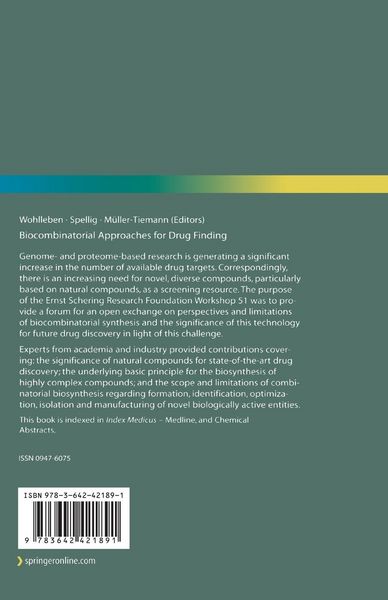
  • Produktbild: Biocombinatorial Approaches for Drug Finding
  • Produktbild: Biocombinatorial Approaches for Drug Finding
Band 51

Biocombinatorial Approaches for Drug Finding

149,99 €

inkl. gesetzl. MwSt., Versandkostenfrei


Beschreibung

Genome- and proteome-based research is generating a significant increase in the number of available drug targets. Correspondingly there is an increasing need for novel, diverse compounds, particularly based on natural compounds, as screening resource. The purpose of the Ernst Schering Research Foundation...

Beschreibung

Genome- and proteome-based research is generating a significant increase in the number of available drug targets. Correspondingly there is an increasing need for novel, diverse compounds, particularly based on natural compounds, as screening resource. The purpose of the Ernst Schering Research Foundation Workshop 51 was to provide a forum for an open exchange on perspectives and limitations of biocombinatorial synthesis and the significance of this technology for future drug discovery in  light of this challenge. Experts from academia and industry provided contributions covering: the significance of natural compounds for state-of-the-art drug discovery; the underlying basic principle for the biosynthesis of highly complex compounds; and the scope and limitations of combinatorial biosynthesis regarding formation, identification, optimisation, isolation and manufacturing of novel biologically active entities.

Produktdetails

Einband

Taschenbuch

Erscheinungsdatum

02.12.2014

Herausgeber W. Wohlleben + weitere
Verlag Springer Berlin

Produktdetails

Einband

Taschenbuch

Erscheinungsdatum

02.12.2014

Herausgeber
Verlag Springer Berlin
Seitenzahl

284

Maße (L/B/H)

21/14,8/1,7 cm

Gewicht

405 g

Auflage

2005

Sprache

Englisch

ISBN

978-3-642-42189-1

Herstelleradresse

Springer-Verlag GmbH
Heidelberger Platz 3
14197 Berlin
Deutschland
Email: sdc-bookservice@springer.com
Url: www.springer.com
Telephone: +49 30 827870
Fax: +49 30 8214091

Noch keine Bewertungen vorhanden

Verfassen Sie die erste Bewertung zu diesem Artikel

Helfen Sie anderen Kundinnen und Kunden durch Ihre Meinung.

Kundinnen und Kunden meinen

Bewertungen (0)

  • Produktbild: Biocombinatorial Approaches for Drug Finding
  • Produktbild: Biocombinatorial Approaches for Drug Finding
  • Protein Domain Fold Similarity and Natural Product Structure as Guiding Principles for Compound Library Design.- Sources of Polyketides and Non-Ribosomal Peptides.- Polyketide Synthases: Mechanisms and Models.- Functional and Structural Basis for Targeted Modification of Non-Ribosomal Peptlde Synthetases.- Prerequisites for Combinatorial Biosynthesis: Evolution of Hybrid NRPS/PKS Gene Clusters.- Engineering Glycosylation in Bioactive Compounds by Combinatorial Biosynthesis.- Glycosyltransferases and Other Tailoring Enzymes as Tools for the Generation of Novel Compounds.- Enzymatic Incorporation of Halogen Atoms into Natural Compounds.- From Glucose to Antibiotics: What Controls the Fluxes?.- Precursor-Directed Biosynthesis for the Generation of Novel Glycopetides.- Tool-Box: Tailoring Enzymes for Bio-Combinatorial Lead Development and as Markers for Genome-Based Natural Product Lead Discovery.- Natural Product Biosynthetic Assembly Lines: Prospects and Challenges for Reprogramming.