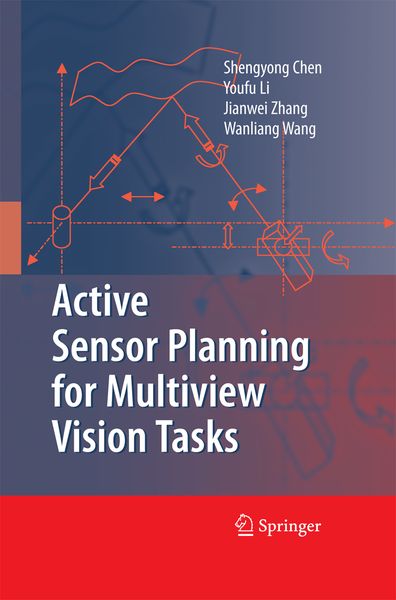
Active Sensor Planning for Multiview Vision Tasks
-
- Hardcover
- Taschenbuch ausgewählt
-
Sprache:Englisch
151,99 €
inkl. gesetzl. MwSt.,
Beschreibung
Produktdetails
Einband
Taschenbuch
Erscheinungsdatum
28.11.2014
Abbildungen
XI, 265 p.
Verlag
Springer BerlinSeitenzahl
265
Maße (L/B/H)
23,5/15,5/1,6 cm
Gewicht
429 g
Auflage
2008
Sprache
Englisch
ISBN
978-3-642-43737-3
An active robot system can change its visual parameters in an intentional manner and perform its sensing actions purposefully. A general vision task thus can be performed in an efficient way by means of strategic control of the perception process. The controllable processes include 3D active sensing, sensor configuration and recalibration, automatic sensor placement, and 3D sensing. This book explores these important issues in studying for active visual perception.
Vision sensors have limited fields of views and can only "see" a portion of a scene from a single viewpoint. To make the entire object visible, the sensor has to be moved from one place to another around the object to observe all features of interest. The sensor planning presented in this book describes an effective strategy to generate a sequence of viewing poses and sensor settings for optimally completing a perception task. Several methods are proposed to solve the problems in both model-based and nonmodel-based vision tasks. For model-based applications, the method involves determination of the optimal sensor placements and a shortest path through these viewpoints for automatic generation of a perception plan. A topology of viewpoints is achieved by a genetic algorithm in which a min-max criterion is used for evaluation. A shortest path is also determined by graph algorithms. For nonmodel-based applications, the method involves determination of the best next view and sensor settings. The trend surface is proposed as the cue to predict the unknown portion of an object or environment.
The 11 chapters in Active Vision Planning draw on recent work in robot vision over ten years, particularly in the use of new concepts of active sensing, reconfiguration, recalibration, sensor model, sensing constraints, sensing evaluation, viewpoint decision, sensor placement graph, model based planning, path planning, planning for robot in unknown environment, dynamic 3D construction,surface prediction, etc. Implementation examples are also provided with theoretical methods for testing in a real robot system. With these optimal sensor planning strategies, this book will give the robot vision system the adaptability needed in many practical applications.
Noch keine Bewertungen vorhanden
Verfassen Sie die erste Bewertung zu diesem Artikel
Helfen Sie anderen Kundinnen und Kunden durch Ihre Meinung.
Kurze Frage zu unserer Seite
Vielen Dank für Ihr Feedback
Wir nutzen Ihr Feedback, um unsere Produktseiten zu verbessern. Bitte haben Sie Verständnis, dass wir Ihnen keine Rückmeldung geben können. Falls Sie Kontakt mit uns aufnehmen möchten, können Sie sich aber gerne an unseren Kund*innenservice wenden.
zum Kundenservice